


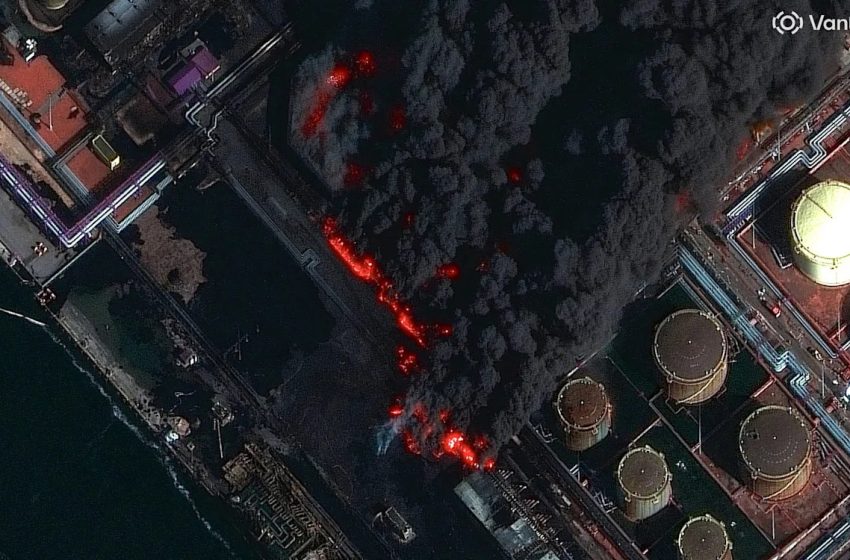
Damage at drone-hit Russian oil depot laid bare by satellite images
Satellite images of one of Russia’s key Baltic oil ports have revealed the destruction caused by Ukrainian strikes.
Kyiv’s drone swarms hit oil hubs in Russia’s Baltic Sea region four times over five consecutive nights this week, sending 100m-high walls of flames into the sky and creating smoke plumes that could be seen from Finland.
In new satellite pictures of Ust-Luga, one of Russia’s main export hubs for refined products, which handles some 18 million tons of fuel oil annually, thick curtains of smog could be seen rising from a pulverised oil loading pier, while damage could also be seen at storage tanks and technical trestles, according to the Ukrainian military analysis website Militarnyi.
The 100-metre-high flames in Ust-Luga could be seen as far as Finland – VANTOR
Russian Telegram channels published footage from Saturday morning showing smoke continuing to billow from Ust-Luga and its near neighbour Primorsk, another crucial Russian port hit in recent days. The intense blaze is believed to be caused by an oil spill.
Local governors in Russia had insisted there had been little damage to the facility, but the satellite images show extensive destruction, which could severely hamper Moscow’s oil trade.
Ukraine has intensified its attacks over the past week, seeking to blunt the windfall from surging oil prices and relaxed sanctions that doubled Moscow’s revenues in the first three weeks of the US-Israeli war on Iran.
Record numbers of drones have traversed near-record distances, weaving through successive layers of air defence to deal a fatal blow to some of Russia’s most critical facilities.
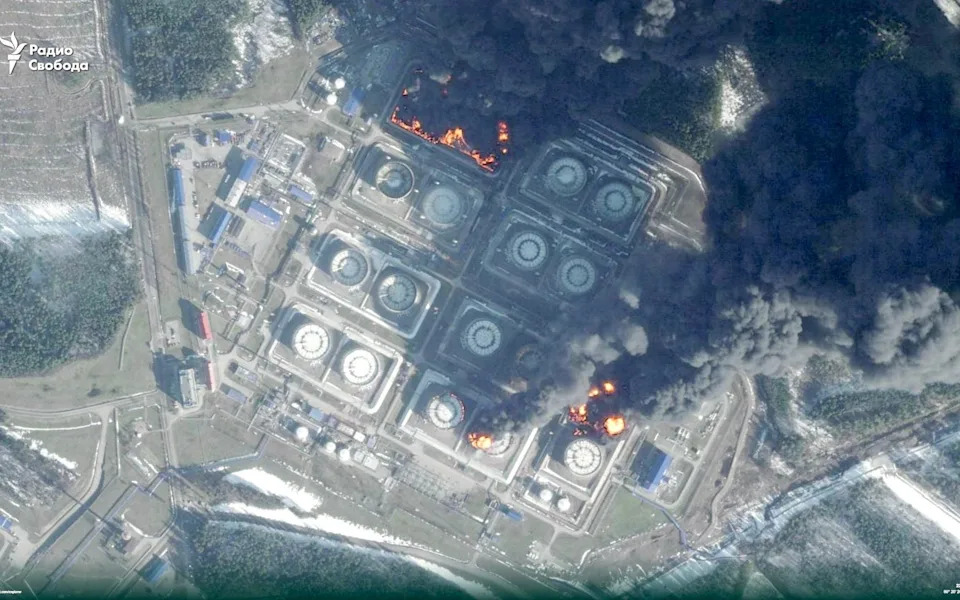
Primorsk is another Russian port that has been hit by a Ukrainian attack in recent days
On Saturday, Russia’s defence ministry said it had shot down 155 Ukrainian drones over 16 regions, including Moscow and occupied Crimea.
The Ust-Luga terminal is believed to still be closed after it was hit in several of the attacks earlier this week, creating a bottleneck which put oil processing at risk in four of Russia’s biggest refineries, according to Reuters.
Kirishi, Yaroslavl, Moscow and Ryazan, which process some 400,000 barrels of oil per day, could be forced to reduce crude runs because of shipping constraints.
Russian oil producers had cautioned buyers that they could be forced to declare force majeure on supplies from the Baltic Sea ports amid the emergency, freeing them from liability if they are rendered unable to fulfil their obligations.
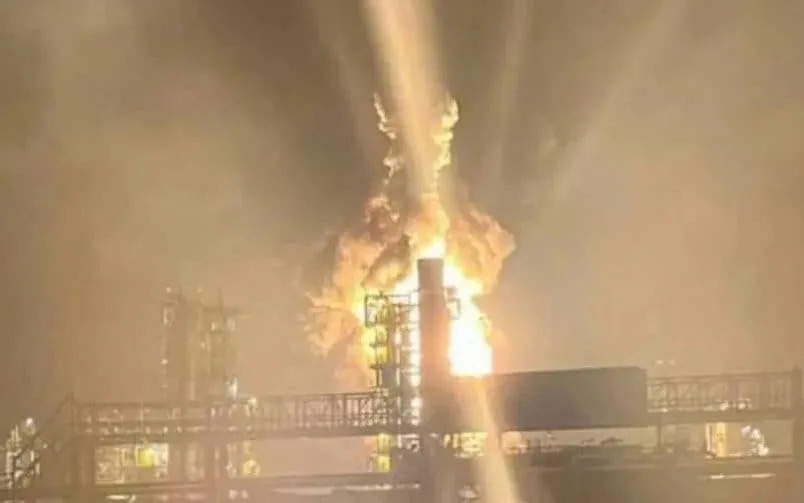
Kirishi is one of four oil refinery’s in Russia which process around 400,000 barrels of oil per day
Analysts also suggested that the attacks could pose a “serious threat” to the Kremlin’s ability to export oil, its dominant export and the lifeblood of its economy. The oil and gas sector accounted for around 30 per cent of Russia’s federal budget in 2024.
“This is the most serious threat to exports of Russian oil and oil products since the war began,” Boris Aronstein, an energy analyst, told the Russian independent TV channel Current Time.
“The thoughtfulness, the scale and direction of the attacks, as well as their timing and execution – all of this together produced an effect that I personally cannot recall in four-plus years of war,” he said.
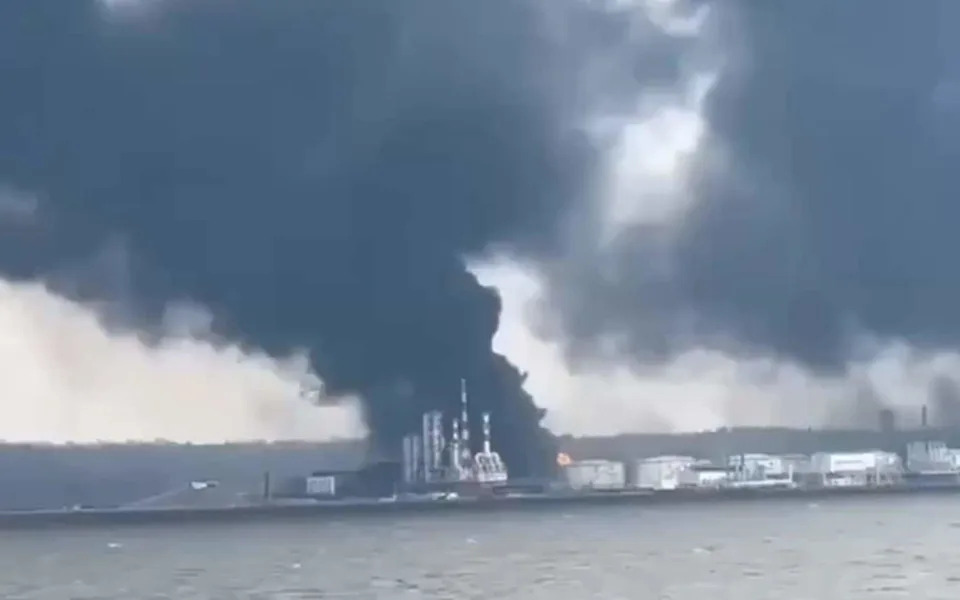
Ust-Luga plants had not loaded any oil for the last five days, CREA estimated
On Wednesday, Reuters reported that at least 40 per cent of Russia’s oil export capacity had been halted by drone attacks, combined with the attack on the Druzhba pipeline and a series of tanker seizures.
Part of the success of recent strikes has been down to their persistence, said Isaac Levy, an analyst with the Centre for Research on Energy and Clean Air (CREA).
“While Russia has previously restored damaged refineries within weeks, Ukraine’s campaign of repeated drone strikes has deliberately slowed recovery timelines,” he told Radio Free Liberty.
CREA estimated earlier this week that the Primorsk and Ust-Luga plants had not loaded any oil for the last five days.
The tempo of attacks shows no sign of fading. Overnight on Saturday, Ukraine hit the Slavneft-YANOS refinery in the central Russian city of Yaroslavl, one of the country’s five biggest refineries, which can produce more than 15 million tons per year.
Meanwhile, Ukraine’s flagship homemade “Flamingo” missile was used to strike an explosives manufacturing plant in Russia’s Samara region, which Ukraine said is used to produce more than 30,000 tons of military-grade explosives per year.
The country’s general staff confirmed a direct hit on the facility, and it was still establishing the extent of the damage.
Russia’s attacks on Ukraine early on Saturday killed at least five people and damaged a port and maternity hospital across the Odesa, Kryvyi Rih and Poltava regions.
“There was no military purpose whatsoever – this was pure terror against ordinary civilian life,” said Volodymyr Zelensky, the Ukrainian president.
First Appeared on
Source link






