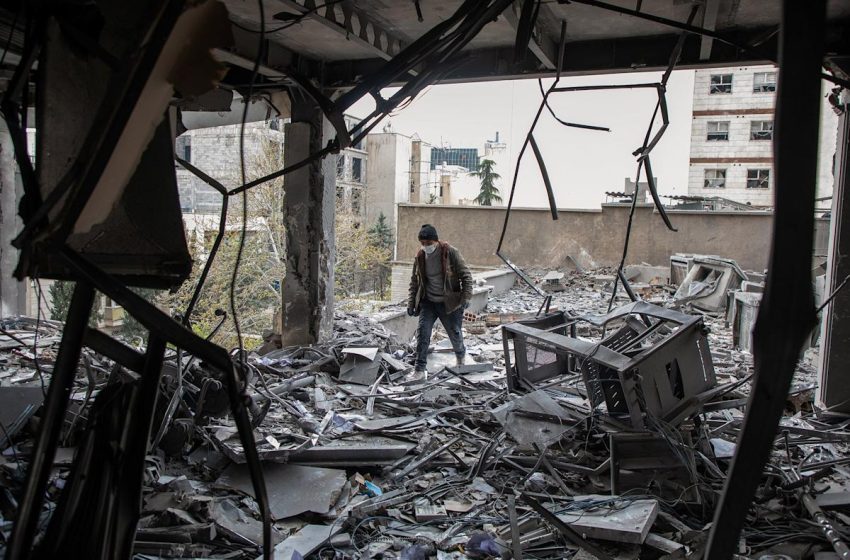
(Bloomberg) — Stocks extended a selloff and oil rose as Iran-backed Houthi forces entered the Middle-East conflict and an expanded US military presence raised concerns about a prolonged confrontation. Government bonds advanced.
A gauge of Asian shares fell 2.1% on concern that higher crude oil prices will weigh on economic growth. Contracts for the S&P 500 Index erased earlier losses and edged up 0.1%, indicating some of the selling pressure may be easing. European equity-index futures were also well off their session lows, trading 0.7% lower.
Some of that was helped by Brent crude coming off session highs to advance 2.1% and trade below $115 a barrel. Oil has risen about 90% this year. Aluminum climbed as much as 6% after Iran attacked two production sites in the Middle East as the conflict entered its fifth week.
The renewed market turmoil came as additional US troops arrived in the Middle East, fanning fears of a risky ground attack on Iran. President Donald Trump is weighing a military operation to extract uranium from Iran, the Wall Street Journal reported. Trump hasn’t made a decision on whether to give the order, it said.
“Markets spent a month pricing a short, contained conflict,” said Hebe Chen, senior market analyst at Vantage Global Prime. “That wishful optimism has now broken with the Houthis’ entry over the weekend. The playbook is being rewritten from this week as prolonged war risk becomes increasingly credible.”
After weeks of resilience amid extreme volatility driven by turmoil in crude oil markets, risk assets have begun to show signs of capitulation in recent sessions. Traders are also gauging how prolonged elevated energy costs may affect global growth and whether they will convince policymakers to keep interest rates higher for longer.
Meanwhile, Trump said the country had good negotiations with Iran and the Islamic Republic “gave” the US most of the 15 demands it issued to Tehran to end the war. Publicly, Iran has rejected the US’s 15-point list of ceasefire terms.
In an interview with the Financial Times on Sunday, Trump said he wants to “take the oil in Iran” and could seize the export hub of Kharg Island, a move that could trigger significant retaliation from Tehran. Earlier this month, the US struck military sites on the island.
“Claims from the US are almost always denied by the Iranian side, which says no such discussions are taking place,” Yugo Tsuboi, chief strategist at Daiwa Securities, said on Trump’s latest remarks. “It would be more reassuring if there were clearer confirmation from Iran that it’s indeed engaging in negotiations with the United States.”
What Bloomberg’s Strategists Say…
“Equities will decline further this week as the fallout from the Iran war ripples across industries. Bonds have potential to outperform as broadening supply shocks highlight the likelihood that global economic growth is headed for a severe slowdown.”
— Garfield Reynolds, MLIV Asia Team Leader. Click here for the full analysis.
The conflicting comments are adding to the strain in the equity markets. The 3.4% drop in the S&P 500 over Thursday and Friday was its biggest two-day decline in a year, leaving the benchmark more than 8% below its January record. The Nasdaq 100’s two-day, slide sent it into a 10% correction.
In other corners of the market, the cost to insure Asian investment-grade debt widened by about two basis points Monday to roughly 94 basis points, according to credit traders, a level last seen in May of 2025. India’s rupee posted its biggest gain since February after a central bank move aimed at curbing speculation triggered a rush among lenders to sell dollars.
The yen rose against all its Group-of-10 peers after Japan’s currency chief Atsushi Mimura said the nation may take bold action in the foreign-exchange market if the current situation continues. Gold steadied after its first weekly gain since the Middle East conflict began, as dip-buyers supported prices.
Treasuries rose, with the yield on the benchmark 10-year falling four basis points to 4.38%. Sovereign bonds are rising around the world as concern the Middle East conflict will derail global economic growth revives demand for beaten-down government debt.
Some Wall Street bond-fund managers say markets are underestimating the risk that the US war in Iran will cause a sharp slowdown in an already sputtering economy. At companies including Pacific Investment Management Co., JPMorgan Chase & Co. and Columbia Threadneedle Investments money managers are preparing instead for an economic hit that will eventually trigger a bond-market rebound and cause yields to come sliding back down.
“The market is now letting its imagination run wild about what the world might look like in a month’s time if there is no resolution by then” to the Middle-East war, said Gareth Berry, a strategist at Macquarie Group Ltd. “Parallels with Covid are already being identified as economies at risk of shutting down — this time due to lack of fuel.”
Oil may hit a record $200 a barrel if the Iran war drags on until June, with the Strait of Hormuz staying shut, Macquarie Group Ltd. warned. A conflict that stretches through the second quarter would result in historically high real prices, analysts including Vikas Dwivedi said in a note, outlining a scenario with odds of 40%.
An alternative outlook, with a probability of 60%, suggested the war may finish at the end of this month, they said.
“Market behavior reflects a clear shift toward capital preservation,” Wee Khoon Chong, a senior strategist at BNY in Hong Kong, wrote in a note to clients.
Corporate News:
-
Toyota Motor Corp. sales dipped slightly in February, hurt by aggressive competition in electric vehicles in China and weak demand at home in Japan.
-
BYD Co. Chairman Wang Chuanfu warned of further pain ahead for China’s electric vehicle industry after the world’s biggest EV maker delivered its third straight quarter of disappointing earnings.
-
Asian aluminum shares advanced after Iranian attacks on two Middle Eastern producers raised the prospect of record prices for the metal.
Some of the main moves in markets:
Stocks
-
S&P 500 futures were little changed as of 6:50 a.m. London time
-
Nasdaq 100 futures were little changed
-
The MSCI Asia Pacific Index fell 2.1%
-
Japan’s Topix fell 3.1%
-
Hong Kong’s Hang Seng fell 1.2%
-
The Shanghai Composite was little changed
-
Euro Stoxx 50 futures fell 0.7%
Currencies
-
The Bloomberg Dollar Spot Index was little changed
-
The euro was little changed at $1.1515
-
The Japanese yen rose 0.4% to 159.69 per dollar
-
The offshore yuan rose 0.1% to 6.9121 per dollar
-
The British pound rose 0.1% to $1.3275
Cryptocurrencies
-
Bitcoin rose 1.4% to $67,466.93
-
Ether rose 2.3% to $2,048.21
Bonds
-
The yield on 10-year Treasuries declined four basis points to 4.39%
-
Japan’s 10-year yield declined 2.5 basis points to 2.360%
-
Australia’s 10-year yield declined three basis points to 5.07%
Commodities
-
Spot gold rose 0.6% to $4,520.87 an ounce
-
West Texas Intermediate crude rose 1.2% to $100.84 a barrel
This story was produced with the assistance of Bloomberg Automation.
–With assistance from Abhishek Vishnoi, Momoka Yokoyama, Ruth Carson, Matthew Burgess, Elena Popina and Kentaro Tsutsumi.
More stories like this are available on bloomberg.com
©2026 Bloomberg L.P.