


First US advanced fighters arrive for permanent duty at air base in Japan
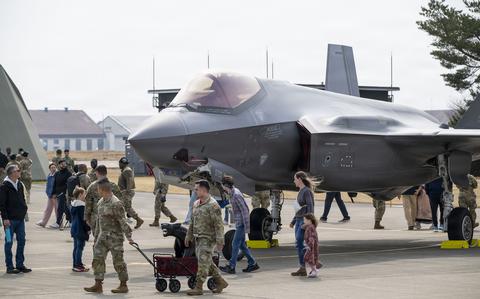
Service members, families and community members walk past a parked U.S. Air Force F-35A Lightning II during the F-35 first aircraft arrival at Misawa Air Base, Japan, March 28, 2026. (Gavin Hameed/U.S. Air Force)
A contingent of fifth-generation stealth fighters arrived at Misawa Air Base in northeastern Japan over the weekend, the first replacements the Air Force pledged for the F-16 Fighting Falcons stationed there.
An undisclosed number of F-35A Lightning II aircraft landed Saturday at the air base at the northern tip of Honshu, the largest of Japan’s four main islands, according to images posted online by the Defense Visual Information Distribution System. The new fighters were assigned to the 13th Fighter Squadron at Misawa.
The Air Force in 2024 announced plans to replace the 36 F-16 Fighting Falcons at Misawa with 48 F-35As.
A spokesperson for the air base did not respond Monday to an email and phone call from Stars and Stripes seeking further information.
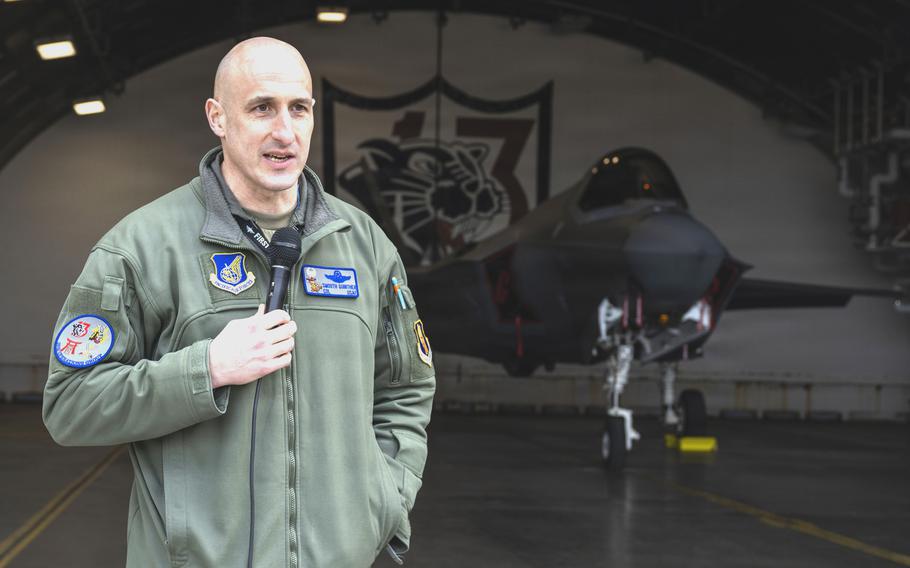
U.S. Air Force Col. Jeremy Guinther, 35th Operations Group commander, delivers a speech in front of an F-35A Lightning II during the F-35 first aircraft arrival at Misawa Air Base, Japan, March 28, 2026. (Patrick Boyle/U.S. Air Force delivers a speech in front of an F-35A Lightning II.)
“The new aircraft will strengthen the United States Air Force’s ability to maintain combat-ready airpower in northern Japan, integrate with allies and partners, and support regional stability across the Indo-Pacific,” a post states on the air base’s official Facebook page.
The 35th Fighter Wing specializes in Wild Weasel missions that suppress and destroy enemy air defense.
Positioning the advanced fighters at to Misawa is part of a sweeping U.S. force realignment in Japan, which also includes the stationing of F-15EX Eagles on Okinawa and the replacement of Navy F/A-18 Super Hornets with F-35Cs at Marine Corps Air Station Iwakuni.
The Defense Department in July 2024 said the plan – coordinated with the Japanese government – represents more than $10 billion invested in improved capability to enhance the U.S.-Japan alliance, strengthen deterrence and promote peace and stability in the Indo-Pacific region.
The Japan Air Self-Defense Force, which shares the Misawa base with its American counterparts, has operated its own fleet of F-35As at Misawa since 2018.
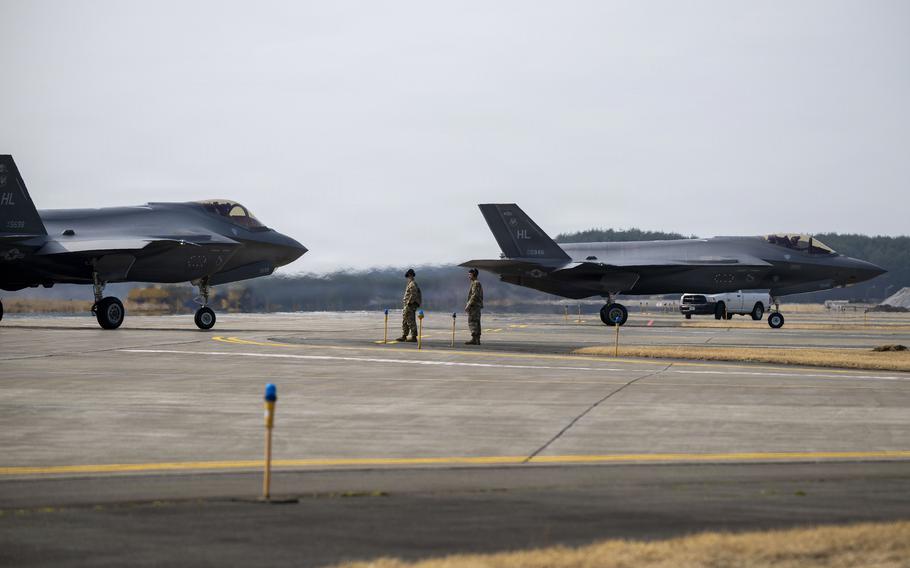
Two U.S. Air Force F-35A Lightning II aircraft taxi on the flightline during the F-35 first aircraft arrival at Misawa Air Base, Japan, March 28, 2026. (Gavin Hameed/U.S. Air Force)
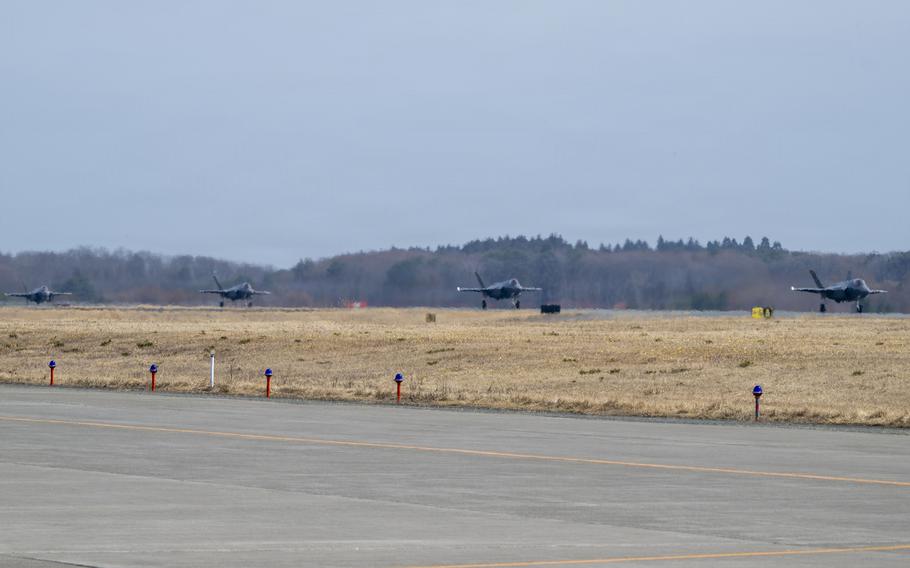
Four U.S. Air Force F-35A Lightning II aircraft taxi on the runway during the F-35 first aircraft arrival at Misawa Air Base, Japan, March 28, 2026. (Gavin Hameed/U.S. Air Force)
“The Department’s plan to station the Joint Force’s most advanced tactical aircraft in Japan demonstrates the ironclad U.S. commitment to the defense of Japan and both countries’ shared vision of a free and open Indo-Pacific region,” the Pentagon said in a July 3, 2024, statement.
In June, the 35th Wing stood up the 35th Munitions Squadron, created with 225 airmen previously assigned to the wing’s maintenance squadron, in preparation for the new aircraft arrivals.
The F-35A, designed to operate from conventional runways, is the most common of three variants. The B model, which can land vertically and take off from short distances, is flown by the Marine Corps. The Navy flies the C model, which is designed for the rigor of carrier operations.
F-35s are multirole fighters that can carry out a range of missions, from strategic attacks to ground support, air superiority, air defense and electronic warfare.
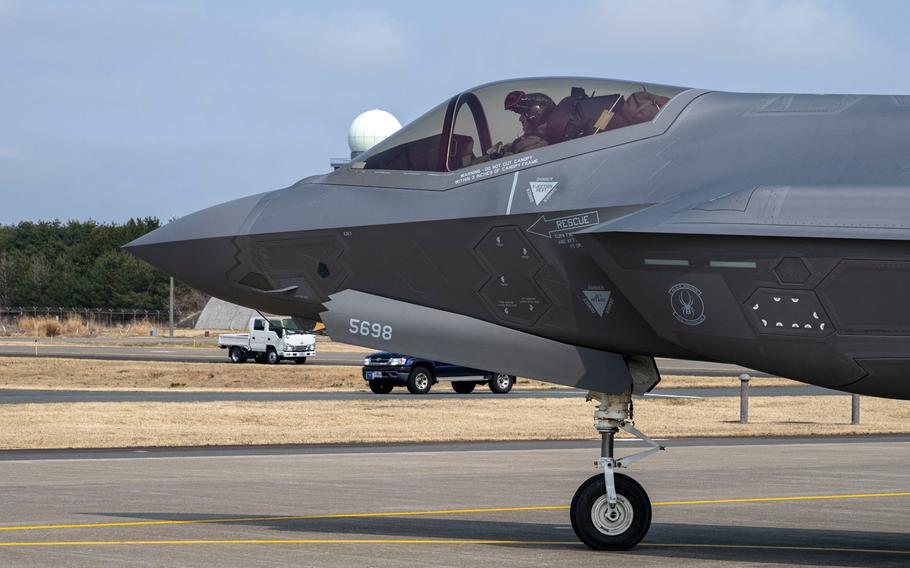
A U.S. Air Force F-35A Lightning II assigned to the 13th Fighter Squadron taxis out of a hangar during the F-35 first aircraft arrival at Misawa Air Base, Japan, March 28, 2026. (Patrick Boyle/U.S. Air Force)
It carries the most advanced suite of sensors of any fighter in history, according to its maker Lockheed Martin. The Lightning II also works as a network hub tying together other assets on the ground, sea and air.
The Air Force stopped taking delivery of F-35s between July 2023 and July 2024 while the manufacturer dealt with a core processor issue inside the aircraft, according to a 2024 report by the Congressional Research Service.
The Government Accounting Office in April 2024 found the F-35 fleet falling short of goals for availability, reliability and maintainability. Readiness challenges include “a heavy reliance on contractors, inadequate training, lack of technical data, lack of spare parts, and lack of support equipment,” according to the GAO report cited by the Congressional Research Service.
First Appeared on
Source link






