


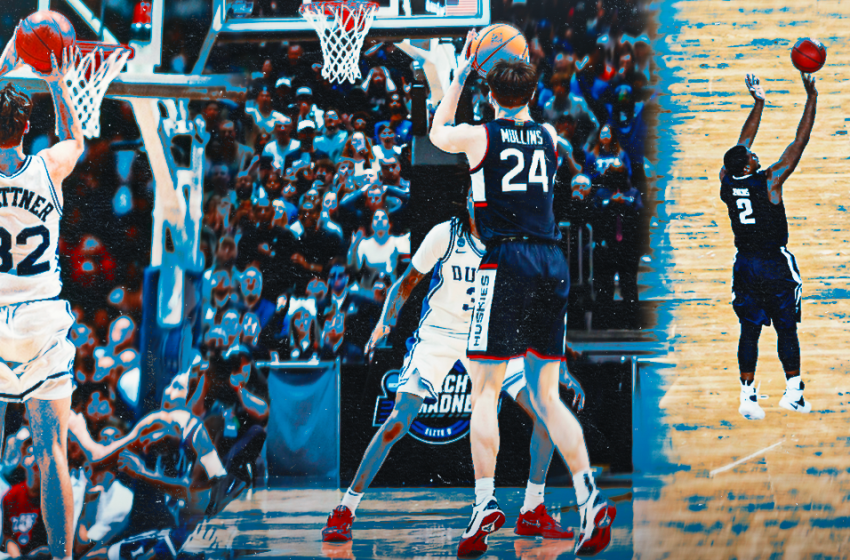
UConn’s insane shot to beat Duke forces a re-rank of the best NCAA Tournament buzzer beaters
Admit it. You jumped from your couch or barstool or airplane seat when you saw Connecticut freshman Braylon Mullins sink a 35-footer Sunday to beat Duke and send the Huskies to the Final Four.
But where does Mullins’ shot rank among the greatest NCAA Tournament buzzer-beaters? We’re trying not to be prisoners of the moment, but the stakes, the circumstances and the execution of that particular shot put it in some pretty lofty company.
So here, after the Indiana kid dragged his team to a Final Four in Indianapolis, is the updated top 10 NCAA Tournament buzzer beaters.
1. Christian Laettner, 1992 Duke vs. Kentucky
The round: Elite Eight
Clock after shot: 0.00 in overtime
Would his team have lost if he missed?: Yes
The situation: With 2.1 seconds remaining in overtime of the East Region final, Duke trails Kentucky 103-102. Grant Hill throws from the baseline to the other free throw line where he hits Christian Laettner, who catches the ball, dribbles once and sinks the shot over two Kentucky defenders.
Degree of difficulty: Besides the brands of the teams involved, the reason The Shot endures above all others is that the pass and the shot felt equally improbable. In fact, the pass may have been more difficult. If Hill, the son of a former NFL receiver, doesn’t throw a perfect 27-yard laser beam, the play has no chance. And we’ll never know what might have happened had Rick Pitino decided have someone guard Hill on the inbound.
The round: National championship game
Clock after shot: 0:00 in regulation
Would his team have lost if he missed?: No
The situation: North Carolina’s Marcus Paige makes a three-pointer with six seconds remaining to tie the national title game. It would have been one of the the most iconic shots in UNC history had Ryan Arcidiacono not dribbled from the free throw line to the top of the other key and handed off to Jenkins, who calmly drills the game-winner.
Degree of difficulty: It was an open shot because North Carolina defenders thought Arcidiacono was going to drive and Arcidiacono essentially created a screen. Still, it was a three-pointer for the national title with zeros on the clock. The sheer stakes of it lift it higher in the ranking.
The round: Elite Eight
Clock after shot: .4 seconds in regulation
Would his team have lost if he missed?: Yes
The situation: Duke has the ball up two with 10 seconds remaining. Because UConn only had seven team fouls, it seemed likely the Huskies would foul the first Blue Devil to touch the ball and hope he missed the front end of the one-and-one. Nope. Dan Hurley’s team presses but doesn’t immediately foul. Duke actually completes three passes before freshman guard Cayden Boozer tries to throw at two open players downcourt and has the ball deflected by Silas Demary with six seconds remaining. Mullins scoops up the ball and finds senior Alex Caraban. Caraban is met five feet from the 3-point line by 6-foot-9 forward Cam Boozer, so Caraban, kicks it back to Mullins, who stands between the “e” and the first “s” in the word Madness on the midcourt logo. Mullins rises and swishes the shot just before time expires.
Degree of difficulty: If the backboard had lit up with the shot in the air, this might have passed the Jenkins shot. Everything else about this sequence fits with the Laettner shot against Kentucky in terms of improbability. There should have been no way for UConn to get the ball. A less experienced player than Karaban might have tried to shoot over Cam Boozer instead of kicking it to the player with the deeper — but more open — shot. More than anything, the distance of the shot was absurd.
The round: National championship game
Clock after shot: 0:00 in regulation (Houston would have gotten some time — but not enough — today)
Would his team have lost if he missed?: No
The situation: With the score tied 52-52, N.C. State holds for one final shot to try to beat Hakeem Olajuwon, Clyde Drexler and Phi Slamma Jamma. But after more than 40 seconds of passing the ball around — the shot clock wouldn’t be part of the tournament until 1986 — the Wolfpack have nothing. So Dereck Whittenburg heaves a shot from where the logo would have been today. It’s an airball that turns into an alley-oop as big man Charles grabs the ball mid-air and dunks it as time expires to touch off an all-time classic Jim Valvano celebration.
Degree of difficulty: There was a three-point line at this point, but teams didn’t really like to shoot from deep. But with Olajuwon in the post, trying to get a clean shot in the paint was nearly impossible. When Whittenburg shot, Olajuwon drifted toward the free throw line. That left Charles open for the dunk. There appeared to be a full second remaining on the clock when the dunk went through. So had it happened today, Houston probably would have had a second to attempt a Hail Mary alley-oop to Olajuwon.
5. Mario Chalmers, 2008 Kansas vs. Memphis
The round: National championship game
Clock after shot: 2.1 seconds in regulation
Would his team have lost if he missed?: Yes
The situation: After Memphis point guard Derrick Rose makes one of two free throws, Kansas trails by three with 10.8 seconds remaining. Kansas had made only two 3-pointers prior. Sherron Collins nearly loses the ball while driving, but he gathers it and kicks to Chalmers, who sinks a shot that Sports Illustrated would deem “Mario’s Miracle.” Kansas goes on to win 75-68 in overtime.
Degree of difficulty: This was not a clean catch-and-shoot look. With the entire season on the line, Chalmers had to dribble and shoot over a defender in the highest pressure situation imaginable. That it forced overtime (instead of winning the game) and the time remaining on the clock are the reasons this shot doesn’t rank higher.
6. Christian Laettner, 1990 Duke vs. Connecticut
The round: Elite Eight
Clock after shot: 0:00 in regulation
Would his team have lost if he missed?: Yes
The situation: Duke trails by one with 2.6 seconds left after UConn’s Tate George nearly ends the game by intercepting a pass. Instead, George can’t hold the ball and it goes out of bounds, giving Duke one last chance. Laettner inbounds the ball to Brian Davis, who tosses it back to Laettner. Laettner then elevates and sinks a jumper to send the Blue Devils to the Final Four.
Degree of difficulty: Mike Krzyzewski said “run the special” before Duke broke its huddle. The play was designed for the sophomore Laettner, who hit what he probably thought at the time was the biggest shot of his life.
The round: Elite Eight
Clock after shot: 0:00 in regulation
Would his team have lost if he missed?: Yes
The situation: After making one free throw to cut Purdue’s lead to two with 5.9 seconds remaining, Virginia guard Ty Jerome has to miss the second free throw for the Cavaliers to have any chance. He’ll say later he wasn’t trying to miss, but he hits the front of the rim, and Diakite tips the ball toward the backcourt. Freshman guard Kihei Clark sprints to other end and grabs the ball. From about 10 feet short of the midcourt stripe, Clark whips a pass to Diakite, who in one motion catches the ball and shoots over 7-3 Purdue center Matt Haarms. The jumper forces overtime, and Virginia goes on to win and continue its march toward the national title.
Degree of difficulty: I covered this game for Sports Illustrated, and no one in the Virginia locker room could believe what had happened. Purdue guard Carsen Edwards had torched the Cavaliers for 42 points. When he banked in a three near the end of regulation, Virginia coach Tony Bennett ripped his play card in half. Even when Clark got the ball in his hands, no one thought he’d get it back into a place where the Cavaliers could get a decent shot. Then Diakite, the definition of a role player, hit a shot over a center who was six inches taller. “There’s no way we practice that,” Virginia assistant Jason Williford told me after the game. “It was just the luck of the bounce, Mamadi’s presence to tip it back and hopefully somebody was going to be there to get it. The basketball gods were with us tonight.”
8. Tyus Edney, 1995 UCLA vs. Missouri
The round: Round of 32
Clock after shot: 0:00 in regulation
Would his team have lost if he missed?: Yes
The situation: After a Julian Winfield basket gives Missouri a one-point lead with 4.8 seconds remaining, UCLA has to go the length of the court. Cameron Dollar inbounds to Edney, who had the option to drive or pass. Edney dribbles behind his back near the top of the key to set up the drive. Then he slashes into the paint, where he hits a layup over Derek Grimm and Jason Sutherland.
Degree of difficulty: The fact that it’s in the second round pushes this one down the list, but it’s certainly deserving because of the sheer onions it took to dribble behind the back to get Sutherland moving the wrong direction to set up the drive. Most players simply wouldn’t have been able to set up that shot in such a compressed time. Plus, Edney’s shot kept a national title run alive.
The round: Round of 64
Clock after shot: 0:00 in regulation
Would his team have lost if he missed?: Yes
The situation: Valpo trails 69-67 with 2.5 seconds remaining. The Crusaders must go the length of the court. Jamie Sykes throws the inbound pass — with current Ole Miss athletic director Keith Carter defending — to Bill Jenkins, who catches between two defenders and dumps off to coach’s son Drew. Drew rises and hits one of the most iconic Cinderella shots ever.
Degree of difficulty: The shot itself is incredibly difficult, as is the inbound and the Jenkins pass. The only reason this isn’t higher is it came in the first round. The Crusaders made the Sweet 16, but everyone else on this list either won the national title or made the national title game.
The round: Round of 32
Clock after shot: 0:00 in regulation
Would his team have lost if he missed?: Yes
The situation: Michigan trailed by two with 3.6 seconds remaining and had to go the length of the floor. Isaiah Livers throws in to Muhammad-Ali Abdur-Rahkman, who is met at midcourt by two Houston defenders. He throws to Poole on the right wing. Poole has no time to gather himself. He must catch and shoot immediately. He drains the shot, and the Wolverines keep marching toward an eventual national title game loss to Villanova.
Degree of difficulty: John Beilein teams were always prepared, and this one was no different. Despite the dire circumstances, Livers and Abdur-Rahkman played their parts perfectly. Poole was the player who needed to take this shot. The underrated piece of this is that Poole probably got fouled by Houston’s Corey Davis on the shot. (Or Poole made us think he was fouled by splaying his legs as the players’ chests made contact just after his release.) There was no call, so instead of days of talk radio debate we got a classic buzzer-beater.
First Appeared on
Source link






