



Scientists Say All Life on Earth Traces Back to a Single Missing Ancestor Born in a World of Fire, Magma, and Falling Space Rocks
Long before animals, plants, or even complex cells, Earth was dominated by microscopic life. At the center of this vast evolutionary story stands LUCA, the Last Universal Common Ancestor, an organism believed to predate all modern life forms. Its descendant, LECA, later gave rise to all eukaryotes, organisms with complex cells and nuclei.
Pinning down when these ancestral forms appeared remains one of science’s most difficult puzzles. Fossils offer little help, since such soft-bodied microbes rarely leave traces. That gap has pushed researchers toward genetic tools and geological clues to reconstruct a timeline that stretches back billions of years.
Hostile Early Earth May Still Have Supported Life
The earliest chapter of Earth’s history, known as the Hadean period, was anything but welcoming. Space debris bombarded the young planet, generating extreme heat and vast seas of magma. At first glance, it seems incompatible with life.
Yet according to a study published in PNAS, researchers Morgan Sobol and Carolina Martinez-Gutierrez suggest life may have emerged during this very period. Their argument draws on geochemical evidence, particularly ancient zircon crystals. These minerals indicate that as early as 4.4 billion years ago, surface temperatures may have been low enough for liquid water to persist.
That detail matters. Liquid water is widely considered a prerequisite for biological activity. As the researchers explain, this pushes back the possible timeline for life’s origin, placing it in an era once dismissed as too extreme.
Molecular Clocks Point to an Ancient LUCA
Without fossils, scientists have turned to molecular clocks, DNA-based tools that track genetic mutations over time. These methods allow researchers to estimate when key evolutionary events occurred, including the emergence of LUCA.
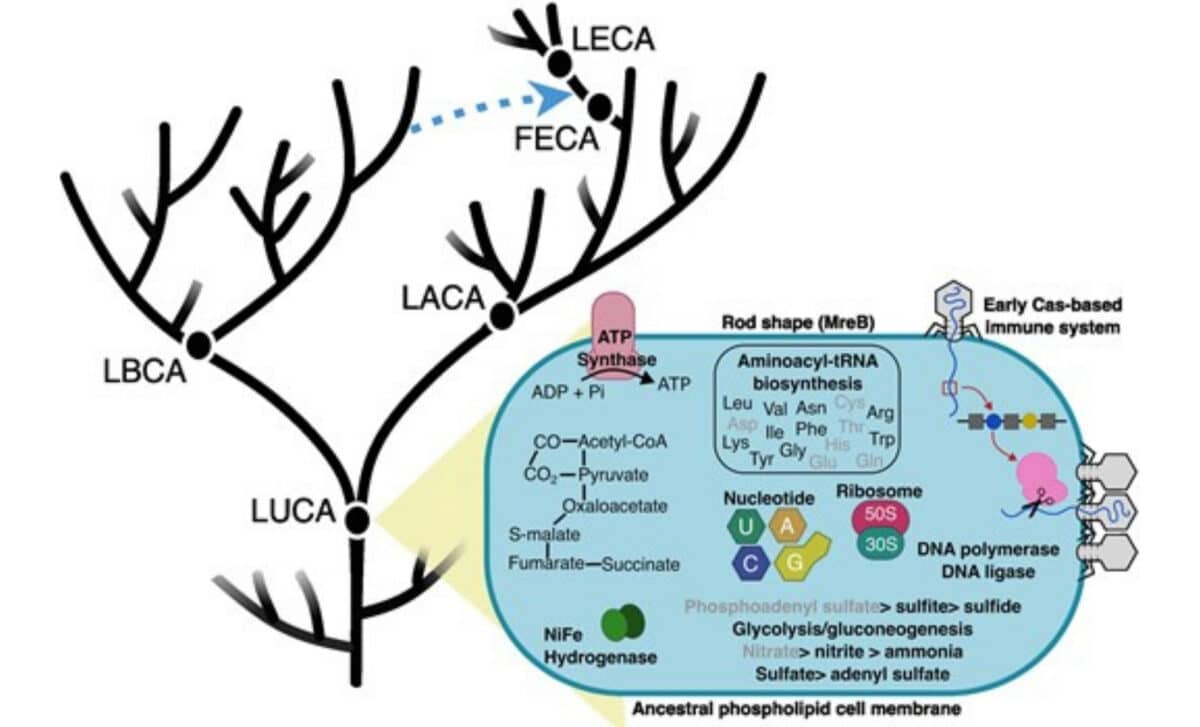
According to research referenced by Popular Mechanics, molecular clock analysis suggests LUCA may have existed around 4.2 billion years ago, during the late Hadean. That places it only a few hundred million years after the Moon-forming impact.
This ancestral organism was likely a prokaryote, lacking a nucleus but still relatively complex. It appears to have thrived in anaerobic environments and may have been metabolically flexible, capable of both producing its own organic compounds and consuming them. Given the harsh conditions of early Earth, LUCA was probably an extremophile, adapted to survive in environments far removed from anything familiar today.
The Rise of Complex Cells and the Mystery of Mitochondria
After LUCA, another major evolutionary leap followed: the emergence of eukaryotic cells, marked by the appearance of LECA. These cells, defined by their nuclei and internal structures, are thought to have arisen through a merger between simpler prokaryotic organisms.
Recent phylogenetic studies support the idea that mitochondria, the energy-producing structures inside cells, originated from Alphaproteobacteria, possibly related to Rickettsiales. Still, their exact place on the tree of life remains debated.
Some scientists argue mitochondria belong to a lineage closely related to Rickettsiales, while others believe they diverged earlier from Alphaproteobacteria. Advances in phylogenomics, which analyzes entire genomes to map evolutionary relationships, are expected to clarify this question.
According to Martinez-Gutierrez and Sobol, improved genome recovery from environmental samples will reveal previously hidden lineages. These discoveries could sharpen our understanding of how life evolved from its earliest forms into the diversity seen today, though, for now, LUCA itself remains an invisible starting point in Earth’s deep history.
First Appeared on
Source link






