


The long shadow of Tiger Woods
There’s never been just one way to discuss Tiger Woods. Yet, after the 50-year-old golf icon’s most recent DUI arrest, there was one appropriate response.
Not again.
With Muhammad Ali as the sole comparison, no athlete has ever been more sublime, so deeply embedded in expectation, image, and race, while dominating at a superhuman level. Woods reconfigured what winning looked like and to whom golf belonged. Whether or not he intended to, he authored new chapters in golf and the story of race in America. His relationship to those topics is questioned endlessly — what he said, what he didn’t say, and what many different backgrounds expected him to represent.
Hence why his now decades-long emotional wandering isn’t surprising. He lives and suffers similarly to how he played: intensely. There’s an anecdote from Wright Thompson’s 2016 profile of Woods that haunts. Following his father’s funeral, Woods flew back home. Earl Woods was arguably a more complex man than his son became. The depth of their relationship, though, was undeniable. The seat across from Tiger on the plane, long occupied by Earl, was empty.
The detail is minute, but it sits there. The truth is, there’s always been a sense that the foundation in his life was irreversibly cracked by the death of his father.
Golf has long been positioned as the most mentally taxing sport. To Tiger, golf’s calculus was basic arithmetic. Over time, though, that same control he exerted withered away in public and in his own life. Tiger Woods’ story isn’t about decline. It’s about an emotional conflict — tragic and human.
Joe Raedle/Getty Images
Jokes on social media are commonplace. Commentary from President Donald Trump echoes louder than it ever should have. Watching an icon grow older is only a single part of a complicated equation. The world watches a man operate in the cold breezes of his own mythology. The certainty in Tiger Woods is extinct. What’s survived is a reality far more intricate than a comeback.
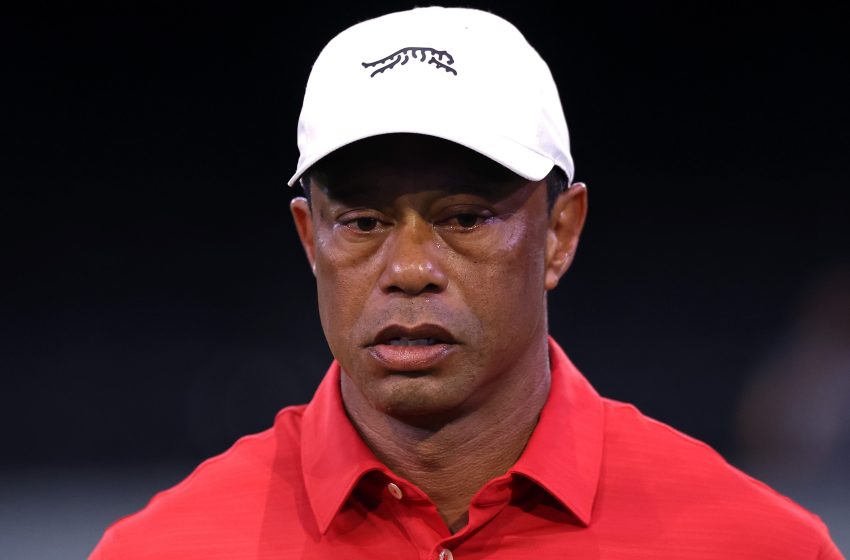
Look into Woods’ eyes. The myth lives there. Tiger Woods was the world’s No. 1 player for 683 weeks; the reign began in June 1997 and ended in October 2010, about 13 years. The thing about the old days, the Baltimore orator Slim Charles opined, they the old days. Nearly 16 years later, Tiger Woods in strife has lasted longer than Tiger Woods, the inevitable.
His most recent arrest follows a nearly 20-year history of vehicular accidents. This didn’t feel catastrophic like 2009 — when the reports of his marital infidelity became international fodder. Or 2017, when police found Woods sleeping in his running car with a list of substances in his system. Or 2021, when Woods nearly lost his leg (and life).
Those were tectonic. This latest arrest simply registered.
Woods was not found under the influence of alcohol but refused to take a urinalysis. Local Martin County, Florida, authorities, according to an affidavit, said Woods’ eyes were “bloodshot and glassy” while he was also sweating heavily. Two hydrocodone pills were found in Woods pocket and he later told officers “I take a few” when asked about prescription meds.
Woods’ demons seem so common because they are. This isn’t hyperbole: Woods flirts with death in ways excruciating to watch and impossible to turn away from. Yet, with Woods, the reaction isn’t disbelief anymore. It’s expected. It’d almost be more logical if each public sand trap were random. Or if they weren’t all seemingly connected by dependency. If ever an athlete seemed to carry the vaccine to prevent this sort of uncontrollable unraveling, it was Woods. His entire ethos was discipline.
Woods played in some of the most stressful scenarios an athlete has ever seen. He never had a teammate to pass to or block for him. It was man vs. nature — advantage: man more often than not. Golf was a metaphor for life in the stillness, presence, and internal order it requires for success. The same qualities have long made the vulnerability in his life that much harder to process.
Contrary to our own ignorance, no myth can fully protect any man. It shouldn’t, at least. For a figure as public as Woods, others want to define what transpires in front of us. And sometimes the quiet part is said aloud.
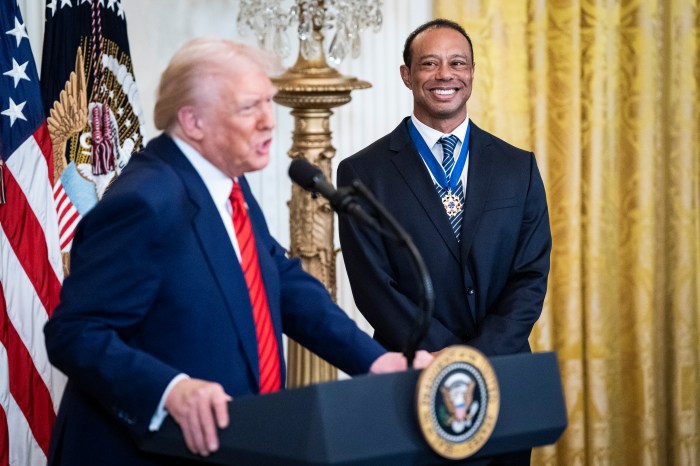
Trump, in this rare instance, isn’t even a political lightning rod. How he described his “close friend” is blunt and reductionist.
“He’s an amazing person, amazing man,” Trump said. “But some difficulty.”
Those final two words, “some difficulty,” perform a spectacular amount of heavy lifting there. Trump, a world leader stalked by controversy every second of every day, admitted Woods had demons he couldn’t out-drive.
But atop the criticism, the questions and jokes, lies the familiarity of it all. It’s a routine that, like Woods, just can’t seem to stop. Woods’ falls leave questions about his career and life. Some questions will be answered. Some still haven’t. Most won’t.
Then there’s hope. Tiger is still actively involved in the PGA’s growth, serving as vice chair of PGA Tour Enterprises and chairing the Future Competition Committee. And seeing Tiger and his son, Charlie, grow together on the course was deja vu.
What’s different now is belief. The belief that Woods once instilled is extinct. As each day passes, the 2019 Masters feels less like a resurrection and more like a last dance. That same rhythm couldn’t feel more off-key now.
Greatness outliving the script it was given is sobering.
That leaves the rest of us continuing to watch. But why? Is it a return you seek? Or is it closure? What does closure even resemble? And will it ever be possible to discuss Woods without the extremes he seems to live by?
Those questions do provide insight into one truth: Woods doesn’t exist in one complete category. He’s not just the brightest star the game of golf has ever produced. He’s certainly not just an icon who fell from previous elevated thresholds of grace. The canvas we paint him on is a lot more complex. He’s a contradiction and the author of a life still in play.
Currently, that ever-evolving memoir is only hours removed from his mug shot being plastered all over social media. Now the 2026 Masters — the latest edition of the major that propelled him into worldwide acclaim 29 years ago — isn’t just about who’ll be the next to don its coveted green jacket. Rather, the biggest question is what’s next for the most famous and accomplished man to don that green jacket.
Woods was once sports’ greatest inevitability and scriptwriter. Every swing, every Sunday charge, every major felt like destiny fulfilled. But inevitability lives forever and ages horribly. What remains is the supernova we remember and the falls we witness. Here stands a man shouldering the weight he once carried and the anxiety of what happens next.
Woods used to write the most dominating endings in sports. Now, more than ever, he searches for something far less certain: a new, very much necessary beginning.
First Appeared on
Source link






