


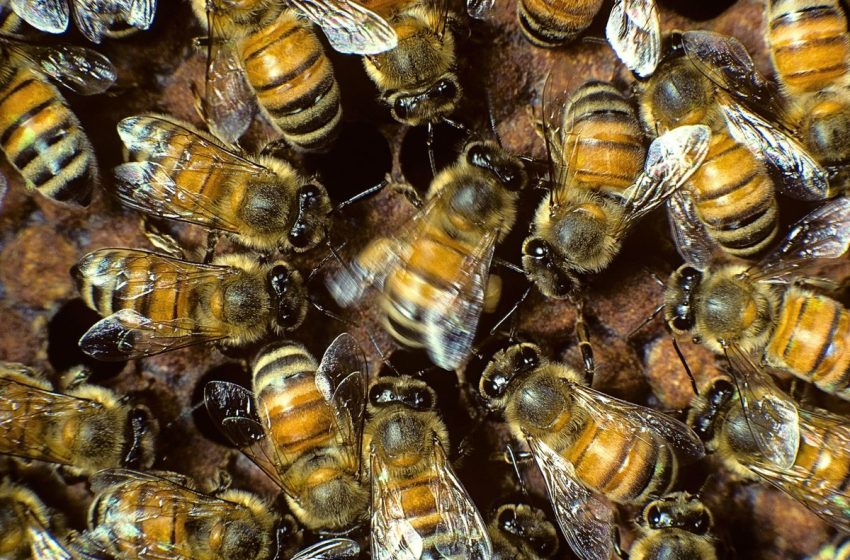
Scientists looked inside a bee hive. What they saw is remarkable
Bees most definitely do not dance like no one is watching. A study published in Proceedings of the National Academy of Sciences shows that the insects adjust their famous ‘waggle dance’ depending on the composition of their audience.
Bees know how to cut some shapes. The insect’s impressive waggle dance is a nifty figure-of-eight move, performed with a pulsating abdominal wiggle. Returning foragers perform it to their hive mates to convey food-related information. The angle of the dance indicates the direction of the food relative to the sun, whilst the duration signifies distance.
Researchers noticed that sometimes the movements are clean and crisp, and the instructions are clear. On other occasions, however, the same performer loses her groove. The dance, and the message it conveys, become less obvious – less breakdance, more dad-dance.
To find out why, the scientists set up an experiment where a returning forager bee was allowed to do her dance, whilst they manipulated the audience.
In one experiment, watching bees were gently removed, causing the audience to shrink. In another, the usually attentive adult observers were replaced with younger bees, who just weren’t interested. In both cases, the quality of the dance and its message, deteriorated. Then, when the balance of the audience was restored, the performance picked back up.
“Our study shows that honey bees quite literally dance better when they know someone is watching,” says Lars Chittka from Queen Mary University of London. “When followers are scarce, dancers wander around searching for listeners – and in doing so, their signals become fuzzier.”
Co-author James Nieh, from the University of California San Diego, likens the situation to a street performance. “Everyone has seen a street musician or a performer adjust to a changing crowd,” he says James Nieh. “In the hive, we see a comparable trade-off.” When the audience shrinks or loses focus, the performer adjusts their communication style to compensate.
The study shows how the accuracy of a signal can depend on the availability of receivers, not just the motivation of the sender. “That kind of feedback may be important in animal societies, engineered swarms and other distributed systems with the quality of information can rise or fall with audience dynamics,” says Nieh.
For anyone struggling to get their message across, there’s a broader lesson too. The study reinforces the idea that communication is a dynamic-two way street that requires, not just an engaged audience, but a communicator who is sensitive to its needs.
More amazing wildlife stories from around the world
First Appeared on
Source link






