


The actual danger of Trump’s phony vote-by-mail executive order.
Sign up for the Slatest to get the most insightful analysis, criticism, and advice out there, delivered to your inbox daily.
Sometimes it’s the chaos, not the cruelty, that’s the point.
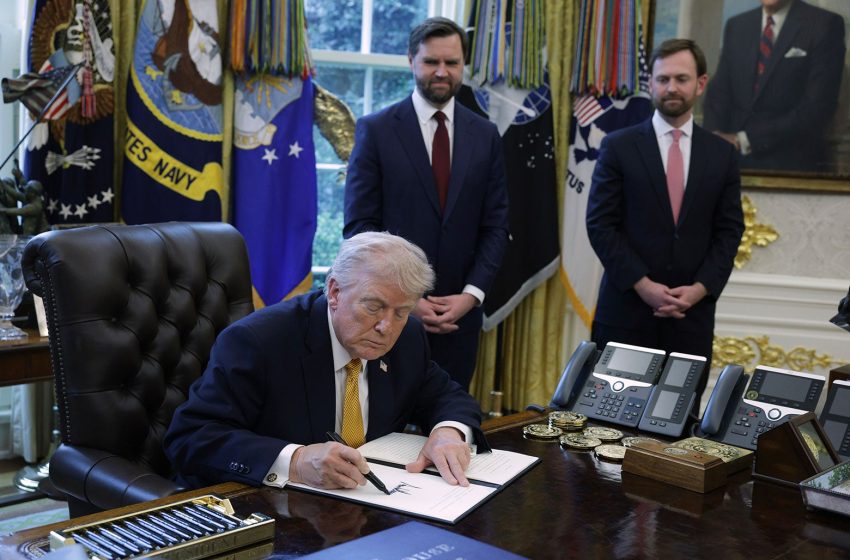
That certainly seems true of President Donald Trump’s second executive order on elections, issued on Tuesday. The order purports, among other things, to direct the United States Department of Homeland Security to create a list of all U.S. citizens over 18, to supply that list to states, and for the United States Postal Service to refuse to accept mailed-in ballots from voters unless that voter’s name appears on a list of the state’s eligible voters that it has given USPS months before the election (a list which presumably the state would have to match with the DHS’ list, though that part—among many others!—is unclear).
The order will face multiple court challenges and likely will be found unconstitutional by courts. Even if courts did not intervene before November, the multiple rulemakings and new procedures for DHS, USPS, and state and local election officials envisioned by the order would be impossible to implement before November’s elections. Indeed, the order is so underwhelming that it suggests Trump’s real purpose was not its implementation but to create more confusion and litigation around elections, further undermining voter confidence in the integrity of American elections.
To understand the likely fate of this new executive order, we should begin with his first executive order on elections, issued in March 2025. That order, like the new one, was marketed as a means for the president to protect the integrity of federal elections by changing federal election rules. Among other things, the first order purported to direct an independent federal agency, the U.S. Election Assistance Commission, to enact new rules requiring that people using a federal form for voter registration supply documentary proof of citizenship.
The problem Trump faced with the first executive order is that the Constitution gives the president no role to play in the conduct of elections. Federal District Court Judge Colleen Kollar-Kotelly, enjoining key parts of that order, wrote: “Put simply, our Constitution does not allow the President to impose unilateral changes to federal election procedures.”
The new EO should fare no better. To put this in plain terms: The order would use the USPS, which is not under the direct control of the president, to interfere with a state’s lawful transmission of ballots if the state did not comply with Trump’s rules. It would also provide no mechanism for eligible voters who move to the state or register with the state for the first time in the weeks before the election to cast a ballot by mail because they would not be on the state’s list. This alone interferes with both the state’s right to conduct its elections as well as Congress’s ultimate right to resolve any election disputes by looking at the ballots cast by all of the state’s eligible voters.
The upshot is this: The president does not have this authority to interfere in state election processes. The new order cites to two federal voting statutes, a part of Article 4 of the Constitution, saying that “the United States shall guarantee to every State in this Union a Republican Form of Government.” These sources, though, do not give him authority to force states to change their election rules.
Indeed, Article 1, Section 4 of the Constitution says that states through their legislatures set the rules for congressional elections, subject to congressional override. States also have authority under the 10th Amendment’s reservation to the states and people the power to run their own state elections. Article 1 also gives states the right to set voter qualifications, even in federal elections. The president has no role to play here.
Trump is also trying to exert power over USPS, which Congress in the Postal Reorganization Act of 1970 recast as an independent agency. Just like Trump failed in claiming power over the Election Assistance Commission in his first executive order, he will likely fail in claiming power over USPS in his second one.
Critically, even if courts don’t put Trump’s new order on hold as lawsuits work their way through the courts, the timing here makes these rules virtually impossible to implement in time for November’s elections. The order calls for extensive rulemaking by both DHS and USPS, and complicated implementation rules for the states, including rules related to the types of envelopes states must use and forms of ballot tracking. Such changes cannot be done on the fly, as we learned during the 2020 COVID-laden elections. That’s not to mention the need to resolve questions about the relationship between the citizen lists created by DHS and state voters lists that states must provide to USPS to get their voters’ ballots accepted.
This half-assed effort is surely going to disappoint the election-fraud conspiracy theorists whom Trump has cultivated. Consider how mild the new order is compared to the draft EO leaked to the Washington Post from election conspiracy theorists. It would have had Trump declare a national emergency and take over all aspects of federal elections, from registration and voting machines to voter ID, banning almost all mail ballots, and more. (The Constitution has no emergency exception that would give the president powers over elections.)
Rather than opting for an outlandishly illegal order, Trump went for a weaker (though still illegal) order that will have to be hashed out in courts, over time, keeping in the news the “cheating” that Trump falsely claims is endemic to mail balloting. He knows he is likely to lose, telling the press while signing the EO: “They’ll probably challenge it. … You find a rogue judge—a lot of rogue judges. Very bad, bad people. Very bad judges. And hopefully we’ll win on appeal.”
The point, though, isn’t to win in court. Trump is engaging in election-denialism theater. It makes voters of all sides mistrust the election process and the virtues of democracy. It convinces his supporters that Democrats have to cheat to win, something that will come in handy should Democrats take back control of the House in November with the intent of beginning investigations and potentially impeachment. It lets Trump, the most powerful person on earth, paint himself as a victim of fraud and of “bad, bad” judges. It also puts into question the rules of an election that is just months away, giving voters reason to fear that the Postal Service could sabotage their ballots. (The recent Supreme Court ruling saying that Postal Service employees cannot be held liable for intentionally failing to deliver mail surely doesn’t help that perception.) Trump’s executive order seems aimed to sow chaos in elections and depress turnout.
We will look back at Donald Trump’s presidency as years where the concept of election integrity got turned on its head. In the name of protecting democracy, Trump is breaking democracy. The damage could last a generation, even if the shelf life of his new executive order might be measured in days.

First Appeared on
Source link






