



Trump appointee-led commission approves White House ballroom plans
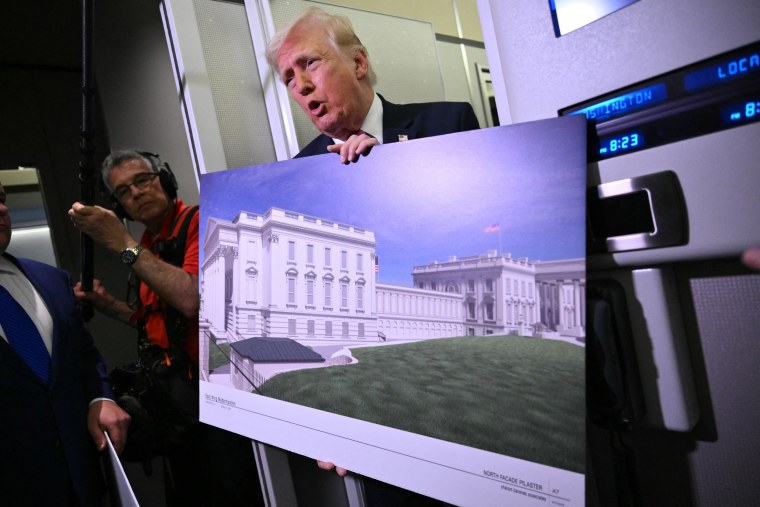
The National Capital Planning Commission on Thursday voted to approve President Donald Trump’s plans to build a new White House ballroom, which has faced steep opposition from critics.
Subscribe to read this story ad-free
Get unlimited access to ad-free articles and exclusive content.

The commission, which is led by Trump appointees, met last month to evaluate the plans and public comments, many of which were negative. Critics have blasted the project as “appalling,” a “monstrosity” and “vulgar” in the public comments.
Will Scharf, the Trump-appointed commission chair, said he personally read every comment submitted to the commission and many of the negative ones were “unresponsive” and “dealt with issues beyond the scope of this commission,” such as the ballroom’s funding, the demolition process and Trump.
“Considering issues of this sort is not within our mandate,” he said. “We are not some sort of free-ranging ballroom justice commission.”
Another commission member, Phil Mendelson, who is the chairman of the D.C. Council, expressed his opposition to the ballroom plans based on the structure’s proposed size.
“It’s just — I’m trying to be nice here — it’s just too large,” he said. “It’s just too large. And if we can get the same program but not as tall, not competing in height with the main structure, and a condensed footprint, we are better for that.”
At Thursday’s vote, Mendelson was the only commission member to vote against the ballroom plans, though several others voted “present,” abstaining from a yes or no vote.
Scharf previously said at the start of the March 5 meeting that the panel would hold a final vote on the project in April because of the high volume of public comments and testimony. The panel would typically vote directly after public testimony, Scharf said at the time.
But later in the meeting, Scharf asserted that the voting plans were not being delayed, saying that “our plan has been to proceed to a final vote on this project on April 2 for quite some time.”
Another commission member appointed by the president, Michael Blair, said during the meeting that Trump was blending “great architecture with great hospitality,” in his plans for the ballroom, pointing to the need for a space to welcome visitors like King Charles, who plans to visit the U.S. later this month.
“The King of England will be here at the end of the month, and we will likely dine in tents. When the president was recently in the United Kingdom, they dined in Windsor Castle. It’s a little bit different,” Blair said. “And you know, we would say that it is not fitting of the presidency or the White House to have to invite the king of our oldest ally, and, you know, perhaps most loyal ally, to come and eat in tents on the White House lawn.”
The ballroom project faces a new legal hurdle after a federal judge issued an order ealier this week temporarily blocking the its construction and any additional demolition of the East Wing.
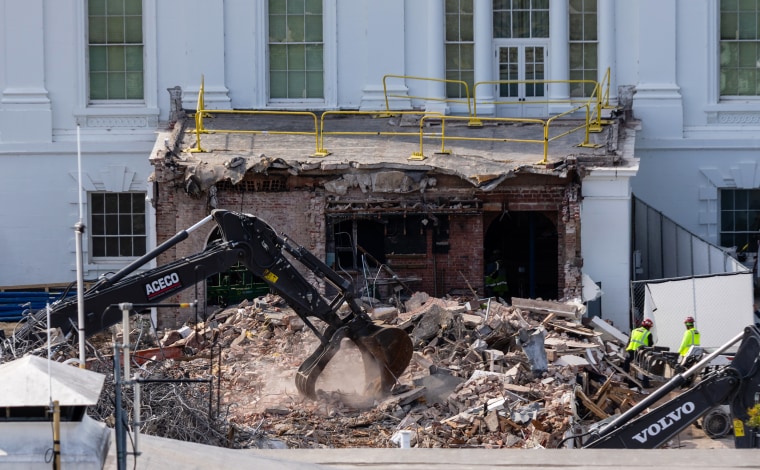
Demolition of the old East Wing began 164 days ago, on Oct. 20.
U.S. District Judge Richard J. Leon said in his opinion that the National Trust for Historic Preservation, which brought the lawsuit, “is likely to succeed on the merits because no statute comes close to giving the President the authority he claims to have.”
“The President of the United States is the steward of the White House for future generations of First Families,” Leon, a President George W. Bush appointee, said at the beginning of the opinion. “He is not, however, the owner!”
After the judge’s ruling, Trump argued in a Truth Social post that the project was “under budget, ahead of schedule” and predicted it would be “the finest Building of its kind anywhere in the World.” The president has said that the ballroom would be used to host large indoor events and foreign leaders.
Critics, however, have said the planned addition would dwarf the executive mansion, with far more space than needed for what Trump estimated would be nearly a 1,000-guest capacity. The proposed structure also would ruin the symmetry of the White House layout, they have said.
Carol Quillen, the head of the National Trust for Historic Preservation, told the National Capital Planning Commission in public testimony last month that the panel doesn’t have to “choose between respecting our history for the American people and accommodating modern government’s needs. In the case of the East Wing Modernization Project, you can do both.”
It simply required the members “engage seriously with ideas offered by the tens of thousands of architects, planners, scholars, and patriotic citizens who have submitted comments,” Quillen said, according to her prepared remarks.
“The resulting ballroom would be smaller AND it would hold 1,000 people for a seated dinner,” Quillen said. “It would be lower in height AND it would still accommodate the functions proposed in the current plan. It would respect the building’s original architectural style. And, by retaining the historic axis along Pennsylvania Avenue between the Capitol and the White House, it would preserve the material representation of the symbolic connection between the legislative and the executive branches in a nation committed to representative government and public accountability.”
The $400 million ballroom project is anticipated to encompass 90,000 square feet if it moves forward. The president has said that private donors, himself included, would fund the ballroom. Comcast Corp., the parent company of NBC News, is among the corporate donors.
The East Wing was demolished in October to clear the way for the project, despite Trump’s previous comments that the ballroom “won’t interfere with the current building.”
Last week, the president confirmed that the military was building a “massive complex” under the ballroom. Other outlets had previously reported that the military would renovate a bunker under the East Wing.
First Appeared on
Source link






