


Hulu’s ‘Handmaid’s Tale’ Sequel Stalls Out
“Ordinary is just what you’re used to,” Aunt Lydia (Ann Dowd) says in the first episode of “The Handmaid’s Tale,” speaking to a classroom filled handmaids in training. Some women are already wearing their red tunics and white bonnets. Others are in casual clothes, not yet aware of what Gilead expects of its subjects. Many, if not all, are afraid.
Aunt Gladys sees these scared faces and, in her own way, offers reassurance: “I know this must feel very strange,” she says. “This may not seem ordinary to you right now, but after a time it will. This will become ordinary.”
And it did, much to the series’ detriment.
After a debut season as shocking and raw as Aunt Lydia’s aforementioned act of discipline, Bruce Miller’s adaptation of Margaret Atwood’s landmark novel drifted into repetitious patterns with a familiarity that dulled their impact. Scenes of disciplining (aka torture) were always agonizing to sit through, but less eye-opening (and more contrived) every time. June traveled in and out of Gilead so often she may as well have sprouted wings and flown — which, as a convenient bonus, would’ve supported her superhero-esque transformation into an iconic feminist warrior.
Perceived redundancies weren’t helped by reality, either. Living under an openly misogynistic president may have felt freakish in 2017, but by his second term, bigotry became yet another disgusting norm. Did we still need an accompanying onscreen allegory? “Oh, is that what it feels like to exist in a far-right totalitarian hellscape? Well, now I understand.”
Well before it sputtered to a close, “The Handmaid’s Tale” was narratively, thematically, and creatively stagnant. Fans knew what they were getting each season, so much so that even the finale — in which June (Elisabeth Moss) successfully liberates Boston but refuses to retire until Gilead is gone — punted on closure in favor of proliferating old habits.
Remembering that becoming ordinary was once the series’ most chilling consequence is both peculiar and paramount. In the premiere, Aunt Lydia’s promise lingers over Offred’s head like the blade of a guillotine. Moss’ dour expression, over-relied upon for silent exposition throughout six seasons, conveys terror in the here and now, as well as for a future where fear is replaced by acquiescence. Gilead cannot become ordinary. It cannot become the standard. It cannot be seen as anything other than what it is: a tyrannical patriarchy in need of eradication.
That’s still the goal in “The Testaments,” and while the approach is reversed, the banality persists. Whereas our previous narrator, Offred (aka June), was an outsider to Gilead desperate to reclaim the freedoms she once enjoyed, our primary guide through the sequel series only knows life “under his eye.”
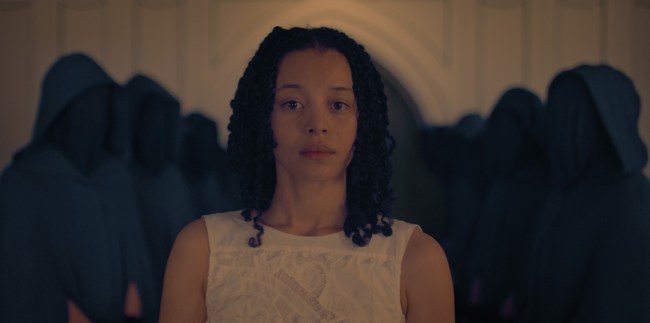
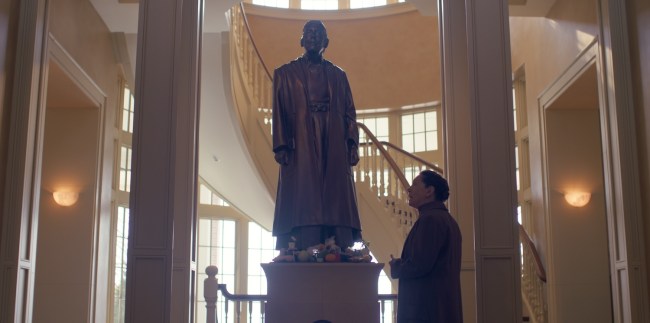
Agnes (Chase Infiniti) is obedient, respectful, and pious. Raised by a relatively kind commander (Nate Corddry) and a flatly evil step-mother (Amy Seimetz), Agnes grew up as privileged as a prisoner can be. Her house is immense and kept in immaculate condition by her family’s servants (the Marthas). She knows all the customs of Gilead, as well as its expectations of her — a young woman approaching adulthood. When the series begins, Agnes is a “plum” — her assigned grouping at Aunt Lydia’s preparatory school for future wives. She’s almost ready to graduate, meaning she’ll be married off to a man, and her greatest aspiration is to land a partner with the highest stature.
But on the precipice of all she’s ever wanted, Agnes is “terrified.” You would think the corpses left hanging by the roadside on her way to school would be the cause, but those are normal, as are the armed guards who watch over class outings and the ritual punishments performed on malfeasants during school assemblies. No, what scares Agnes is something unspeakable; something she can’t put into words even if she was allowed to voice them.
In narration, she remembers smiling at a boy when she was still a “pink” (the youngest students). For “tempting” him, her mouth was taped shut, and she was forced to hold a sign that said “slut.” So now, as a plum, she knows better than to act on her feelings for Garth (Brad Alexander), the Guardian who escorts her around Gilead like a modern-day princess. She wonders what it would be like to kiss him, but it’s a fantasy without the possibility of fulfillment.
Until, perhaps, a new girl arrives at school. Daisy (Lucy Halliday) is a recruit from Toronto, lured across the border by Gilead missionaries called Pearl Girls and enrolled with Agnes to learn the ways of her adopted society. Daisy sees the dead bodies hanging from buildings and public torture sessions just as we do: They’re sickening. She sprints out of the school assembly to vomit when a man’s arm is sliced off with a table-saw, and she blanches at the people around her who consider such acts part and parcel of a prosperous civilization.
It’s here, in the coming-of-age bonds between two kids from disparate backgrounds facing a future neither wants, that “The Testaments” stokes the flames of rebellion. After being paired together by the powers that be, Agnes and Daisy inch ever closer to becoming full-blown members of a religious cult, and they’re appropriately unnerved by the prospect. Their differing perspectives and evolving understanding of the world they’re meant to inherit (as much as any woman can inherit anything in Gilead) are the friction that creates change.
It’s a shame there’s so little of it. “The Testaments” is deeply flawed, most noticeably as a story. In what feels like a pilot’s worth of plot stretched across 10 truncated episodes (most run less than 45 minutes and three clock in well under 40), the sequel series is very much a direct continuation of “The Handmaid’s Tale,” but with a relationship to its predecessor that’s simultaneously distant and redundant. The distance is felt in how “The Testaments” treats facts already shared in “The Handmaid’s Tale” like major reveals. Fans may be confused by the finale, which pivots on a disclosure that’s bound to be common knowledge for viewers (and should already be recognized by the characters, too).
But repetition may be the series’ greater sin. Aside from brightening up the color palette and toning down the amount of violence (which makes sense, given “The Testaments” is rooted in a sheltered, upper-class perspective, rather than the routine atrocities faced by their servants), the tenor, structure, and ideas are all ripped straight from “The Handmaid’s Tale.”
The mood is serious to a fault; Lord knows these girls are oppressed (and conditioned to accept it), but a high school filled with humorless teens proves as unnecessary as it is unrealistic. Without getting into spoilers, much of the tension rests on whether certain protagonists get caught. Yes, there are still Mayday spies in Gilead, and yes, they’re still reporting to their same handlers (enjoy the cameos, everyone), but they’re also still moving in and out of a police state with an ease as convenient as the plot demands. That not only cuts down on any suspense related to the show’s grander designs (how impenetrable can Gilead be when there are this many leaks?), it also emphasizes “The Testaments’” faulty ambitions are the same as “The Handmaid’s Tale’s.”
Despite overt assertions to the contrary, nothing in the first season implies its next-generation of rebels is any better equipped to bring down Gilead than the last, and “The Testaments” struggles to define how these new, younger voices differ from the ones we heard from before. That’s (at least in part) by design. Both shows take place at a time when a “plummeting” birth rate creates mass panic. Protecting fertility trumps everything, whether it’s a monogamous marriage, historical racism, or free will.
That means there’s no need to acknowledge a shift in younger generations’ desire to procreate. Agnes claims she wants to get married and have children, but “The Testaments” isn’t interested in challenging viewers’ assumptions about bringing kids into a totalitarian, patriarchal nightmare. Instead of asking whether the dream in her head clashes with the nightmare in front of her eyes, “The Testaments” gives her (and viewers) an easy out: All her suitors are creepy old men. Yuck, right? It’s a lot easier to understand why no one wants to start a family with a pedophile than to consider why, even with the worldwide population falling, some people can’t imagine adding to it.
Race, another highly pertinent topic, is also a frustrating non-factor (just like it was in the original series). Even establishing a Black lead character and casting an exciting Black actress to play her can’t motivate “The Testaments” to budge from its postracial interpretation of religious fundamentalism in America. (Infiniti is effective and affecting, albeit limited by a script that asks her to repeat the same beats.) Whenever various wives whisper about Agnes’ tainted lineage, it’s clear they’re only referring to the fact she’s adopted, not that she’s a person of color in a world Atwood designed after white supremacists, yet has nothing to say about those influences.
What is relevant to reality — misogyny, homophobia, blind capitulation, willing capitulation, etc. — was also relevant 10 years ago, which contributes to “The Testaments” tedium. Seeing privileged young women wisen up to their standardized subjugation is bound to be less dramatic than witnessing a righteous workers’ rebellion. Active engagement with new perspectives could’ve helped spice things up, but there’s only so much generational commentary available when the priorities of those generations are taken off the table.
Instead, like the book before it, the series sees itself as an act of bearing witness. “This is what it was like” for Agnes, Daisy, and Aunt Lydia is easily interpreted as, “This is what it feels like for you and me.” But even with three narrators instead of one, “The Testaments” struggles to express anything that “The Handmaid’s Tale” hasn’t already observed. If we, the audience, are to appreciate the plight of these characters in order to avoid falling into the same traps, or to gain inspiration to survive like they do, or to simply engage with modern events within the relative safety of our TV sets, then future seasons will have to dig a lot deeper.
Otherwise, we’re just watching history repeat itself. And in 2026, that’s a habit that’s become all too ordinary.
Grade: C-
“The Testaments” premieres Wednesday, April 8 on Hulu with three episodes. New episodes will be released weekly through the Season 1 finale on May 27.
First Appeared on
Source link






