


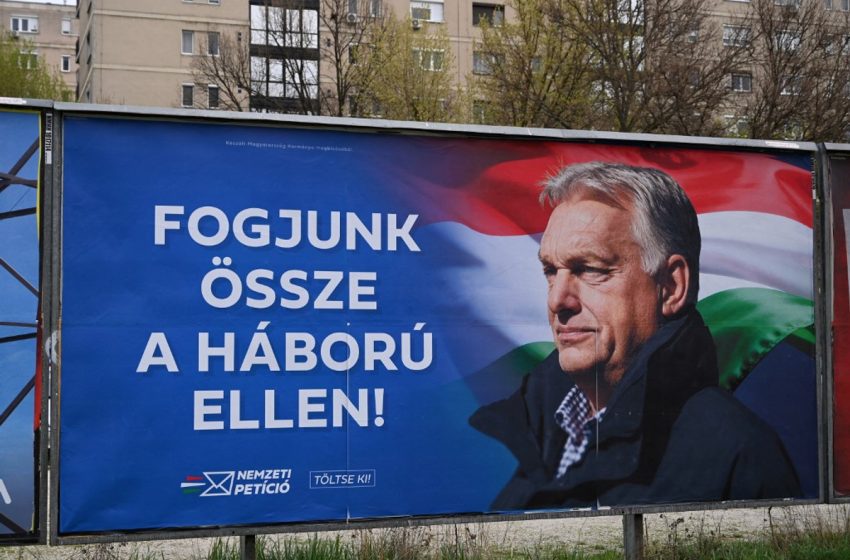
Hungary Vote Unlikely to Deliver Pro-Ukraine Shift, Politico Reports
Will a possible change of government in Hungary, resulting from the country’s parliamentary election on April 12, improve Budapest’s relations with the EU and Ukraine?
Not necessarily, it seems. The leading opposition figure, Péter Magyar of the Tisza party, has so far articulated positions on Ukraine that closely align with those of Prime Minister Viktor Orbán, despite presenting himself domestically as an anti‑establishment challenger.
JOIN US ON TELEGRAM
Follow our coverage of the war on the @Kyivpost_official.
EU officials frustrated by Orbán’s repeated blocking of support for Kyiv have hoped that a change in leadership could ease tensions, but Politico reports little evidence of a substantive policy shift.
On Ukraine, Magyar has opposed fast‑tracking EU accession, arguing that membership should instead be decided through a Hungarian referendum – a proposal that could delay the process indefinitely. He has also rejected providing military aid to Ukraine, insisting that such steps do not reflect Hungarian public opinion.
Magyar’s party has mirrored this approach in the European Parliament, voting against a €90 billion ($104 billion) EU loan package for Ukraine.
Politico notes that this vote reinforced concerns in Brussels that a Magyar‑led government would prioritize domestic political positioning over EU unity on Ukraine.
Like Orban, Magyar has framed his stance in nationalist terms, emphasizing Hungarian sovereignty and voter sentiment. He, too, has criticized Ukraine over its approach to Hungary’s ethnic minority in Transcarpathia and has said openly that Hungarian voters do not want a pro‑Ukrainian government.
Other Topics of Interest
Ukrainian Military Presence Reported in Western Libya Amid Expanding ‘Shadow War’ With Russia
Reports suggest over 200 Ukrainian military personnel are operating in western Libya, pointing to a widening covert confrontation between Kyiv and Moscow beyond Ukraine.
Politico reports that these positions reflect a broader political reality in Hungary, where anti‑Ukrainian sentiment remains deeply rooted. That sentiment has been reinforced in recent years by government messaging.
Orbán’s administration has increasingly antagonized Kyiv while simultaneously cultivating closer ties with Moscow, particularly in the energy sector.
Even if Magyar were to win the election, Politico concludes that any shift would likely be constrained by domestic public opinion rather than a strategic realignment with Kyiv’s priorities.
Nevertheless, in Kyiv, hope of a change in Budapest’s position in case of a Magyar victory remains. Politico quotes an unnamed advisor to the Ukrainian government as saying: “Yes, he’s a bit more flexible.”
First Appeared on
Source link






