


Middle East crisis live: US and Iranian forces race to recover missing pilot from downed jet; Israel bombards Beirut | US-Israel war on Iran
Welcome summary
Hello and welcome to our continuing live coverage of the US-Israel war on Iran and its impact on the region, the world and the global economy.
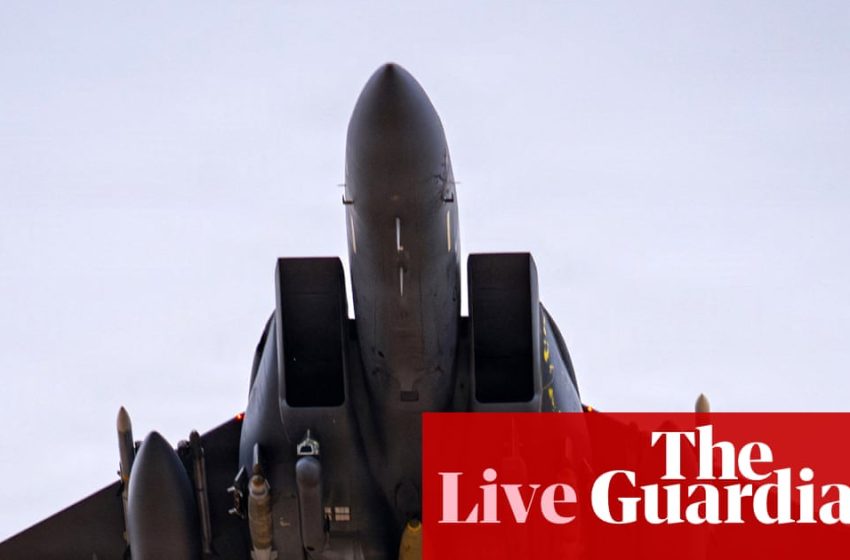
Iranian and American forces were racing each other early on Saturday to recover a crew member of the first US fighter jet to go down inside Iran since the start of the war.
Tehran said it had shot down the F-15 warplane, while US media reported American special forces had rescued one of its two crew members and the other was still missing.
Iranian authorities urged people living in the country’s rugged south-west to search for the jet’s crew, as state TV broadcast images of what was said to be the mangled debris.
Iran’s military said it also downed a US A-10 ground attack aircraft in the Gulf, with US media saying the pilot was rescued.
US Central Command did not immediately comment on the loss of the F-15, but the White House said Donald Trump “has been briefed”.
The US president told NBC the F-15 loss would not affect negotiations with Iran, saying: “No, not at all. No, it’s war.”
Fresh strikes meanwhile hit Israel, Iran, Lebanon and Gulf countries – and large blasts reportedly rocked northern Tehran. Israel said it had launched a wave of strikes in the Iranian capital, alongside parallel attacks in Beirut.
Strikes by all sides have increasingly targeted economic and industrial sites, raising fears of wider disruption to global energy supplies.
Here are the other main news developments:
-
Tehran rejected a US proposal for a 48-hour ceasefire, said Iran’s semi-official Fars news agency, citing an unnamed source. There was no immediate comment from the US. Earlier, the Wall Street Journal reported that Iran had officially told mediators it was unwilling to meet with US officials in Islamabad in the coming days.
-
The UN force in Lebanon said a blast at one of its positions had wounded three peacekeepers, two of them seriously, in the third such incident in a week.
-
Israeli fire killed a man in Syria’s Quneitra province in the south near the Israeli-occupied Golan Heights, Syrian state media said. The man was killed in an attack by “an Israeli tank”, the Sana agency said, while state TV said a car was targeted.
-
An Egyptian national was killed and four others wounded after a fire at a gas complex in Abu Dhabi, caused by falling debris from an intercepted attack, the government media office said. Two of the four people hurt were from Egypt, while the others were from Pakistan, it said.
-
Trump asked lawmakers to approve a $1.5tn defence budget for 2027 as the US faces rising costs from its war with Iran and mounting global security commitments. The proposal would lift Pentagon spending by more than 40% in a single year – the sharpest increase since the second world war.
-
The US embassy in Lebanon said Iran and allied groups could seek to target universities in the country, where Tehran-backed Hezbollah is at war with Israel and Israeli troops are carrying out a ground invasion.
-
Three tankers, including one co-owned by a Japanese company, crossed the strait of Hormuz by hugging close to Oman’s shore – a rare transit route – maritime traffic data showed on Friday.
With agencies
Key events
Further to the last post: as combat search and rescue (CSAR) teams are activated to retrieve a missing pilot after a downing, their soldiers – such as retired master sergeant Scott Fales – have been suiting up in a “ready room”.
Experts like Fales – a pararescue jumper who played a key role in the 1993 “Black Hawk Down” incident in Mogadishu, Somalia – are always standing by whenever US aircraft are over enemy territory.
“Before any operations are conducted … there is always a CSAR plan,” Fales told Agence France-Presse.
Simultaneously, an immense amount of intelligence is gathered and analysed on the location and status of the missing aviator. Fales said:
Everything from human intelligence to imagery intelligence to, you know, all the different drones we have looking – signals intelligence. It’s all being used to try to find this guy.
Once the missing aviator is located, a rescue plan is formulated in real time inside the helicopters.
“Those gunners are spotting and looking for threats, the pilots are looking for a place to land, we’re reaching out to that downed aviator,” Fales said.
On the ground, they ensure the pilot is actually the person they are searching for, and a threat-versus-medical-needs assessment is done. In their minds, Fales said, would be:
What kind of immediate threat are we in? How much time do we have to get this person out? What kind of injuries do they have? And then we’ll make up our mind on the type, amount of treatment that’s needed on the scene – or do we just grab and go depending on the threat?
With a fellow soldier still unaccounted for in south-west Iran, Fales said he was “very hopeful” the aviator would be located.
I’m hoping that friendly people have found him and are hiding him. Or he’s still evading.
Hide, find water: ex-pilot tells how to survive being shot down
As US forces race against time and Iran’s military to locate an aviator reportedly shot down on Friday, a former air force pilot has detailed what it takes to hide, survive and extract someone behind enemy lines.
“You’re like, ‘Oh my God, I was in a fighter jet two minutes ago, flying 500 miles an hour, and a missile just exploded, literally 15 feet from your head,’” said retired brigadier general Houston Cantwell, who is now at the Mitchell Institute for Aerospace Studies.
With that said, a pilot’s training – known as survival, evasion, resistance and escape (Sere) – would likely kick in before he or she parachutes to the ground, the Agence France-Presse news agency’s report says.
“Your best view of where you may want to go or where you may want to avoid is while you’re coming down in your parachute,” said Cantwell, who logged 400 hours of combat flight experience, including missions over Iraq and Afghanistan.
Parachuting to the ground risked foot, ankle and leg injuries, the former airman said.
There are many stories of survivors from Vietnam that had severe injuries – compound fractures – just from the ejection.
Upon landing, “take an inventory of yourself to figure out: what condition am I in? Can I even move? Am I even mobile?”
Aviators then figure out where they are, whether it is behind enemy lines, where they can hide and how they can communicate.
Cantwell said:
Try to avoid enemy capture, as long as you can. And if I were in a desert environment, I’d want to try to find some water.
Simultaneously, combat search and rescue teams – highly trained soldiers and pilots already on alert – would be activated. But the missing crew member can increase the odds of a safe rescue. Cantwell said:
My priority would be, first of all, concealment, because I don’t want to be captured. I want to try to get to a location where I can get extracted.
In a city, that may be a rooftop. In a rural setting, a field where helicopters can land. Movement was best at night, he said.
Cantwell said that when he flew, he also carried a pistol.
Welcome summary
Hello and welcome to our continuing live coverage of the US-Israel war on Iran and its impact on the region, the world and the global economy.
Iranian and American forces were racing each other early on Saturday to recover a crew member of the first US fighter jet to go down inside Iran since the start of the war.
Tehran said it had shot down the F-15 warplane, while US media reported American special forces had rescued one of its two crew members and the other was still missing.
Iranian authorities urged people living in the country’s rugged south-west to search for the jet’s crew, as state TV broadcast images of what was said to be the mangled debris.
Iran’s military said it also downed a US A-10 ground attack aircraft in the Gulf, with US media saying the pilot was rescued.
US Central Command did not immediately comment on the loss of the F-15, but the White House said Donald Trump “has been briefed”.
The US president told NBC the F-15 loss would not affect negotiations with Iran, saying: “No, not at all. No, it’s war.”
Fresh strikes meanwhile hit Israel, Iran, Lebanon and Gulf countries – and large blasts reportedly rocked northern Tehran. Israel said it had launched a wave of strikes in the Iranian capital, alongside parallel attacks in Beirut.
Strikes by all sides have increasingly targeted economic and industrial sites, raising fears of wider disruption to global energy supplies.
Here are the other main news developments:
-
Tehran rejected a US proposal for a 48-hour ceasefire, said Iran’s semi-official Fars news agency, citing an unnamed source. There was no immediate comment from the US. Earlier, the Wall Street Journal reported that Iran had officially told mediators it was unwilling to meet with US officials in Islamabad in the coming days.
-
The UN force in Lebanon said a blast at one of its positions had wounded three peacekeepers, two of them seriously, in the third such incident in a week.
-
Israeli fire killed a man in Syria’s Quneitra province in the south near the Israeli-occupied Golan Heights, Syrian state media said. The man was killed in an attack by “an Israeli tank”, the Sana agency said, while state TV said a car was targeted.
-
An Egyptian national was killed and four others wounded after a fire at a gas complex in Abu Dhabi, caused by falling debris from an intercepted attack, the government media office said. Two of the four people hurt were from Egypt, while the others were from Pakistan, it said.
-
Trump asked lawmakers to approve a $1.5tn defence budget for 2027 as the US faces rising costs from its war with Iran and mounting global security commitments. The proposal would lift Pentagon spending by more than 40% in a single year – the sharpest increase since the second world war.
-
The US embassy in Lebanon said Iran and allied groups could seek to target universities in the country, where Tehran-backed Hezbollah is at war with Israel and Israeli troops are carrying out a ground invasion.
-
Three tankers, including one co-owned by a Japanese company, crossed the strait of Hormuz by hugging close to Oman’s shore – a rare transit route – maritime traffic data showed on Friday.
With agencies
First Appeared on
Source link






