


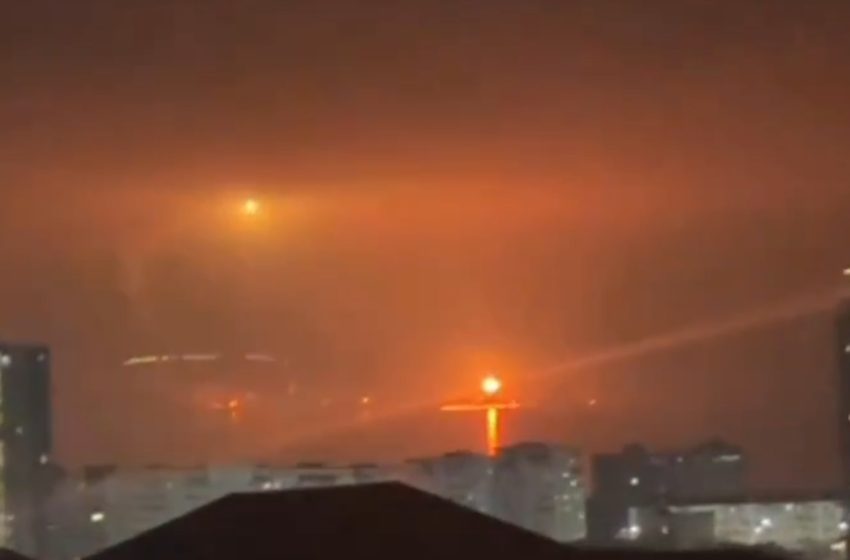
Novorossiysk in flames as Kyiv intensifies campaign against Russian energy exports
Ukraine has launched a series of sweeping strikes against Russian energy infrastructure over the weekend, targeting the Sheskharis oil terminal at Novorossiysk, the Lukoil NORSI refinery in the Nizhny Novgorod region, the Baltic port of Primorsk and a grain-carrying vessel in the Sea of Azov – a coordinated assault designed to squeeze Moscow’s oil export revenues at a moment when Middle East war has driven global energy prices to historic highs.
The most dramatic strike hit Novorossiysk overnight, with a massive blaze tearing through the port’s Sheskharis oil terminal following a reported Ukrainian drone attack on one of Russia’s most critical Black Sea export hubs. The scale of the fire underlined the ambition of Kyiv’s latest energy campaign, which has been steadily escalating in recent weeks as Ukraine attempts to compound the pressure already bearing down on Russian oil revenues from Western sanctions.
Earlier in the weekend, Ukrainian drone forces struck the NORSI refinery – formally the Lukoil-Nizhegorodnefteorgsintez facility in Kstovo – sparking a large-scale fire at a plant that produces over 50 types of petroleum products including aviation and diesel fuel, has an annual capacity of 17 million tonnes and provides nearly 30% of the gasoline consumed by the Moscow region while directly supplying fuel to Russian forces in Ukraine. Ukraine’s drone forces commander Robert Brovdi confirmed the strike, saying his forces had “paid a gracious visit to Lukoil in Kstovo.”
The Baltic port of Primorsk, a key hub for Russia’s oil export company Transneft, was also targeted, as it has been regularly for the past fortnight. Leningrad regional governor Alexander Drozdenko initially claimed Russian air defences had shot down 19 drones and that debris had “damaged a section of the oil pipeline near the port of Primorsk, and the pipeline is being safely burned out” – before updating his account two hours later to say the pipeline was undamaged, attributing a fuel leak to “a shrapnel hit on one of the fuel tanks.” Brovdi confirmed the strike, saying his forces had “once again struck the Transneft Primorsk port.”
In the Sea of Azov, a Volgo-Balt class cargo ship carrying wheat sank after coming under attack from Ukrainian drones, according to Russia-installed Kherson region official Vladimir Saldo. “The reason for the sinking of the Volgo-Balt in the Sea of Azov was a terrorist attack by the Kyiv regime,” Saldo wrote on Telegram. Two crewmembers were killed, with nine others evacuated in a lifeboat. Ukrainian defence intelligence has previously tracked multiple Volgo-Balt vessels transporting stolen Ukrainian grain from occupied ports to Russia for onward export to third countries under the guise of Russian exports.
The strikes come as global energy markets remain severely dislocated by the US-Israel war on Iran, which the International Energy Agency has described as the largest oil supply disruption in history. That context has created an unusual political opening for voices calling for a resumption of Russian energy flows to Europe. Slovak prime minister Robert Fico, speaking after a call with Hungarian counterpart Viktor Orbán – both of whom have maintained relations with Moscow as outliers within the EU – called on the bloc to end sanctions on Russian oil and gas imports to address the energy crisis. Fico said the EU should renew dialogue with Russia so member states could access supplies “from all sources, including Russia.”
The call is unlikely to gain traction in Brussels, where the majority of member states remain firmly opposed to any sanctions relief for Moscow.
First Appeared on
Source link






