


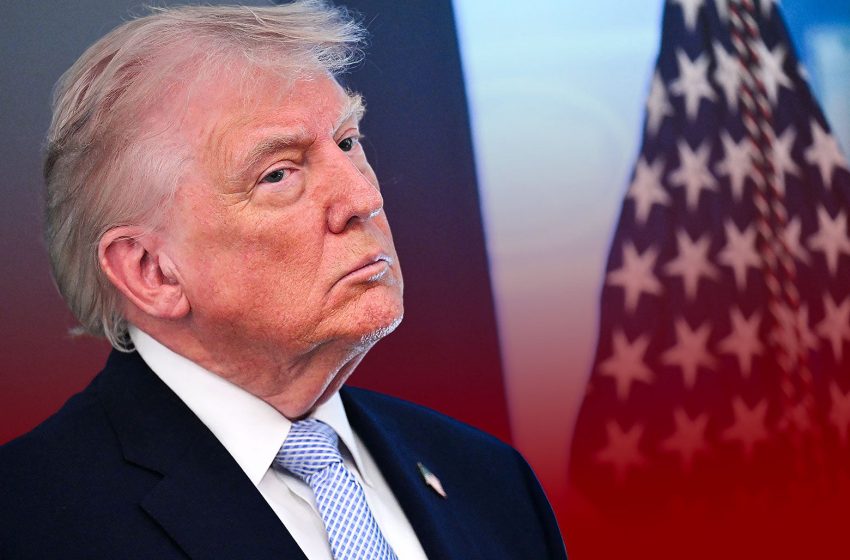
Trump is just openly threatening war crimes.
Sign up for the Slatest to get the most insightful analysis, criticism, and advice out there, delivered to your inbox daily.
In the wake of President Donald Trump’s obscene and vile Easter-weekend posts on social media, two questions come to mind: Are any senior U.S. military officers preparing to resist unlawful orders? Are any Cabinet secretaries or GOP legislators weighing whether it’s worth the shame and career suicide to continue bootlicking an unhinged war criminal?
The posts were, even by Trump standards, off-the-charts batshit crazy. First, on Saturday:
Remember when I gave Iran ten days to MAKE A DEAL or OPEN UP THE HORMUZ STRAIT. Time is running out – 48 hours before all Hell will reign down on them. Glory be to GOD!
Then on Sunday morning:
Tuesday will be Power Plant Day, and Bridge Day, all wrapped up in one, in Iran. There will be nothing like it!!! Open the Fuckin’ Strait, you crazy bastards, or you’ll be living in Hell – JUST WATCH! Praise be to Allah.
Where to begin?
First, what kind of president, politician, or person talks or writes like this? Few if any of even Kim Jong-un’s looniest tirades match these posts for their wild-eyed savagery.
Second, deliberately blowing up bridges, electric power plants, and other civilian targets would clearly violate the laws of war and various international treaties. At a news conference Monday, devoted mainly to the successful rescue of two downed U.S. pilots in Iran, Trump was asked whether it bothered him to commit war crimes. Trump asked what paper the reporter represented. When the reporter said “the New York Times,” Trump said that the paper’s circulation was way down (not true) and bitterly recalled that it had predicted he would lose the election. He then said, “We’re never going to let Iran have a nuclear weapon”—which evaded the issue of war crimes. (Remarkably, no other reporter repeated the question.)
Third, Trump began his bombing campaign five weeks ago with a call for the Iranian people to rise up against their newly vulnerable oppressive regime. Now he’s threatening to kill untold numbers of civilians and destroy Iran’s society (in his speech last week, he threatened to bomb Iran “back to the Stone Ages, where they belong”). At Monday’s news conference, he said that Iran would take 100 years to recover from the attack that will begin Tuesday at 8 p.m. Eastern time if Iran doesn’t open the Strait of Hormuz.
Fourth, one might charitably interpret Trump’s tweets as a reprise of Richard Nixon’s “madman strategy”—the notion that an enemy will surrender out of fear that the American president is as crazy as he sounds and really will carry out his threat. But it’s worth noting the ploy didn’t work for Nixon against North Vietnam—and it’s unlikely to work for Trump against Iran.
In fact, the Iranian leaders may be feeling pretty good about the war as it stands. Trump said Monday that U.S. bombs and missiles have hit more than 13,000 targets in Iran, yet the theocratic regime persists and its military continues to fire drones and missiles (and it doesn’t take many to keep the Strait of Hormuz blocked up). While Trump takes pride in the rescue of two downed American airmen deep inside Iranian territory (most of Monday’s hourlong news conference was devoted to the subject), Iranians take pride in having shot down two American planes—in defiance of Trump’s claim that the U.S. had achieved “air supremacy,” allowing its jets to fly over every stretch of Iranian territory, unimpeded.
Trump’s latest screeds may have struck Iran’s leaders as a sign of desperation and a howl of holy war—a combination that might instill fear but might also boost morale. The Iranian people, many of whom despise their government, also have a deep dread of foreign intervention, and while many cheered Trump’s initial airstrikes against Tehran’s rulers, his relentless attacks since—and his threats to rain down hell and bomb Iran back to the Stone Age (as well as the implicit contempt he holds for Iran by saying the Stone Age is where it belongs)—could rally the people to their country’s defense. Whatever happens, the assault may well discourage the Iranian people—many of whom have been very pro-American—from viewing the United States as a friend in the future.
Meanwhile, if Iran’s rulers believe Trump’s threats, they may fight on more fiercely, even if it means going down with the ship, rather than succumb to an American president whose words—whether those words are promises or threats—they cannot believe. After all, in his first term, Trump tore up the nuclear accord, with which Iran had been in compliance. At the end of this past February, he launched a surprise attack in the middle of negotiations, which were going pretty well. At his news conference on Monday, he said it’s hard to negotiate with Iranians because his airstrikes have destroyed their communications—but he still plans to wreck the entire country if they don’t give up by Tuesday. “The entire country could be taken out in one night,” he said in a disturbingly casual tone, “and that night might be tomorrow night.”
Why is he still fighting this war, much less threatening to make it a total war? He said at the press conference that his main goal is to keep Iran from having a nuclear weapon—but he also repeated earlier claims that his attack on Iran’s enrichment sites last June had “obliterated” Iran’s ability to make a nuclear weapon.
In a Substack piece last fall, the strategist Lawrence Freedman described Trump and the United States as an “unserious president; serious country.” Whatever Trump’s initial motives for going to war with Iran, he is now using our serious country’s very serious military force as an instrument of personal pique and rage.
Early on, when he mobilized two aircraft carriers and their escort ships within firing range of Iran, Trump pronounced himself “curious” (according to his emissary, Steve Witkoff) as to why Iran hadn’t backed down in the face of such massive firepower. When Trump started bombing Iran, he thought the war would be as brief and victorious as his recent operation in Venezuela—and was surprised (as was his secretary of defense, Pete Hegseth) that the Iranians resisted (even though his intelligence advisers and the chairman of the Joint Chiefs of Staff warned that they would). Last week, after laying waste to their critical infrastructure, Trump was stunned by the Iranians’ persistent refusal to surrender. “Why wouldn’t they call?” he wondered aloud to a Time magazine reporter. “We just blew up their three big bridges last night!”
Trump is so accustomed to “winning” in various other stare-downs—against Congress, media execs, university presidents, and others—he is startled when a foe doesn’t fold. He takes the defiance as an insult and the public insult as an embarrassment.
U.S. military officers are immersed, from the time they’re cadets, in a culture that respects civilian control and discourages getting involved in politics. But U.S. military law also requires them to disobey “unlawful orders.” Where will they draw the line when the president exploits their instruments of national power for such blatantly politicized purposes?
At the news conference Monday, Trump was flanked by Hegseth, CIA director John Ratcliffe, and Gen. Dan Caine, chairman of the Joint Chiefs of Staff. Hegseth spent most of his time at the microphone praising Trump and God. Ratcliffe and Caine revealed some details about the mission to rescue the two American pilots. It was clearly an impressive operation, but it seemed that the main point of the news conference was to tout this tactical success as a distraction from the strategic confusion and humanitarian catastrophe of the war itself. We will know very soon (perhaps by 8 p.m. Tuesday, unless he extends the deadline again) whether Trump will take the full plunge into infamy—and what the enablers around him do in response.

First Appeared on
Source link






