


New DHS chief Markwayne Mullin visits town devastated by Hurricane Helene, promises reforms to FEMA
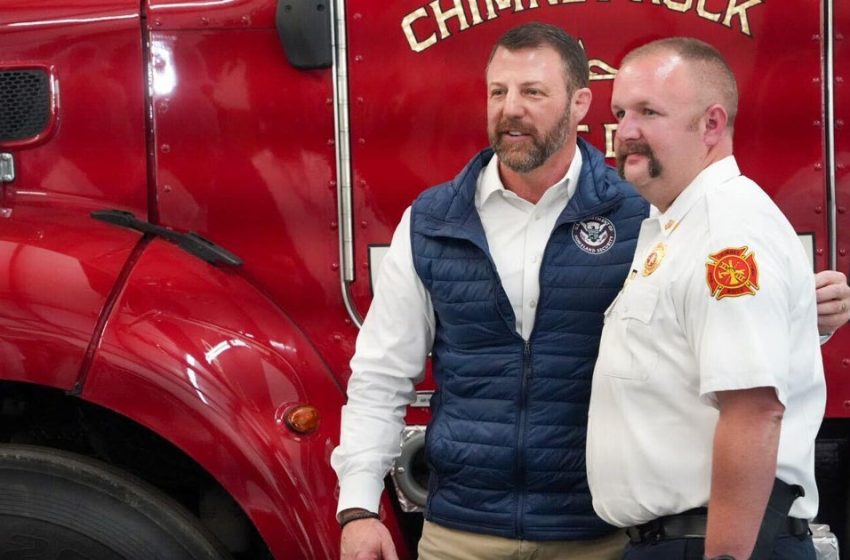
Chimney Rock, North Carolina — From the well-worn interior of a fire department in Western North Carolina, Markwayne Mullin reassured local officials that as homeland security secretary, he intends to reform the Federal Emergency Management Agency — not eliminate it.
Mullin, on his first official visit in his new role, traveled to Chimney Rock, a tiny mountain town that was devastated by Hurricane Helene in September 2024 after 22.5 inches of rain devoured roughly half of all homes along the Rocky Broad River, carrying 1.2 million tons of sediment and wreckage to nearby Lake Lure — creating a 15 foot deep debris field. The lake will reopen in two weeks.
It was this backdrop where Mullin told officials that his goal is to shift FEMA’s role away from being a primary responder and toward funding state and local governments. “We shouldn’t be the first ones in and the last ones out,” Mullin said. “The state is much more equipped… but we can be there to get them past the first heavy lift.”
It took several lifts to dig out Chimney Rock — a process local, state and federal officials told Mullin is still ongoing, 18 months later — challenged by some uniquely stubborn red tape afflicting the mountainous region that was not built to withstand major hurricanes. The discussion, led by GOP Sen. Ted Budd, brought together emergency responders, elected leaders and FEMA officials who talked about the scale of devastation in tens of millions of dollars and in years.
Asked about delays and a backlog of FEMA projects, Mullin said the agency is working to accelerate approvals before the fast approaching hurricane season on June 1. “We’re trying to push this stuff forward as fast as possible … so we aren’t entering hurricane season behind,” he said, noting FEMA is still managing 22 open and pending major disasters nationwide.
The new secretary bounced a small, pink rubber ball — his signature quirk — as he shook hands with locals and acknowledged frustration from residents who feel forgotten, pointing to recent funding approvals as progress. His visit came one day after FEMA announced $26 million to buy out 75 homes in North Carolina — a move aimed at helping families relocate out of high-risk flood zones and clearing the way for long-term mitigation.
Still, the fix comes as thousands of cases remain unresolved. “We got the first 75 out, but we’re looking at the other ones,” he said, referring to housing assistance. “We’re honestly… working from the easiest to the hardest ones. We got to get the money flowing at some point. That’s part of the backlog.”
Nicole Sganga
Officials like Budd applauded Mullin’s decision to rescind a memo from DHS Secretary Kristi Noem last summer requiring her office’s approval on all DHS contracts and grants over $100,000 — including FEMA disaster relief. “That’s leadership,” Budd offered pointedly.
In June 2025, President Trump told reporters he wanted to “wean” states off FEMA assistance after the 2025 hurricane season, and had at one point floated closing the disaster relief agency. In response to questions about the future of FEMA, Mullin pushed back on suggestions the agency could be shuttered for good.
“I think the president was talking about reforming FEMA,” he said. “We want to make sure we get the dollar closer to the state… because when you’re dealing with federal contracts… the price seems to double because of the amount of bureaucracy.”
Mullin also confirmed the administration is working on naming a permanent FEMA administrator, though he declined to provide specifics. “We may have identified someone, but it’s a long process,” he said, adding that Senate confirmation remains a significant hurdle.
A thousand-year storm
Local leaders and first responders described widespread destruction from Helene’s historic rainfall and flooding as a “thousand-year storm” that wiped out roads, severed homes, damaged utilities and left some communities still struggling to restore basic services.
Several pointed to the strain on smaller, rural counties that must front the costs for recovery projects and wait for months on federal reimbursement — often with limited staff and resources. Officials bemoaned overlapping rules, slow approvals and rigid policies that have complicated rebuilding efforts while burying survivors in paperwork.
Mullin indicated he was open to trying to streamline processes, reduce backlogs and give more decision-making flexibility to local leaders. But for residents of western North Carolina who are still waiting for aid, Mullin struck a cautious tone.
“We’re going to do everything we can possibly do to make it happen,” he said. “But the federal government isn’t going to take care of everybody’s problems … we’re there to help ease the pain.”
During the visit, Mullin also promised that FEMA workers would be paid for their hours worked during the first six weeks of the shutdown by Friday, with all pay checks reaching their bank accounts by Monday, the latest.
Nicole Sganga 
“This is my hometown”
Eighteen months after Helene, trailers are still visible along the banks of the Rocky Broad River. Debris falls from homes spliced open by the floodwaters.
The Chimney Rock Fire Department served as both refuge and command post when Helene tore through western North Carolina, bringing mudslides and flash flooding that ripped apart homes and washed away roads. Chimney Rock State Park closed for nine months as a result of the hurricane.
Inside the fire station, Fire Chief Chris Melton, gestured toward a torn-up American flag hanging in the back of the hall.
“I haven’t brought that flag out until yesterday,” Melton said, his voice catching. “It was pulled out of the river as we was doing some rescues.” As he wiped away a tear, he could offer only, “This is my hometown.”
Mullin listened, and then pointed toward the flag. “I think it should be framed.” He asked Melton, “Would you allow me to pay for that frame?” The chief nodded. Mullin directed one of the FEMA employees to send him the bill directly.
Nicole Sganga 
For the new secretary, the test will be whether the symbolic gestures and promises made in rooms like this translate into faster help before hurricane season begins.
Hours earlier, traversed the banks of the Broad River with local leaders, jumping over boulders and surveying what residents here still refer to as “the town that washed away” — where floodwaters piled debris, ripped apart mountain cottages and reshaped the now winding and jagged landscape.
Along the river, residents at River Watch Bar and Grille watched the spectacle, remarking that they couldn’t remember the last time they saw this many people crowded along its banks. The parking lots in the once tourist-lined street overflowed with black SUVs and white vans, as Mullin shuffled into a nearby gift shop advertising “homemade fudge.”
“I guess this is what happens when the government comes to town,” one remarked.
Another chuckled, calling it a “dog and pony show.”
The bartender smiled, noting the kitchen had been slammed for days, ever since Interstate-64 reopened traffic from nearby Asheville into the town last week. “But hey, we’re not mad at it,” she said. “We’re just happy that everybody is finally here.”
First Appeared on
Source link






