


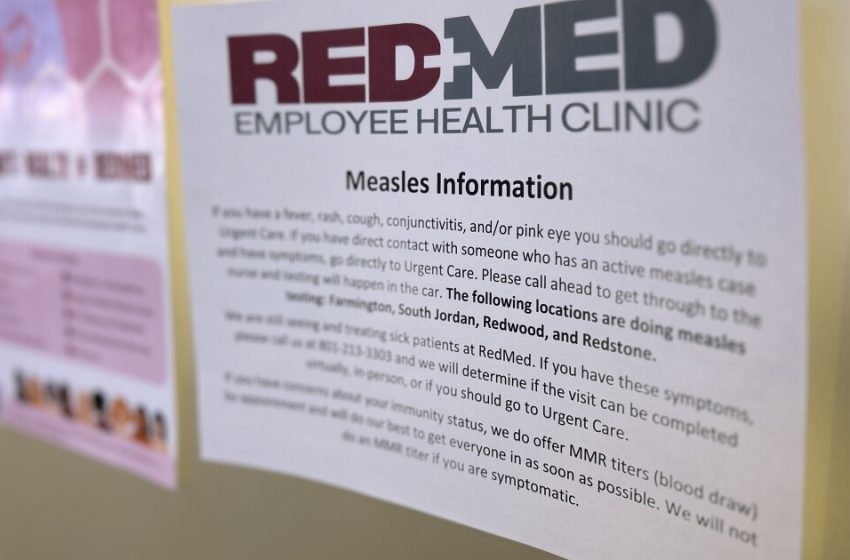
Measles outbreak spreads in Utah, hitting people without the vaccine
Utah’s measles outbreak started in a remote area, but is now spreading across the state.
As of the most recent update from the Utah Department of Health and Human Services, there have now been 583 confirmed cases since last summer. Only Texas and South Carolina have had more.
You wouldn’t know it by the buzz of activity on campus, but the University of Utah is currently dealing with a measles exposure of its own. Someone with a confirmed case of the disease was on campus for at least four days at the end of March. The university told students to stay home for 21 days if they feel sick or are not vaccinated due to the highly contagious nature of measles.
For Freshman Hailey Perkins — who was vaccinated as a child — the outbreak isn’t something she’s really thinking about.
“I was like, I don’t really know what you change,” she said. “I still have to go to class. So I was just like, ‘it is what it is.’”
Utah’s outbreak took off in the Southwest corner of the state last summer in small communities near the Arizona border. People there are known for being affiliated with a fundamentalist religious sect, and they have low vaccination rates. Almost half of Utah’s measles cases have come from that region.
And it’s quickly spreading.
“It is now hitting people from all different areas of the state with all different practices from all different kinds of communities,” said state epidemiologist Dr. Leisha Nolen. “It isn’t limited to any specific group anymore.”
Back in February, there were exposures at a high school wrestling tournament at Utah Valley University near Provo and at Highland High School in Salt Lake City. That same month, Salt Lake County announced that the disease was “actively spreading” in the county.
According to the Utah Department of Health and Human Services, 83% of confirmed cases are among unvaccinated people, and children are outpacing adults by a near 2-1 margin.
Even for seasoned professionals, the severity of some of these cases has been eye-opening.
“I think a lot of clinicians who are seeing patients with the measles are surprised by how sick these people are, often as kids, teens,” said Nolen. “A lot of the providers talk about these teenagers who come in and just look horrible, that they are not wanting to move, they just are extremely uncomfortable with crazy high temperatures, not able to keep food or drink down.”
Measles is more dangerous for children under 5, as well as people with weakened immune systems. Severe complications can lead to fever, pneumonia or brain swelling, and in rare cases can even lead to death, with three deaths recorded across the country in 2025.
The disease was declared eliminated in the U.S. in 2000, but it experienced a surge in cases starting in 2025.
Public health experts say the rhetoric and new policies of U.S. Health and Human Services Secretary Robert F. Kennedy Jr. are fostering vaccine skepticism and confusion by not encouraging vaccination, though he did endorse the MMR vaccine on April 6.
For public health officials like Nolen, the last year-and-a-half has felt like navigating uncharted waters.
“As a pediatrician doing training in the late 90s, early thousands, I didn’t learn about measles,” she said. “It was something that maybe you’d see if you went internationally, you certainly didn’t expect to see it here in the United States.”
In the conservative, religious region where the outbreak started, trust in public health took a serious hit during the COVID years, said Southwest Utah Public Health Department Public Information Officer David Heaton.
Six years later, he’s still working on getting correct vaccine information out to the public, but he says there has been a glimmer of hope.
“We do still see that people have a little more trust in local public health,” he said. “And so we’re leveraging that as much as we can to reach out to people, to at least give them education. Our big thing is personal responsibility.”
The number one thing Heaton said could move the needle? Actual conversations with local health care providers.
“We respect anyone that has worries or doubts or questions, we hope they would talk to their doctor, but to be aware that there’s a lot of information on the internet that take kind of that fear, that fear approach that you’re endangering your child and making certain health care claims that really are unfounded.”
Despite the push for outreach and vaccinations, epidemiologist Nolen isn’t holding her breath for the end of the outbreak. Still, she’s hoping that things might get better now that it’s spring and people are spending less time inside.
“Now that we have it really throughout the entire state, it’s very hard to know how we’re going to be able to contain this anytime soon,” she said.
First Appeared on
Source link






