


Why Experts Recommend It and What It Really Does
In recent months, a simple kitchen ritual has gained quiet traction across homes and wellness circles: boiling orange peels with cinnamon. Advocates praise the blend for its warming aroma and nostalgic comfort—but underneath the scent lies a more provocative question. Is this domestic tradition just olfactory charm, or does it mark the return of overlooked biochemical intelligence?
Emerging scientific reviews and clinical research suggest the answer may be far from trivial. As interest grows in natural antimicrobial agents and air purifiers, attention is shifting to the overlooked properties of food waste and spice rack staples. What was once dismissed as kitchen folklore is now under peer-reviewed scrutiny—and the findings are drawing serious attention from biochemists, neurologists, and public health researchers.
The growing convergence between anecdotal practice and empirical validation has put orange peels and cinnamon at the center of a broader discussion: Can common household ingredients serve as functional health tools without crossing into pseudoscience? And if so, how far can their use extend beyond scent into measurable health impacts?
A Pot on the Stove or a Low-Tech Purification System?
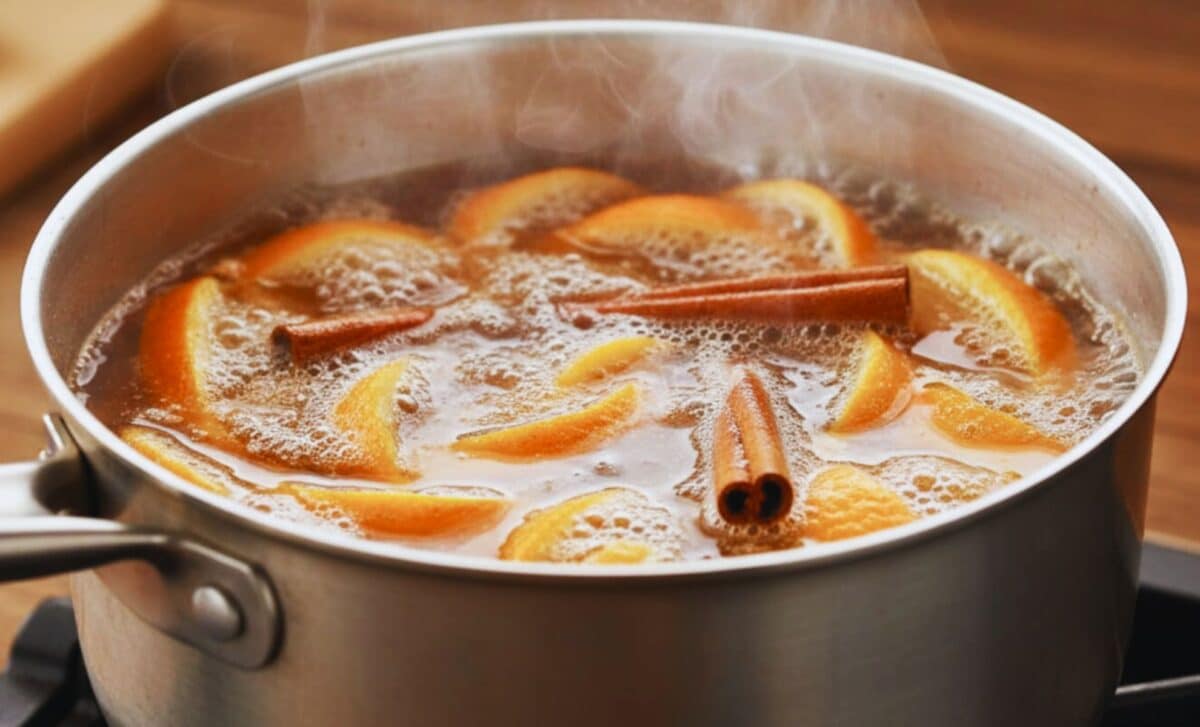
The core of the practice is straightforward: simmering two or three orange peels with cinnamon sticks in water for 10–15 minutes. The resulting vapor releases a sweet, tangy scent often described as “cleaner than synthetic air fresheners” and “distinctly uplifting.” But it also disperses active compounds into the air—compounds with known antibacterial and antifungal properties.
A 2023 peer-reviewed review in the Journal of Food Chemistry & Nanotechnology reported that orange peels, long treated as waste, contain high levels of flavonoids, phenolic acids, and carotenoids—molecules shown to reduce oxidative damage at the cellular level. These compounds are especially concentrated in the citrus albedo (white inner peel), which is often discarded in food preparation but becomes bioactive when heated and aerosolized.
On the cinnamon side, evidence is equally compelling. A landmark review published in Critical Reviews in Food Science and Nutrition confirmed that Cinnamomum zeylanicum, known as Ceylon cinnamon, demonstrates potent antimicrobial, antioxidant, and anti-inflammatory properties in vitro and in vivo. While most findings stem from laboratory settings, the molecular activity—especially against airborne bacteria—raises questions about cinnamon’s role in indoor air quality.
Crucially, both ingredients have documented activity against pathogens that thrive in humid or poorly ventilated spaces, such as Staphylococcus aureus, E. coli, and various molds. Experts emphasize this isn’t equivalent to sterilization, but it does represent a measurable contribution to air purification—one supported by evolving bioactive research.
“What’s remarkable is how much therapeutic potential is hiding in food by-products like citrus peels,” said Dr. Y. Guo, a co-author of a 2022 NIH-supported study on nobiletin, a key citrus flavonoid. “The compounds we isolate in lab settings are already present in these materials, often in high concentrations.”
From Scent to Synapses: A Cognitive Link Emerges
Beyond the sensory and antimicrobial appeal lies a more surprising development: neurological research. A 2022 review in Nutrients analyzed dozens of studies exploring the effect of citrus flavonoids—especially nobiletin—on memory, inflammation, and oxidative stress in the brain.
In human clinical trials, citrus peel extracts taken over several weeks improved memory scores and increased brain-derived neurotrophic factor (BDNF) levels—an important protein linked to cognitive resilience and synaptic plasticity. These effects were observed not only in elderly subjects but also in patients with mild cognitive impairment and early-stage Alzheimer’s disease.
Cinnamon also contributes to this equation. Preliminary studies suggest its compounds may act as insulin sensitizers, improving glucose uptake in the brain—an important function, given that impaired glucose metabolism is increasingly recognized as a hallmark of neurodegenerative disease.
While the boiling method delivers lower concentrations than clinical doses, vapor exposure and ingestion from repurposed decoctions (e.g., used as tea or cleaning agent) may still provide a low-grade delivery of bioactives, especially in consistent daily use.
Household Utility and Public Health Implications
From a functional standpoint, the decoction left after boiling orange peels and cinnamon holds further value. Users report it works effectively as a natural surface cleaner, a floor rinse, and a room spray—each reapplication extending the ingredient’s lifecycle while reducing dependence on chemical-laden products.
More importantly, the antimicrobial profile of these compounds opens the door for low-cost health interventions in under-resourced settings. In regions where air purification or access to over-the-counter disinfectants is limited, heat-activated citrus and spice compounds may offer a scalable, sustainable alternative with minimal environmental impact.
That said, researchers caution against overextension. “The evidence is promising but not conclusive,” said Dr. Akira Nakajima, a metabolic health researcher at the University of Tokyo. “We’re seeing enough positive trends to warrant clinical trials, but not enough for public health policy shifts—yet.”
First Appeared on
Source link






