


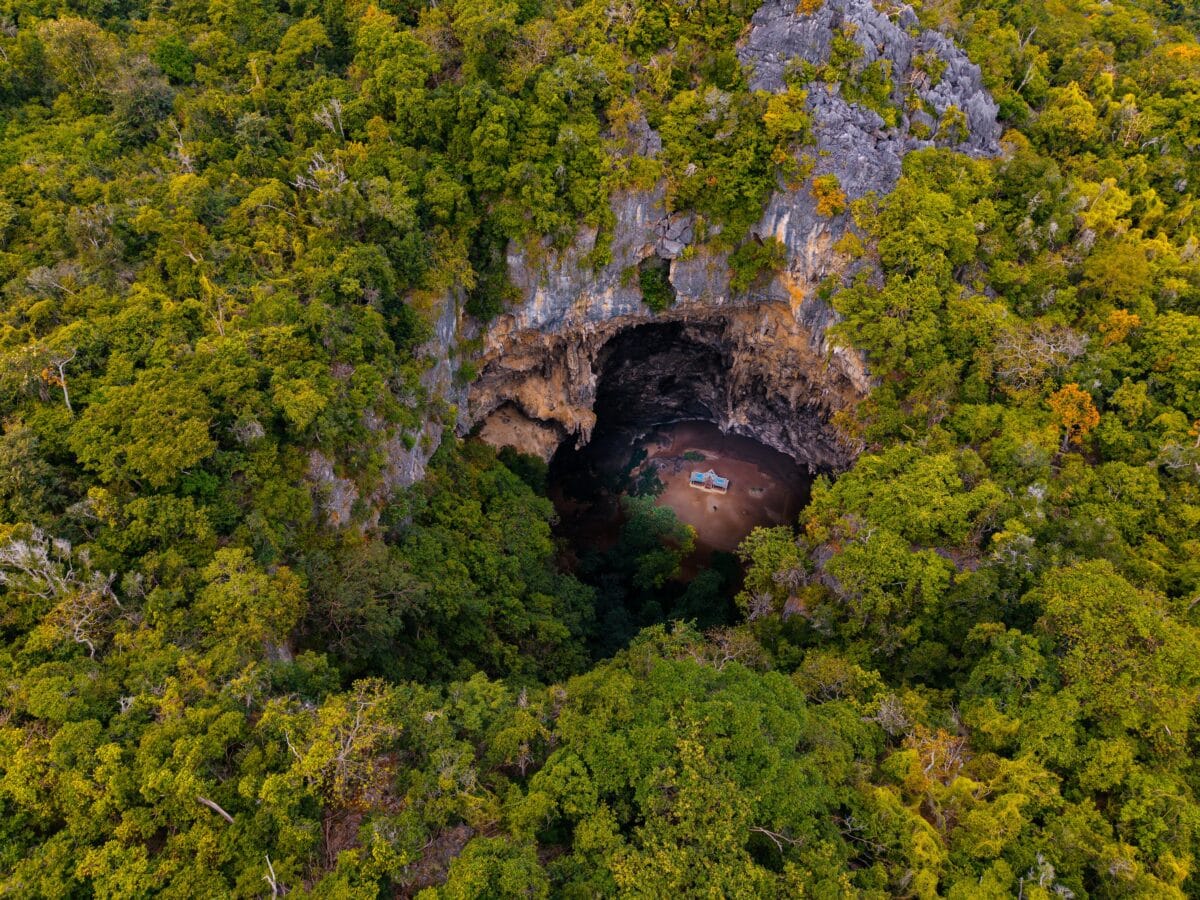
Scientists Unearth an Epic Underground Cave Hidden Inside a Giant Sinkhole in China
In a remote corner of southern China, a giant sinkhole has unveiled an extraordinary underground cave system, sparking excitement in the world of geology. Known as Hong Kong ‘Haiting Hall’, this massive vault has been hailed as one of the most impressive geological discoveries in recent years.
This sinkhole, located in Guangxi province, was first discovered by a Hong Kong expedition in 2023. But it wasn’t until this year, when a joint Chinese-British team returned for further exploration, that they were able to confirm its full scale and significance.
The Quest to Uncover the Hidden Cave
According to the Xinhua news agency, between October 4 and 8, a team of 19 scientists, led by Zhang Yuanhai from the Institute of Karst Geology and Andy Eavis from the British Caving Association. With only a single rope to guide them, they navigated the deep, rocky chasm. Their goal was simple: map the cluster’s structure and assess its geological importance. What they found was far from ordinary.
The sheer size of the pit, measuring a staggering 6.7 million cubic meters in volume, is enough to make anyone pause. As Zhang noted, this discovery places the cave among the world’s most remarkable sinkholes. The team also used 3D scanning technology to capture detailed images of the vast interior—corridors, hallways, and the countless natural formations that have been slowly sculpted over time by water and geological forces.
Interestingly, the underground chamber also contains cave pearls—small, perfectly round stones that have been smoothed and polished over eons by mineral-rich water.
The Sinkhole’s Incredible Dimensions
According to the team’s measurements, the sinkhole is 100 meters wide, nearly 200 meters long, and plunges to a depth of 118 meters. These vast dimensions make it one of the largest sinkholes ever recorded. Yet, it’s not just the size that’s remarkable—it’s the way the collapse at the southeast end of the sinkhole has created a complex system of underground caverns. What was once a vast open pit is now a labyrinth of geological features, offering a glimpse into the dynamic forces at work beneath our feet.
One of the more fascinating aspects of the discovery is the underground river that runs through the cave, feeding into the nearby Panyang River.
“These giant caves are natural caves, most of which are caused by collapses and are related to underground rivers,” he added.
A Process Thousands of Years in the Making
Sinkholes like Hong Kong·Haiting Hall are not formed overnight. They are the result of a gradual process that can take millions of years. According to Zhang, the collapse that created the sinkhole likely began with the erosion of underground limestone by water, slowly weakening the rock until its collapsed.
This type of formation, called karst topography, is common in areas rich in limestone, and it’s responsible for creating some of the world’s most awe-inspiring landscapes. The process is long, but it’s not a one-time event. As the expert explains, these ones have histories that stretch back over 2 million years, shaped by constant erosion and collapse.
“Three-dimensional scanning found that Hong Kong·Haiting Hall has retained a lot of evidence of the collapse of the crater evolution, especially the traces of rock mechanics produced after the collapse, which are clearly visible, demonstrating the evolutionary characteristics of this tiankeng.”
This process is similar to that of other famous sinkholes, like the Xiaozhai Tiankeng, the largest sinkhole in the world, which formed above an underground river. Hong Kong·Haiting Hall likely shares much of the same geological history.
First Appeared on
Source link






