



Scientists Uncover Continent-Sized Structures 100X Taller and Billions of Years Old
Something vast is lurking beneath our feet—so immense and anomalous that scientists are rethinking what qualifies as the tallest “mountains” on Earth.
A new study published in Nature reveals the existence of two colossal subterranean structures stretching from the core-mantle boundary deep within the planet. Towering up to 1,000 kilometers (620 miles) high—nearly 100 times taller than Mount Everest—these features sit beneath Africa and the central Pacific Ocean. They’re not made of rock in the conventional sense, but their scale makes them the largest identified features inside Earth.
The discovery not only redefines Earth’s internal landscape—it introduces a powerful new tool for exploring planetary evolution. These dense regions may be billions of years old, preserving chemical signatures from early Earth and potentially influencing surface phenomena like volcano formation, plate tectonics, and mantle convection.
The Tallest Structures on Earth Are Underground
The findings come from a breakthrough seismic modeling study led by Arwen Deuss at Utrecht University. Her team used a technique involving normal-mode oscillations, which measure how the entire planet vibrates following powerful earthquakes. The method allowed researchers to map attenuation—how seismic energy weakens as it moves through the Earth—across three dimensions of the mantle.
In doing so, the team identified zones of both low shear wave velocity and low attenuation beneath Africa and the Pacific. The correlation between these two unusual traits pointed to the presence of vast, anomalous domains now known as Large Low Shear Velocity Provinces (LLSVPs).
“These are not mountains in the conventional sense,” the authors clarify in Nature, “but thermochemical structures that rise from the core-mantle boundary and influence mantle flow.”
Each structure spans up to 5,000 kilometers wide, with vertical dimensions so extreme that if relocated to the planet’s surface, they would obliterate any previous definition of “tall.” The new model—QS4L3—is the first of its kind to resolve these deep-Earth attenuation properties on a global scale.
Ancient Slabs, Buried Deep in Earth’s Mantle
One of the most striking aspects of LLSVPs is their likely origin. The prevailing theory, supported by this study, is that they are remnants of subducted tectonic plates—ancient crustal material that sank into the mantle billions of years ago and accumulated at the base, forming “slab graveyards.”
Because of their distinct chemical makeup and density, these zones resist being mixed into the rest of the mantle through convection. This makes them some of the most chemically stable and long-lived features on Earth.
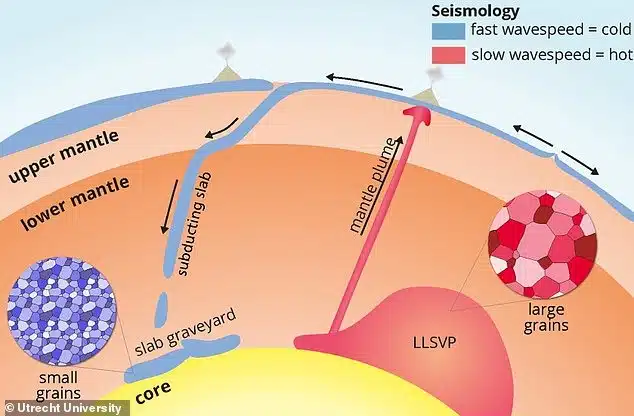
“They appear to be chemically distinct domains that have persisted since the early stages of Earth’s history,” the authors note in Nature. This observation is reinforced by the correlation between low attenuation and low shear wave velocity—two traits that together suggest high density, high temperature, and unique composition.
Their location—directly above the core—has long made them candidates for fueling mantle plumes, deep thermal upwellings that give rise to volcanic hotspots like Hawaii, Réunion, and Iceland. Their size and structure may also play a role in large-scale mantle convection, the engine behind plate motion and continent breakup.
Anchoring Earth’s Interior—And Reshaping Its Surface?
The team’s seismic model not only visualizes these zones but decouples temperature effects from compositional anomalies for the first time at a planetary scale. That capability has broad implications for understanding the geodynamical forces that shape Earth’s surface.
LLSVPs may act as mantle anchors, holding stable positions for hundreds of millions of years and redirecting convection currents. This stability makes them likely players in the long-term cycles of supercontinent formation and dispersal, adding a new layer to plate tectonic theory.
While past models focused on velocity alone, this new attenuation-based method reveals how efficiently seismic energy moves through the mantle—providing crucial insights into its thermal and chemical structure. The study confirms that the zones of lowest attenuation coincide spatially with the LLSVPs, reinforcing the idea that they are compositional anomalies rather than simply hotter areas.
The data also suggest that while most of the mantle undergoes mixing and recycling, LLSVPs remain isolated—functioning as repositories of ancient material and potential sources of volatiles that affect surface climate and biology.
First Appeared on
Source link






