


Scientists Just Found a Tiny Island Hiding a Lost Continent Beneath the Indian Ocean
Scientists have uncovered what appears to be the scattered remains of an ancient continent buried beneath the Indian Ocean. Tiny mineral grains found in the beach sands of Mauritius point to a vanished landmass—named Mauritia—that once sat between India and Madagascar before sinking beneath the waves.
In the grand story of Earth’s moving plates and drifting landmasses, Mauritia may seem like a small detail. The findings, published in the journal Nature Geoscience, provide strong evidence for the existence of a submerged microcontinent. They also show that even on a relatively young volcanic island, geological material dating back billions of years can still reach the surface.
Zircon Grains Too Old to Belong
On the beaches of Mauritius, scientists were studying sand formed by volcanic activity roughly nine million years ago. But within those sands, they stumbled upon something odd: zircon crystals—unimaginably old ones. Some dated back nearly two billion years. The study, published in Nature Geoscience, reveals that those zircons couldn’t have formed on a young volcanic island like Mauritius.
“We found zircons that we extracted from the beach sands, and these are something you typically find in a continental crust,” said Professor Trond Torsvik, who led the research at the University of Oslo.
The crystals, aged between 600 million and 1.97 billion years, clearly didn’t belong to the island’s recent volcanic history. The best explanation? They were remnants of ancient land—ripped from a buried continental fragment and dragged to the surface by magma during a volcanic eruption.
A Sliver From A Broken Supercontinent
To understand where these grains came from, you need to go way back—to a time when Earth’s land was clumped into a giant supercontinent called Rodinia, about 750 million years ago. Back then, India and Madagascar were neighbors. Somewhere in between them, Mauritia once existed, quietly tucked into place, until things began to drift apart.
According to the scientists, the breakup began roughly 85 million years ago, when India started moving northeast. As tectonic forces pulled the plates apart, Mauritia didn’t stand a chance. It fractured, crumbled, and eventually slipped beneath the ocean floor, leaving behind only hints of its former existence.
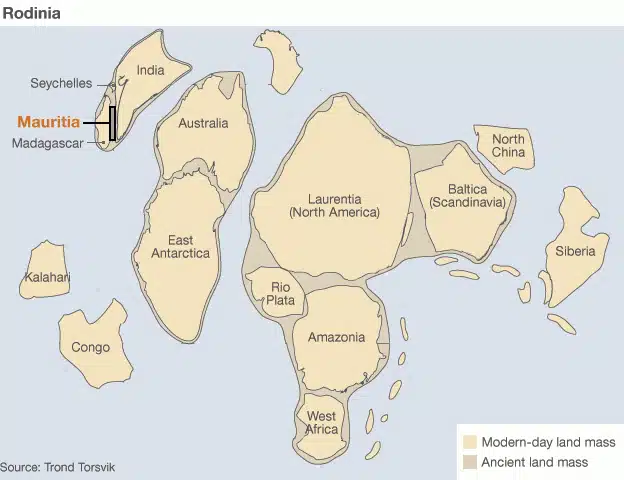
Now, it appears that bits and pieces of that ancient microcontinent may still be down there, beneath Mauritius and perhaps even under the Seychelles, another granitic formation oddly out of place in the middle of the ocean.
What Lies Buried Beneath the Unknown?
The evidence rests in those ancient zircons. But researchers say more data is needed to confirm the full story of Mauritia. Seismic imaging—basically, using sound waves to map what’s under the ocean floor, could reveal whether more chunks of continent are hidden below.
“We need seismic data which can image the structure… this would be the ultimate proof. Or you can drill deep, but that would cost a lot of money,” explained Torsvik in his interview with the BBC.
Drilling into the seafloor could offer even more certainty, though as researchers admit, that kind of work doesn’t come cheap. Still, the possibility of finding more continental fragments, preserved beneath layers of basalt and sediment, continues to drive interest in this forgotten chapter of geological history.
First Appeared on
Source link






