


160-Million-Year-Old Dinosaur Tracks Discovered In Chile’s Atacama Desert
Newly discovered dinosaur footprints in northern Chile are offering scientists a rare window into a world that existed 160 million years ago, when the region’s arid landscape pulsed with cycles of water and life. The find, published in the Swiss Journal of Palaeontology, includes the smallest known theropod tracks ever recorded in Chile, and possibly along the entire western edge of Gondwana.
Traces Of Life In A Desert Long Gone
The fossilized footprints were unearthed in the Atacama Desert, one of the driest places on Earth today. But according to the researchers, it wasn’t always so barren.
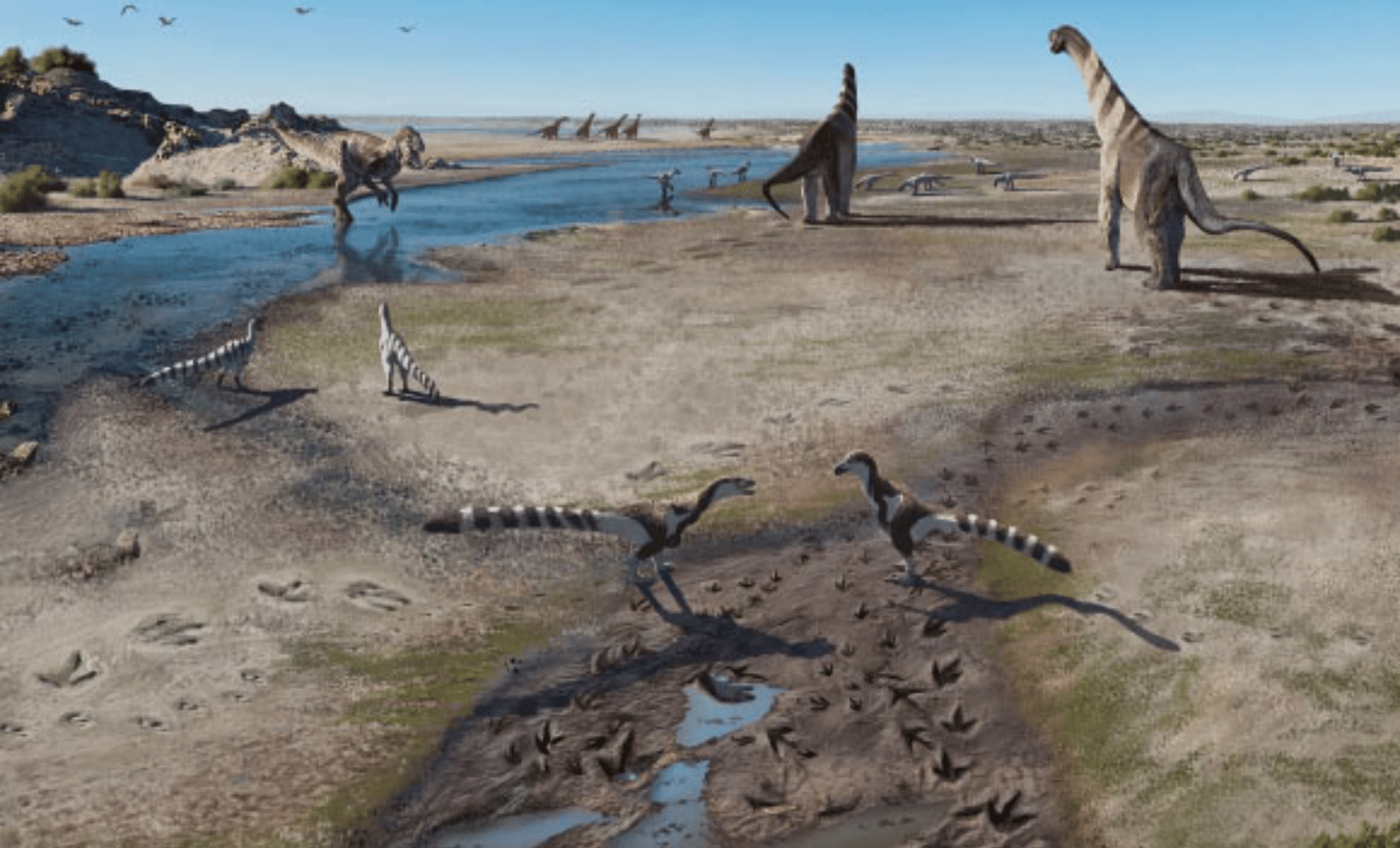
“Around 160 million years ago, northern Chile experienced cycles of flooding and drought,” the researchers explained. “While the climate was largely dry, seasonal water accumulation created ephemeral wetlands that attracted animals of all sizes — from small theropods to massive carnivorous dinosaurs.”
These wetlands, scattered across an ancient desert basin, would have provided temporary oases for dinosaurs roaming through the harsh Jurassic environment. As these animals crossed muddy patches near water sources, they left behind traces of their passage delicate impressions that, against all odds, endured through deep time.
A Moment Frozen In Mud
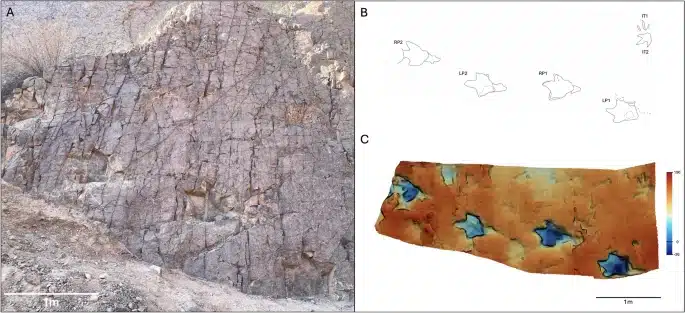
The preservation of these tracks is a story of chance and timing. “As dinosaurs walked across damp mud near these water sources, their footprints were imprinted in the soft sediment,” the scientists noted. “Subsequent flooding gently covered the tracks, preserving them for millions of years.”
The team identified nine footprints, likely from small theropod dinosaurs, arranged in a line that could indicate a single trackway. Although the impressions are faint and fragmented, they retain enough detail for scientists to reconstruct part of the animals’ behavior and environment. The study, published in the Swiss Journal of Palaeontology, uses digital modeling to analyze these subtle forms and estimate the movement patterns of the creatures that left them behind.
The Smallest Theropods Ever Found In Chile
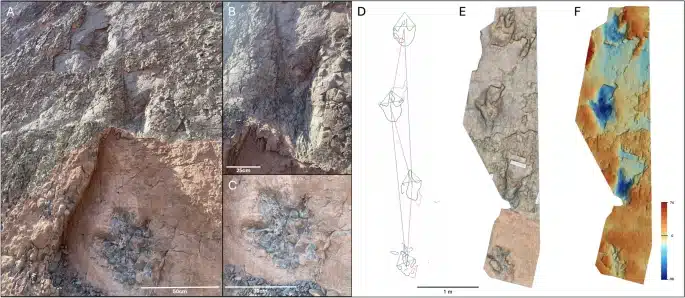
“These footprints constitute the smallest theropod tracks recorded so far in Chile, and possibly across the entire western margin of Gondwana,” the scientists said. The discovery pushes back the known range of small theropods in the region and suggests a more diverse Jurassic ecosystem than previously thought.
The tracks, though poorly preserved, provide invaluable data. “Due to their poor preservation state, quantitative measurements could not be obtained,” the authors said. “Nevertheless, analysis of the digital model enables the inference of the presence of at least 9 footprints that show an alignment which could correspond to a possible trackway.”
The team believes these small dinosaurs could have been juvenile predators or diminutive species adapted to arid, fluctuating conditions. The faint impressions offer a whisper of their movement through a prehistoric landscape that has since turned to stone.
Reconstructing A Lost World
Through sediment analysis and 3D modeling, the researchers reconstructed how the Jurassic ecosystem of northern Chile may have functioned. Seasonal water cycles would have shaped the movements of fauna, concentrating life around temporary ponds and streams. The tracks are evidence of dynamic ecological interactions in what is now a lifeless expanse of sand and salt flats.
By situating these fossils within broader geological data, scientists are piecing together a timeline of changing climates that may have influenced dinosaur evolution across the southern continents. The Swiss Journal of Palaeontology study provides an essential step toward mapping how ancient species responded to extreme environmental variability, a topic that resonates strongly in modern paleoclimatology.
First Appeared on
Source link






