


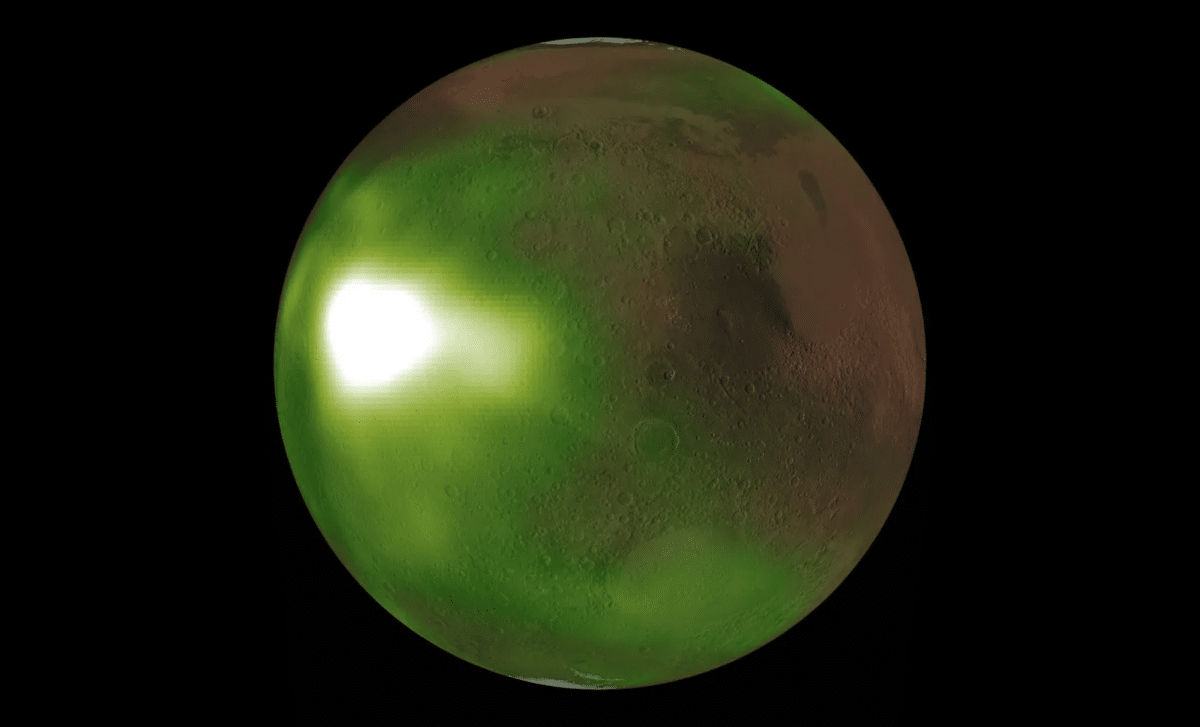
Mars Could Turn Green… And It’s No Longer Just Science Fiction
Advances in synthetic biology, planetary engineering, and ultra-low-cost launch systems have dramatically altered how researchers view Mars terraforming. Once seen as an impossible sci-fi fantasy, greening the Red Planet is now the subject of active scientific debate. A new paper by Erika DeBenedictis and Devon Stork, published on arXiv in October 2025, outlines a phased plan to make Mars more Earth-like and questions whether we’re ready to begin the planet’s transformation.
A Radical Shift From Fiction to Framework
For most of the 20th century, terraforming Mars was dismissed as fantasy, a feat for distant generations, if at all. But recent shifts in technology and scientific modeling have pulled the concept into the realm of plausible research. The study by DeBenedictis, CEO of Pioneer Labs, introduces a multi-stage roadmap for altering Mars’ environment to sustain life, starting with atmospheric warming and ending, possibly, in fully habitable ecosystems.
“Thirty years ago, terraforming Mars wasn’t just hard — it was impossible,” said Erika DeBenedictis. “But new technology like [SpaceX’s] Starship and synthetic biology have now made it a real possibility.”
This evolution in thinking stems from breakthroughs in climate simulation, advances in extremophile microbes, and the promise of cheap interplanetary freight made viable by rockets like Starship. The study encourages science to move beyond theoretical speculation and toward targeted experimentation, beginning with localized tests during upcoming Mars missions.
The paper, titled “An Introduction to Mars Terraforming, 2025 Workshop Summary,” is hosted on arXiv and serves as both a technical proposal and a philosophical prompt. The core idea is to treat Mars not as a sterile relic, but as a potential host for Earth-like life. This pivot, from “Could we?” to “Should we, and how?”, is what defines the modern terraforming debate.
First Step: Warm The Planet And Awaken Water
According to the study, the initial priority is to raise the average Martian temperature by several dozen degrees. This could potentially be achieved through artificial aerosols, greenhouse gases, or targeted radiative heating methods. If Mars’ frozen water reservoirs, some estimated to be enough for a global ocean, are melted, liquid water could become stable on the surface within decades.
Once warmed, Mars could sustain surface-level ecosystems, beginning with genetically-engineered microbes capable of surviving extreme UV radiation, low pressure, and subfreezing temperatures.
“Living planets are better than dead ones,” said study co-author Edwin Kite, associate professor at the University of Chicago. “We now know that Mars was habitable in the past, from data returned by the Mars rovers, so greening Mars could be viewed as the ultimate environmental restoration challenge.”
This environmental vision blurs the lines between exploration and ecosystem design, pushing scientists to think of Mars not only as a site of discovery but as a potential cradle for new biospheres.
Synthetic Biology: The Engine Of Terraforming
At the heart of Mars terraforming is synthetic biology. Researchers propose creating extremophiles, organisms capable of thriving in the hostile Martian environment. These engineered microbes could be seeded across warming regions to begin the slow transformation of the planet’s atmosphere.
“I see humanity as part of the biosphere, not separate from it,” said Kite. “Life is precious — we know of nowhere else in the universe where it exists — and we have a duty to conserve it on Earth, but also to consider how we could begin to propagate it to other worlds.”
This approach reframes terraforming not as a form of conquest, but as a continuation of life’s journey — spreading biospheric presence beyond Earth. The researchers believe that such work could generate insights relevant for solving Earth’s own ecological challenges, especially in developing closed-loop life systems and desiccation-resistant crops.
“If we want to learn how to modify our environment here on Earth, to keep it in a configuration that suits us and other life forms, maybe it would be better to experiment on Mars and say, ‘Look, does this work?’” said DeBenedictis. “I personally would like to be a little more conservative with our home planet. This is the only place we can live.”
Ethical And Scientific Risks
Despite the excitement, not all voices are convinced that terraforming Mars is the right path forward. The study acknowledges significant scientific uncertainties, including how dust storms, subsurface ice layers, or Mars’ own geology would react to sustained warming. There is also the risk of erasing potential evidence of indigenous Martian life, if it exists.
“If we decide to terraform Mars, then we will really change it in ways that may or may not be reversible,” said Nina Lanza, planetary scientist at Los Alamos National Laboratory. “Mars is its own planet and has its own history. When we terraform, then we effectively don’t have the opportunity to study that anymore.”
“If we modify the environment on Mars, we’re going to change the chemistry of the surface and of the subsurface, eventually,” Lanza added. “I can’t say for certain. It’s very complicated, but it’s a risk.”
These ethical concerns shift the conversation from technical possibility to planetary responsibility. Should Mars be left as a record of planetary evolution, or shaped into a new frontier for life? The debate continues to divide planetary scientists, ethicists, and space agencies alike.
First Appeared on
Source link






