


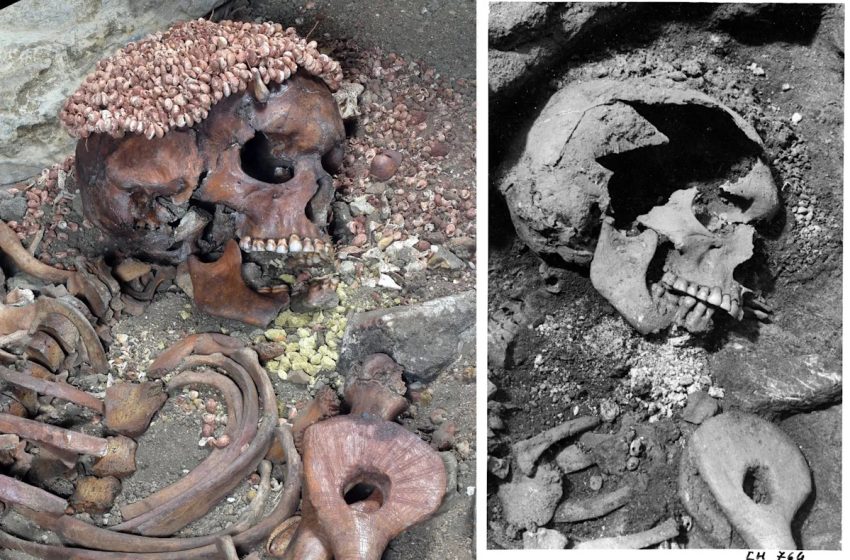
A foraging teenager was mauled by a bear 27,000 years ago, skeleton shows
Early humans were avid, proficient hunters, but they could also become the hunted, living as they did among behemoth megafauna such as leopards, cave bears and saber-toothed tigers. We have little physical evidence of these interactions turning violent, however, because burials were rare and carnivores were more likely to finish off their prey. That’s why the embellished burial site of a 15-year-old from 27,000 years ago is an important window into the past: the teenager’s bones indicate he was mauled by a bear. The finding represents some of the first evidence of its kind.
The remains of the boy, nicknamed “Il Principe” (“The Prince”) because of the bounty found in his burial site, was first uncovered in 1942 in the Arene Candide Cave in Italy. Though scientists first speculated that his death was caused by an animal attack, the claims were never investigated until recently, when researchers reanalyzed the lesions and traumatic injuries using a technique called optic magnification.
The researchers concluded that lesions on the boy’s skull and ankle were bite and claw marks, likely from a cave or brown bear, based on their patterns. “He was probably a budding hunter still learning his skills when this happened,” says lead study author Vitale Stefano Sparacello, a biological anthropologist at the University of Cagliari in Italy. The findings were published in the Journal of Anthropological Sciences.
The animal dislodged the boy’s mandible, left a groove in his skull, broke his clavicle and left a bite mark on his right ankle. Even the boy’s left pinky toe had been fractured. Though we don’t know for sure, Sparacello contends that the injuries are indicative of a bear who would have viewed the boy as more of a menace that needed to be neutralized than a meal because these bears mostly ate plants.
The “Il Principe” burial, as displayed at the Museo di Archeologia Ligure in the Pegli neighborhood of Genoa in Italy.
From “New Signs of Skeletal Trauma in the Upper Paleolithic Principe from Arene Candide Cave (Liguria, Italy) Bear Novel Insights into the Circumstances of His Death,” by Stefano Sparacello et al., in Journal of Anthropological Sciences, Vol. 103; 2025
The lack of bone healing at the clavicle shows that the boy likely suffered with his injuries for days before succumbing to them.
The elaborate nature of the burial site, adorned with a handwoven shell cap atop the boy’s head, along with shells, knives and all sorts of other ritual objects, may have been intended to ward off future evil events like the one that sealed this boy’s fate. “These burials are as much about the living as they are about the dead,” says Christopher J. Knüsel, a biological anthropologist at the University of Bordeaux in France, who was not involved in the study.
The findings provide a firsthand look at the boy’s final agonizing days, says Lawrence Straus, a professor emeritus in anthropology at the University of New Mexico, who was not involved in the study. “This is a glimpse into the humanity of those who lived during the last ice age,” he says.
First Appeared on
Source link






