


Middle East crisis live: strait of Hormuz remains closed over Israel’s attacks on Lebanon, Iranian state media say | Iran
Iran closes strait of Hormuz in response to Israeli attacks on Lebanon – state media
Iran has closed the strait of Hormuz in response to Israel’s attacks on Lebanon today despite the ceasefire, Iranian state media reports, with Iran’s authorities said to be treating the strait as still closed.
The hours-old two-week conditional ceasefire agreed between the US and Iran had a provision for the temporary reopening of the crucial maritime channel. Effectively, the strait has remained closed as traffic had not immediately increased inthe hours after the ceasefire announcement.
Tehran said on Wednesday that it would offer safe passage in coordination with its armed forces, though its coast guard said any ship trying to transit without permission would be “targeted and destroyed”.
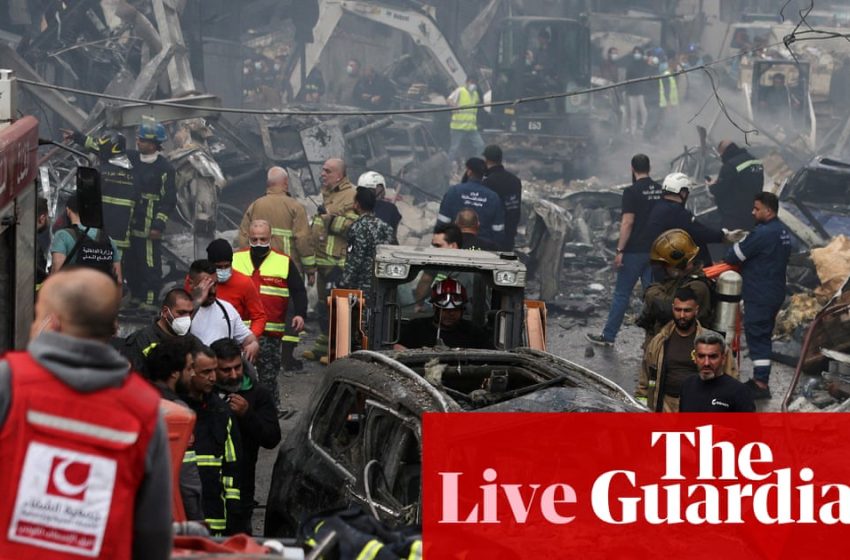
Israel has launched huge strikes across Lebanon today, killing over 250 people, with Trump later clarifying that Lebanon wasn’t included in the ceasefire deal.
Key events
-
Two-week ceasefire a ‘victory’ for the US, White House says
-
Qatar condemns Israel’s ‘barbaric massacres and repeated attacks’ on Lebanon as ‘flagrant violation of international law’
-
Death toll from Israeli attacks across Lebanon on Wednesday rises to 254
-
Iran closes strait of Hormuz in response to Israeli attacks on Lebanon – state media
-
The day so far
-
‘A step back from the brink’: European leaders welcome US-Iran ceasefire
-
Erdogan warns of ‘sabotage’ threat to ceasefire
-
Lebanon not included in ceasefire deal, says Trump
-
Iranian navy threatens ships in strait of Hormuz without permission
-
Analysis: US haste could offer opportunity to Iran
-
Israel is killing unarmed civilians in Lebanon, says Lebanese PM
-
Iran to hand over enriched uranium or US will ‘take it out’ – Hegseth
-
US military objectives achieved, says Caine
-
Hegseth: Iran ‘begged’ for this ceasefire
-
Summary of developments so far
-
Ten ships sail through strait of Hormuz, says AXSMarine
-
Iran will cease uranium enrichment, Trump claims
-
Ship movements resume in strait of Hormuz after ceasefire announcement, says MarineTraffic
-
Lebanon president calls for inclusion of his country in ‘regional peace’
-
Vance: Iran ceasefire a ‘fragile truce’
-
Pakistan PM says Iran has confirmed it will take part in talks in Islamabad
-
Iran president says ceasefire in line with ‘general principles desired by Tehran’
-
IDF tells residents of southern suburbs of Beirut to flee after announcing continued combat and ground operations
-
Oman foreign minister urges both sides to return to negotating table
-
Will the ceasefire see a resumption of pre-war shipping on the strait of Hormuz?
-
Israeli military ‘continues fighting and ground operations’ against Hezbollah in Lebanon, IDF says
-
‘Now it’s time for diplomacy, legality and peace’, says Spanish PM
-
Analysis: US learns a hard lesson about the folly of war
-
‘Unthinkable escalation has been avoided, but the ceasefire is not yet definitive’, says Spanish foreign minister
-
Jet fuel supplies ‘will take months’ to recover, says IATA chief
-
Keir Starmer says ceasefire ‘will bring a moment of relief to the region and the world’ as he heads to the Middle East
-
Interim summary
-
Ceasefire a ‘political disaster’ says Israel’s opposition leader
-
Analysis: Trump’s ‘deal’ is a huge strategic failure for the US
-
Donald Trump claims ‘a big day for world peace’
-
Israel says ceasefire does not include Lebanon
-
Summary
Leavitt says Trump’s red lines, namely the end of Iranian enrichment of uranium, have not changed.
Israel’s prime minister Benjamin Netanyahu is also giving a statement to the media now, I’ll bring you the key lines from that after the White House press briefing wraps up.
Leavitt also calls Tehran’s 10-point proposal “fundamentally unserious, unacceptable and completely discarded”.
Iran then put forward a “more reasonable and condensed plan”, which Trump and his officials determined was “workable”.
Two-week ceasefire a ‘victory’ for the US, White House says
Leavitt calls the ceasefire a “victory” for the United States.
She frames the ceasefire as in line with Trump’s “four-to-six-week” timeline for the war, touts the US’s military capabilities and says the operation “achieved its core military objectives in just 38 days”.
That includes “destroying Iran’s defence-industrial base, crushing the regime’s ability to manufacture weapons,” she claims, adding that Iran’s ability to build and stockpile ballistic missiles and long-range drones has “been set back years”.
Qatar condemns Israel’s ‘barbaric massacres and repeated attacks’ on Lebanon as ‘flagrant violation of international law’
Qatar has condemned “the brutal series of Israeli airstrikes that targeted vast areas in Lebanon” today that, per my last post, have killed at least 254 people and wounded 1,165.
In a statement, Qatar’s foreign ministry added that it considered the attacks “a dangerous escalation and a flagrant violation of the sovereignty of the sister Lebanese Republic, the rules of international humanitarian law, and United Nations Security Council Resolution (1701)”.
The Ministry of Foreign Affairs calls on the international community to fulfill its responsibilities by compelling the Israeli occupation authorities to halt their barbaric massacres and repeated attacks on Lebanon, and to hold them accountable for respecting international covenants and laws.
The White House press secretary, Karoline Leavitt, is due to brief reporters shortly. I’ll bring you all the key lines here.
Death toll from Israeli attacks across Lebanon on Wednesday rises to 254
Israeli attacks have killed at least 254 people and wounded 1,165 across Lebanon today, according to Lebanonon’s civil defence.
Al Jazeera has this breakdown by area:
-
Beirut: 92 killed, 742 injured
-
Southern suburbs of Beirut: 61 killed, 200 injured
-
Baalbek: 18 killed, 28 injured
-
Hermel: 9 killed, 6 injured
-
Nabatieh: 28 killed, 59 injured
-
Aley district: 17 killed, 6 injured
-
Sidon: 12 killed, 56 injured
-
Tyre: 17 killed, 68 injured
Iran closes strait of Hormuz in response to Israeli attacks on Lebanon – state media
Iran has closed the strait of Hormuz in response to Israel’s attacks on Lebanon today despite the ceasefire, Iranian state media reports, with Iran’s authorities said to be treating the strait as still closed.
The hours-old two-week conditional ceasefire agreed between the US and Iran had a provision for the temporary reopening of the crucial maritime channel. Effectively, the strait has remained closed as traffic had not immediately increased inthe hours after the ceasefire announcement.
Tehran said on Wednesday that it would offer safe passage in coordination with its armed forces, though its coast guard said any ship trying to transit without permission would be “targeted and destroyed”.
Israel has launched huge strikes across Lebanon today, killing over 250 people, with Trump later clarifying that Lebanon wasn’t included in the ceasefire deal.
The day so far
-
The Pentagon “for now, for now, has done its part”, the US defense secretary, Pete Hegseth, said on Wednesday during a news conference. “We stand ready in the background to ensure Iran upholds every reasonable term.” Hegseth praised the “bravery and sheer guts” of the US military and said the operation had hobbled Iran’s regime.
-
Hegseth said that Iran will give the US its enriched uranium or else the US will “take it out”. He said the “new Iranian regime” has a different interaction with America than before.
-
World leaders have welcomed the announcement by the US and Iran of a two-week ceasefire, with Tehran agreeing to allow the safe transit of vessels through the strait of Hormuz.
-
The ceasefire that was brokered by Pakistan has been hailed a victory by both sides. Donald Trump repeated the claim that the war has achieved regime change in Iran, while officials in Tehran said the general principles “desired” by Iran were accepted in the ceasefire deal.
-
The prime minister of Lebanon, Nawaf Salam, has accused Israel of killing unarmed civilians in Lebanon and attacking densely populated areas, particularly in the capital city of Beirut. His remarks follow a statement by the Israel Defense Forces (IDF) that it carried out its largest wave of strikes against what it described as Hezbollah targets in Lebanon since the war began on 2 March.
-
The US president said Iran will cease uranium enrichment – a condition that Tehran has previously refused to budge on – and that his country will “work closely’ with Iran. In a post of his Truth Social app, Trump also warned countries supplying weapons to Iran that they will face a 50% tariff on any and all goods “effective immediately”.
-
Lebanon is not part of the two-week ceasefire deal, Trump has told the media. Speaking on the phone with PBS News Hour’s Liz Landers, Trump is reported to have said the Israel-Lebanon conflict is a “separate skirmish”, adding: “Yeah, they [Lebanon] were not included in the deal.”
-
The Iranian navy threatened ships attempting to pass through the strait of Hormuz without Tehran’s permission with destruction, adding that transit through the waterway remained shut, according to several shipping sources. “Any vessel trying to travel into the sea … will be targeted and destroyed,” the message said.
-
The Israeli government and military said the ceasefire does not include Lebanon, where the Israel Defense Forces (IDF) have continued their strikes against the Iran-backed Hezbollah militant group. The IDF ordered people in the southern suburbs of Beirut to flee their homes yet again, as Israeli airstrikes pummelled Beirut and the outskirts of the Lebanese capital.
-
Israel’s defence minister, Israel Katz, said the military had carried out a surprise attack on Wednesday targeting hundreds of Hezbollah members across Lebanon. “The IDF carried out a surprise strike on hundreds of Hezbollah terrorists at command centres across Lebanon. This is the largest concentrated blow Hezbollah has suffered since Operation Beepers,” Katz said in a video statement, referring to a major 2024 operation against Hezbollah involving pager bombs.
-
A US official said Wednesday that a 10-point ceasefire plan published by Iran is not the same set of conditions that were agreed to by the White House for pausing the war. “The document being reported by media outlets is not the working framework,” the senior official told AFP on condition of anonymity.
-
Pakistan said Iran has confirmed it will participate in talks with the US aimed at resolving the conflict. The Pakistani prime minister, Shehbaz Sharif, said he had invited US and Iranian delegations for talks in Islamabad on Friday.
-
The US embassy in Baghdad warned citizens on Wednesday of further attacks after it said Iran-backed armed groups hit a diplomatic support centre at the airport. “Iraqi terrorist militia groups aligned with Iran conducted multiple drone attacks in the vicinity of the Baghdad Diplomatic Support Center and Baghdad International Airport on April 8,” the embassy said in a statement on X.
The Israeli military said it struck a Hezbollah commander in Beirut on Wednesday, after Lebanese state media reported that Israel had targeted a residential neighbourhood in the capital.
“A short while ago, the IDF struck a Hezbollah commander in Beirut,” the military said, without identifying the target.
‘A step back from the brink’: European leaders welcome US-Iran ceasefire
Jennifer Rankin
European leaders have welcomed the US-Iran ceasefire deal, while calling for the reopening of the strait of Hormuz and a permanent end to hostilities, including in Lebanon.
The US and Iran agreed a two-week conditional ceasefire on Tuesday, including a temporary reopening of the strait of Hormuz, after last-minute diplomacy from Pakistan. The Israeli military said on Wednesday, however, that it was continuing “fighting and ground operations” in its war against the Lebanese militia Hezbollah, despite a statement from mediator Pakistan that Lebanon was included in the ceasefire.
France’s president, Emmanuel Macron, welcomed the ceasefire, but called for Lebanon, a former French protectorate, to be included in the deal. He said about 15 countries were mobilised “under French leadership” to facilitate the resumption of traffic through the strait of Hormuz, where around one-fifth of the world’s oil flows.
Spain’s prime minister, Pedro Sánchez, who has been the most outspoken western critic of Donald Trump’s war in Iran, issued a typically blunt reaction, saying his administration “will not applaud those who set the world on fire just because they show up with a bucket”.
In a post on X he said: “Ceasefires are always good news – especially if they lead to a just and lasting peace. But this momentary relief cannot make us forget the chaos, the destruction, and the lives lost.”
You can read the full report here:
The US and Iran have agreed to a two-week conditional ceasefire, thanks to a last-minute diplomatic intervention led by Pakistan.
The conditions include a temporary reopening of the strait of Hormuz, but Israel’s position was left unclear, with airstrikes continuing on the Lebanese capital of Beirut.
Both sides have since claimed victory but who, if anyone, is the real winner here?
Lucy Hough speaks to senior international reporter Peter Beaumont…
First Appeared on
Source link






