



10 bold MLB predictions for 2026: Roman Anthony for MVP, the return of Mike Trout and more
It’s prediction season. But these aren’t your run-of-the-mill predictions. These are bold predictions, which are aiming for a different success rate. Let’s say your standard predictions hope to be right six out of 10 times — they’ve got to beat a coin flip, after all — then these bold predictions are looking to be right about half as much as that.
What is the point of batting .300 when that success rate isn’t necessarily rewarded? Every year, crazy things happen. Last year, Cal Raleigh went from good to elite. Geraldo Perdomo put up an MVP-level season. Maikel Garcia broke out the year after he was boldly predicted to do just that.
The aim is to expand our minds to catch these potential edge cases. Maybe we’ll learn something along the way.
Roman Anthony wins AL MVP
The one knock on Anthony as a Boston Red Sox prospect was that he hit too many ground balls. That was definitely true at the lowest levels, but then he went to work on his swing path and hit a few more balls in the air at every level he reached. Still, a 50 percent ground-ball rate doesn’t seem to presage a big power hitter.
That notwithstanding, he swings the bat really hard, and when he does put the ball in the air, it goes really far. Though the science of giving batters ‘bat path grades’ based on their swing characteristics is in its infancy, Anthony does well there. Over at Driveline Baseball, they used the publicly available Statcast bat-tracking metrics to create a suite of grades evaluating hitters’ swings for their ability to make contact and hit for power, and then in an overall capacity.
Here are the best bat path grades last year for players 26 and under with at least 200 MLB swings.
Best Bat Path Grades Under 26
There a lot of good players on here, but you might notice that some have bat paths that don’t lend themselves to a ton of contact. This is on the 20-80 scouting scale, so Anthony actually joins an even smaller list when you consider that he should have above-average ability to make contact (45+) while also having elite power (60+). Now he starts to look a lot like a Junior Caminero who has the potential to put up better defensive numbers in the outfield.
Of course, he also has some commonalities with Jordan Walker. And only two players have ever won the MVP in their second season. That’s what makes this bold.
Royals offense is top-10
In 2024, my bold prediction was the Kansas City Royals to make the playoffs on the strength of their emerging young offense. Bold Predictions HQ took a win on that one despite the fact that their playoff berth was more due to pitching than anything else. But we’re going back to the well and being more specific this time. The offense. It’s ready to bust out.
Bobby Witt Jr. leads a strong young core for the Royals. (Scott Marshall / Getty Images)
Bobby Witt Jr. was a top-30 hitter last year and hit for more power the two years before. He’s 25. Garcia is fresh off a great run in the World Baseball Classic, was one of 23 players last year with a hard hit rate over 45 percent and a strikeout rate under 20 percent. He’s 26. Vinnie Pasquantino also had a good run in the WBC and was just outside the top 50 hitters in the second half last year after some adjustments to his stance. He’s 28. Jac Caglianone, Junior Caminero, Vladimir Guerrero Jr. and Julio Rodríguez were the only players last year to swing the bat faster than 76 mph and strike out at a less than league average rate. Caglianone is 23. Carter Jensen has a near 75-mph swing and struck out less than 20 percent of the time last year. He’s 22.
The Royals have a young core in their prime years with an enticing ability to hit the ball hard while making contact. And they’ve recently added intriguing veterans like Isaac Collins, Lane Thomas, Jonathan India and Starling Marte. Salvador Perez will always be there for them, it seems. Most projection systems finally give them nine above-average hitters. One projection system — PECOTA from Baseball Prospectus — gives them the best offense in their division.
So why is this bold? Last year, their park-adjusted offense ranked 22nd. Even if it was 11th-best in the second half, they’ve only twice had a top-10 lineup in the last 35 years. You know what happened one of those years.
Mets ride MLB’s best pitching depth to NL pennant
At the beginning of any season, the instinct is to look at Opening Day starters and the first five in a rotation and debate the relative strengths of each rotation based on those five pitchers. But a sixth starter throws, on average, more than 100 innings. Teams use around 10 starters to get through the season, on average. Those depth innings matter a lot.
And the New York Mets might have the best pitching depth in baseball.
Best depth starters by team
| Team | ERA | K-BB% | Number |
|---|---|---|---|
|
3.85 |
14.4% |
5 |
|
|
4.22 |
14.2% |
5 |
|
|
4.01 |
13.7% |
6 |
|
|
4.40 |
13.7% |
4 |
|
|
4.08 |
13.6% |
5 |
Using OOPSY projections from FanGraphs, this looks at all starters not in the top five for their teams who are projected to start at least three games in 2026. With Sean Manaea, Jonah Tong, Tobias Myers, Christian Scott and Jonathan Pintaro, the Mets have the best depth by projected strikeouts minus walks (and ERA, but there are park factors in those). Even if Manaea’s velocity is down and Tong’s spring wasn’t grand, Myers is a young capable veteran and Scott has shown why everyone loved him before surgery.
Britt Ghiroli loves Scott on Rates & Barrels, too, naming him one of her breakout picks for the year. Looks like he could be the latest key cog to demonstrate how much progress Mets pitching development has made over the last few years.
Mike Trout is back
Well not back back. The future Hall of Famer isn’t going to go back all the way to the vintage 10-win production of his early career. But there are indications that Mike Trout is back.
The legs look like they are back, at least. Trout posted a 29.9 feet-per-second sprint speed this spring. According to MLB.com, that was his fastest sprint speed since he tore the meniscus in his left knee in late April 2024.
“I feel great,” Trout told MLB.com’s Rhett Bollinger. “29.9? Huh. I’m going to get to 30. Because I got more in the tank. But the 29.9 surprised me.”
Last year was his worst for sprint speed, as he dropped to the 62nd percentile. Running well again, at a time when he’s going back to playing center field more, will likely be good news for his defensive numbers. The stat may not be predictive of stolen base success, and has an element of hustle in its nature, but it can at least tell us that he’s running faster, on average, this spring.
That’s good news because he’s never really lost the bat speed or the quality of contact numbers. He was 93rd percentile in Barrels last year, 77th percentile in Bat Speed, 85th percentile in Hard Hit rate.
Can he stay on the field? Who knows. Last year was only the second time in the last five seasons that he exceeded the 100 games played mark. Will he strike out as much as he did last year? Maybe. He is 34, and that’s what happens to your strikeout rate as you age.
But if he can stay on the field, his legs may be under him for the first time in a while. And that could push him to his first four-win season since 2022.
Reds win a playoff game at home
The Cincinnati Reds haven’t won a playoff game at home since 1995. Since then, every other team in baseball has at least one. Is the time finally right?
It’s weird timing, because Hunter Greene just had surgery that will keep him out of most, if not all, of the first half. But this is a great staff that’s projected to be among the best in baseball by at least one metric.
Best Starting Rotations by Stuff+
| Team | Starter Stuff+ |
|---|---|
|
109 |
|
|
107 |
|
|
105 |
|
|
104 |
|
|
104 |
“Everybody’s different,” Nick Lodolo said this spring. “Every day someone’s gonna get a different look.”
“We have a good mix of guys,” Rhett Lowder added. “You’ve got stuff, you have location, and game planning and then angles. You have a little bit of everything with this group.”
Young fireballer Chase Burns echoes that sentiment, and emphasizes that this year he is going to get more comfortable with his kick-change and throw it more. Lowder is happy to be healthy and learning from Brady Singer, who he thought had a similar arsenal and was a strike-thrower he could learn from. Lodolo is working on giving his breaking ball different looks this year. Brandon Williamson made the Opening Day roster with much-improved stuff given the extra two ticks he’s playing with and the new cutter shape.
This group was already second in baseball by FanGraphs WAR last year. What’s the reason for added optimism?
Maybe it’s that the offense mimics the rotation in terms of versatility and different looks.
“We’re trying to gain enough offense without sacrificing defense,” manager Terry Francona said, pointing to Spencer Steer as a key cog.
Left without a natural home on the infield due to the emergence of Sal Stewart’s bat and the acquisition of Ke’Bryan Hayes’ glove, Steer’s ability to work some at first and second and left field was something Francona thought would be huge.
“There’s a lot of versatility with this team and a lot of different options,” Steer said. “You can play a lot different matchups for sure. For me, I think my focus is preparing at multiple different positions and wherever they put me, I want to feel prepared.”
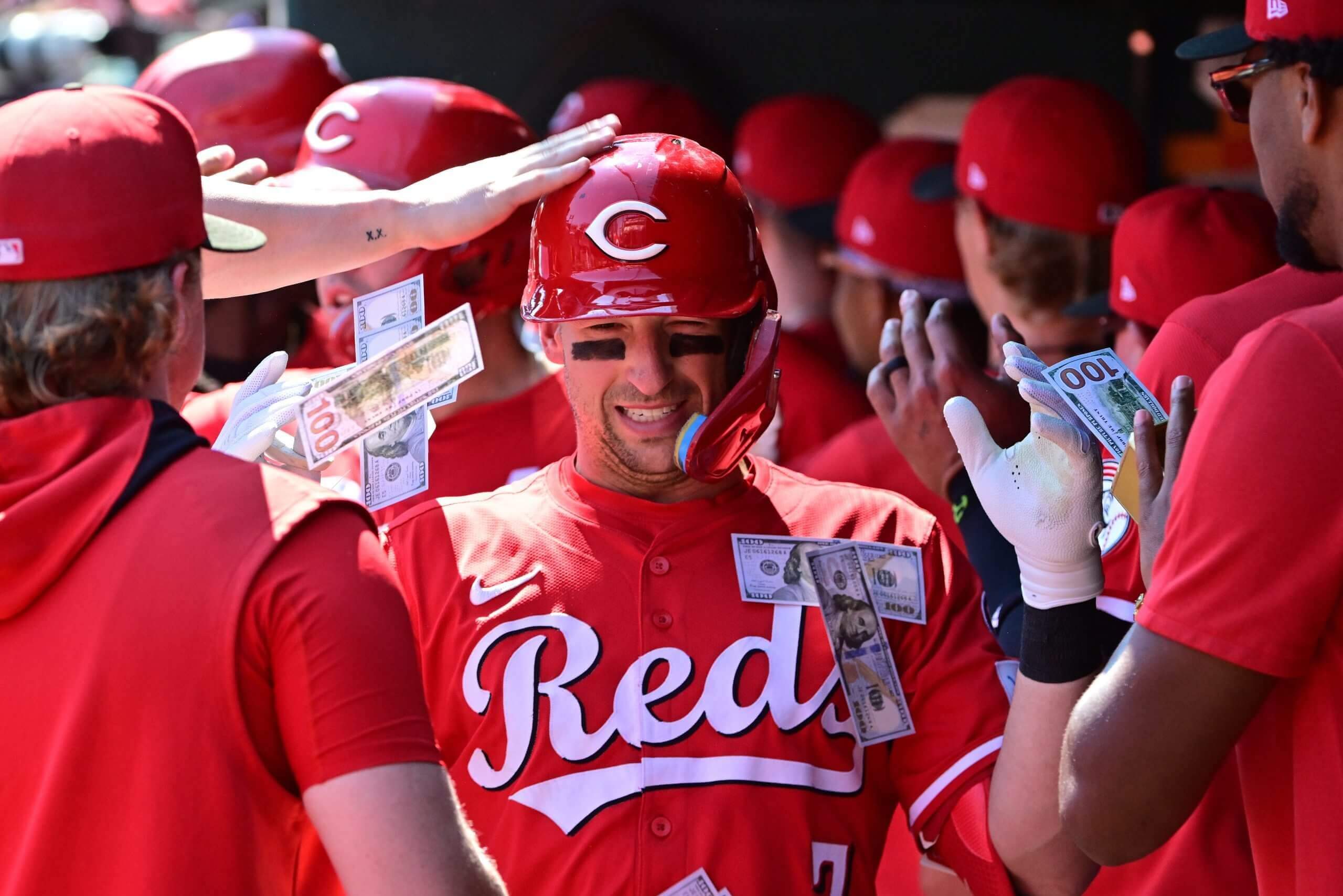
Spencer Steer’s versatility makes him a money player for Terry Francona’s Reds. (Tim Vizer / Imagn Images)
Look around this depth chart now, and there are multiple viable players at each position, including a superstar at shortstop. That gives Francona a lot of different ways to navigate the season.
Drake Baldwin emerges as MLB’s top catcher
This guy does everything right. Seriously, Baldwin does not have an obvious flaw. The 24-year-old Atlanta Braves catcher has pristine peripherals.
Like guys who make contact? He’s top quartile in swinging strike rate and strikeout rate.
Like guys who swing the bat fast? Top 10th percentile there.
Like guys who make good decisions at the plate? Top third of the league when it comes to swinging at strikes and not at balls, in his rookie year. Players usually take more pitches as they age, too.
OK, he’s not the greatest defender, rating a little below average by most metrics, including framing. He’s projected for the least amount of defensive value among the best 15 or so catchers in the big leagues, and this should prevent him from putting up the most Wins Above Replacement among catchers.
But you know who else was a below-average defender with mediocre framing stats in his first season in the big leagues? Cal Raleigh.
A new live-ball era stolen base record is set
In 2024, major leaguers stole 3,617 bases with the new base-running rules in place. That was the most since 1915.
That number decreased dramatically (by 2,000) last season. Why?
It probably has to do with the first base coach, who has increasing control over the running game these days.
“Modern managers seem to favor the first base coaches controlling the running game from the box,” an NL coach said. “The changes in the disengagement rules have led teams to run more based on tip/tells (first base coach homework) versus count/outs/inning/score (manager discretion).”
Why would there be a surge, and then some regression? Maybe the league has caught up to the most aggressive, successful first base coaches.
Those teams “are largely due for some regression,” the coach surmised. “They largely capitalized on negligence. They’ve lost some of the element of surprise.”
That’s why there might have been some regression, and here’s why there might now be a second surge. There was a ton of turnover at the first base coach position this offseason.
Seventeen teams will have a new first base coach. Of those 17, 14 will be in the position for the first time. The White Sox have a new first base coach, and they were 24th in stolen bases last season. They are second in stolen bases this spring. The Rockies were down the list last year and are third in stolen bases this spring. The Marlins, also with a first-time first base coach, are in the top five this spring.
It seems like the new blood thinks there’s more juice to squeeze out of those bigger bases.
Jacob Misiorowski wins the NL Cy Young
Everyone knows Misiorowski throws super hard, and that he lacks command. Even he laughed about that this spring. Last year, the mid-90s slider was the key to unlocking his best starts. Not only could he command that pitch the best, but it also kept him in the right form mechanically for other pitches.
“Everything kind of plays well off of the slider,” Misiorowski said. “I always have that to get me back in line of like, OK, this is what my delivery is doing wrong, I’m getting a little too long.”
The release on the pitch helps remind him to get all of his body parts to the front side easily and smoothly. He spent the offseason doing core work to reinforce that feeling, working the water tanks like Paul Skenes, among other drills. All this to reinforce good habits.
Then he played around a little with his changeup for a new wrinkle, moving his middle finger further and further off the ball until he found a spot he liked.
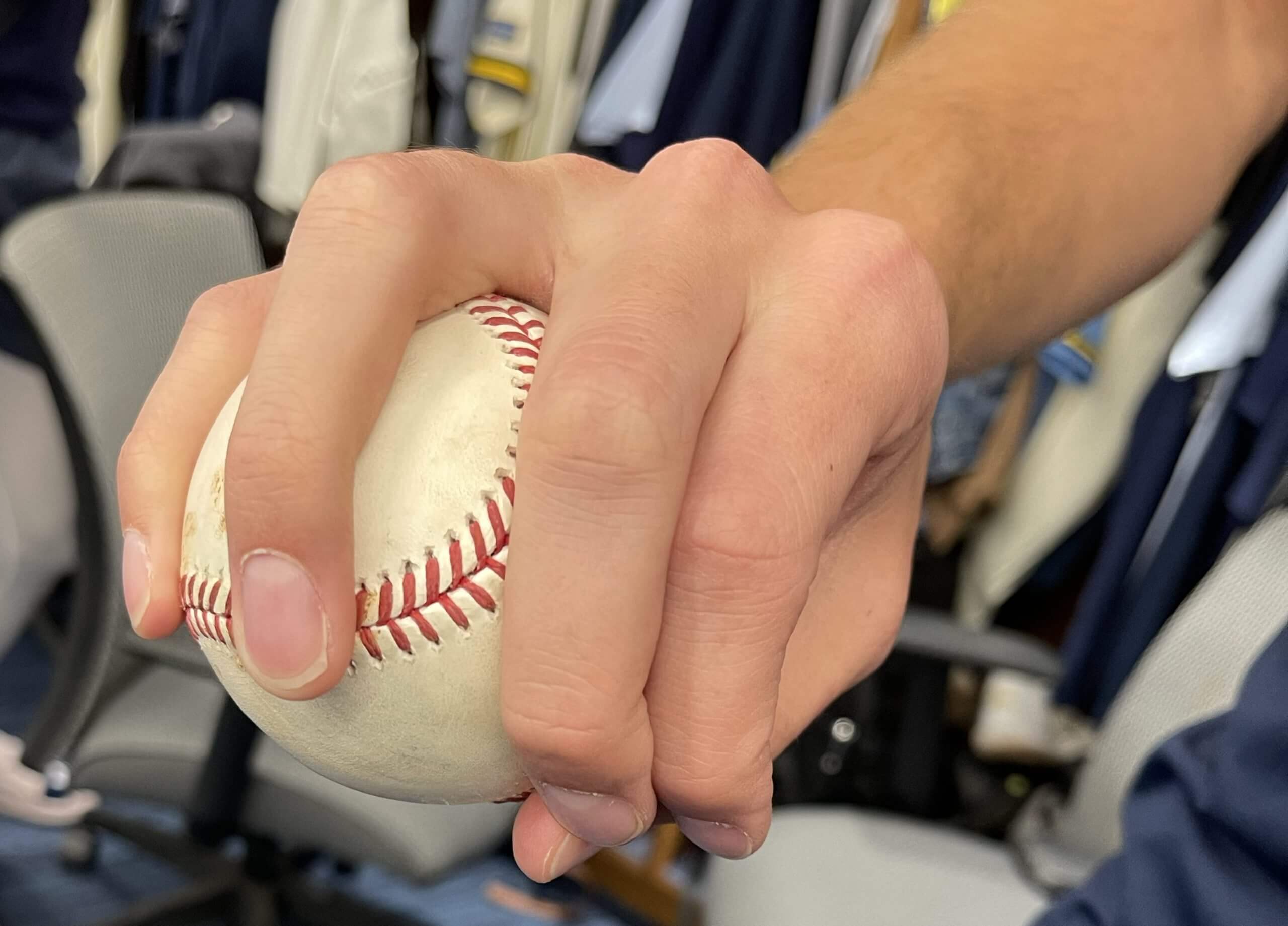
Jacob Misiorowski’s changeup grip. (Eno Sarris / The Athletic)
“It’s a double circle!” he said with his ubiquitous smile.
Usually pitchers will take their index finger off the ball with that circle, but he’s taken it a step further. He’s pleased with the results so far, pointing out a changeup against Great Britain that had four more inches of sideways movement and four more inches of drop than he averaged last year. The difference, in sum, so far this spring is much smaller, and there’s no video of the changeups he referenced, but an even nastier power changeup would add yet another dimension to his arsenal.
But the slider, and the associated command, will still be the key to it all.
Cam Smith breaks out
Baseball has a lot of learned skills that need to be refined. That’s true. But it really helps to start that process as an athlete. And Smith is an athlete.
Young Dudes Who Run Fast & Swing Fast
| Player | Age | Swing Speed | Time to First |
|---|---|---|---|
|
27 |
78.8 |
4.26 |
|
|
25 |
76.4 |
4.29 |
|
|
23 |
76.0 |
4.23 |
|
|
26 |
75.9 |
4.33 |
|
|
24 |
75.3 |
4.22 |
|
|
25 |
74.7 |
4.13 |
|
|
23 |
74.5 |
4.30 |
|
|
23 |
74.5 |
4.36 |
|
|
25 |
74.3 |
4.15 |
|
|
25 |
74.3 |
4.28 |
It’s good to be on a list of pre-peak players who run fast and hit fast, and Smith is in the top third of the league in both. He even adds a plus arm, with 88th percentile arm strength. The way forward for him will be in his pitch selection, which was not a strength, but also not terrible last year. He’s chasing less this spring, which counts as only a small good sign.
The biggest thing that Smith needs, though, is time and reps. He famously only had 134 plate appearances in the minors before coming up last season, and then only 493 in the majors last year. At some point, the approach is going to click, and Smith will likely be a great player with power, speed and defense. Maybe this year is too soon, but we’re trying to keep it bold here.
Justin Wrobleski outproduces Blake Snell
There have been positive spins on Snell’s progression along the way, but some of the quotes are fairly alarming.
“Every throw kind of hurt,” Snell said about his first throwing sessions this spring.
“I was throwing 87 to 89 (mph),” he said a week ago about his first bullpen.
Snell is only now beginning his progression, but he could work through it and be available by May, and give his customary 100 or so innings. He’d still be good, he put up nearly 2 WAR of value last year in 61 1/3 innings, and over 3 WAR in 104 innings the year prior. But his absence will likely give Wrobleski a head start. And the younger Los Angeles Dodger lefty has been putting up good innings totals while refining a strong arsenal of pitches with stuff that he can command. Here’s a look his spring arsenal through the lens of Stuff+ and Location+.
Justin Wrobleski’s Arsenal
| Pitch | n | S+ | L+ |
|---|---|---|---|
|
Four-Seam |
60 |
95 |
134 |
|
Slider |
43 |
109 |
127 |
|
Cutter |
19 |
96 |
119 |
|
Changeup |
13 |
108 |
90 |
|
Curve |
5 |
108 |
137 |
|
Sinker |
5 |
91 |
152 |
The emphasis is on the above-average stuff numbers, because they become meaningful in the tiniest of samples, and location data takes longer (100 is average for all pitches, but the average four-seamer by a starter had a 95 Stuff+ last year). It looks like a nice, wide, stable arsenal with just enough strength on the fastballs to compete. Stability will be something that this Dodgers rotation may need as they encounter their yearly bouts with injury.
First Appeared on
Source link






