


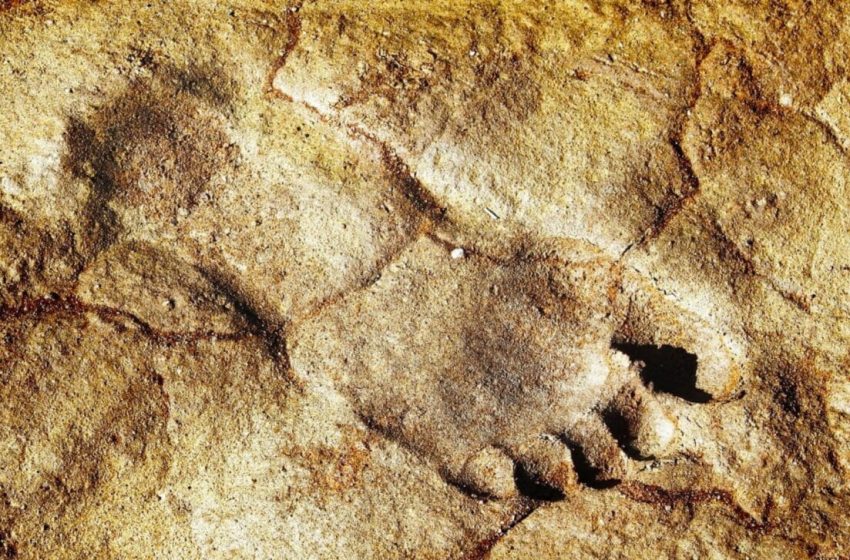
115,000-Year-Old Human Footprints Found in Remote Desert Where They Shouldn’t Exist
The arid expanse of the Nefud Desert in the northern Arabian Peninsula currently holds some of the most hyper-arid conditions on Earth. However, the geological record indicates that this landscape underwent radical transformations during the late Pleistocene. Intervals of increased monsoon rainfall periodically converted these dunefields into a network of lush grasslands and perennial freshwater lakes.
For decades, the specific timing of human movement into these interior regions remained a subject of intense debate among paleoanthropologists. While stone tools suggested a presence, the lack of organic remains or direct dating often left the chronology of early human expansion into Arabia undefined. The discovery of preserved surfaces at ancient lakebeds has recently provided a more precise method for tracking these movements through the fossil record.
One specific site, known as Alathar, has yielded a rare preservation of a single moment in time from 115,000 years ago. At this location, the fossilized impressions of humans and large mammals were found set into the ancient mud of a drying pool. These traces offer a high-resolution view of the faunal diversity and human presence during a brief window of habitability in the Arabian interior.
Archaeological Analysis of the Alathar Trackway
The Max Planck Institute for Chemical Ecology announced the discovery of seven human footprints at the Alathar lakebed. These traces date to approximately 115,000 years ago, based on luminescence dating of the sediment layers. This finding represents the earliest documented evidence of Homo sapiens in this region of the Arabian Peninsula.
The research team identified 376 tracks in total at the site, though only seven were confirmed as human. The remaining 369 tracks belong to ancient animals, including elephants and camels. These footprints were preserved in a layer of lake carbonate that formed during a humid period in the late Pleistocene.
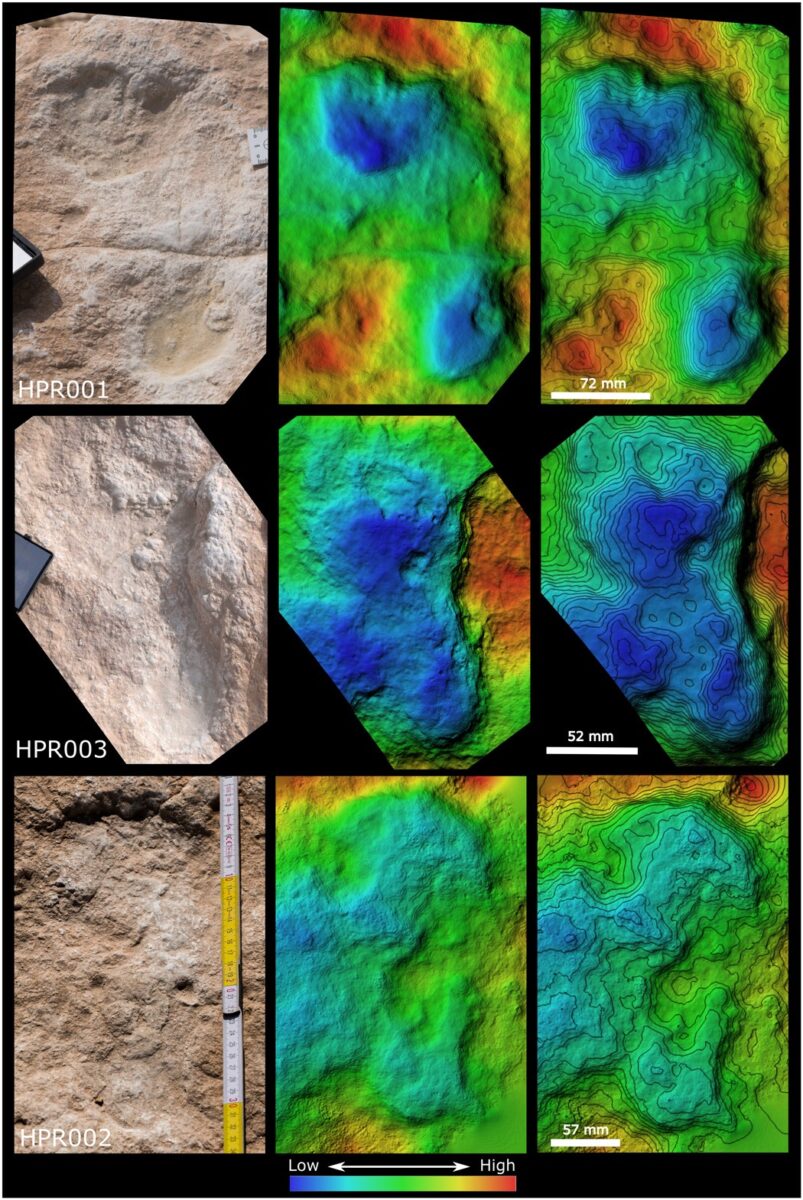
Archaeological surveys at the Alathar site did not recover any stone tools or skeletal remains alongside the tracks. The absence of lithic evidence suggests the location functioned as a temporary watering hole rather than a long-term settlement. Researchers utilized optical stimulated luminescence to date the individual grains of feldspar and quartz within the track-bearing sediment.
The lack of permanent occupation markers indicates these humans were traveling through the region. This movement coincided with a phase where increased rainfall transformed desert basins into freshwater lakes. Detailed mapping of the site shows that the human and animal tracks are contemporaneous, appearing within the same geological horizon.
Anatomical Secrets in the Mud
Researchers published their full technical findings in the journal Science Advances, documenting the anatomical measurements of the human impressions. The footprints show a distinct heel, arch, and toe configuration consistent with anatomically modern humans. Statistical analysis of the stride length and foot size suggests that at least two or three individuals were traveling together.
According to the Max Planck Institute research paper, the team distinguished these tracks from those of Neanderthals based on the length and weight-bearing patterns of the feet. Based on the size and shape of the Alathar prints, the researchers concluded they belonged to Homo sapiens. Neanderthals are not known to have occupied the Levant or the Arabian Peninsula during this specific interglacial period.
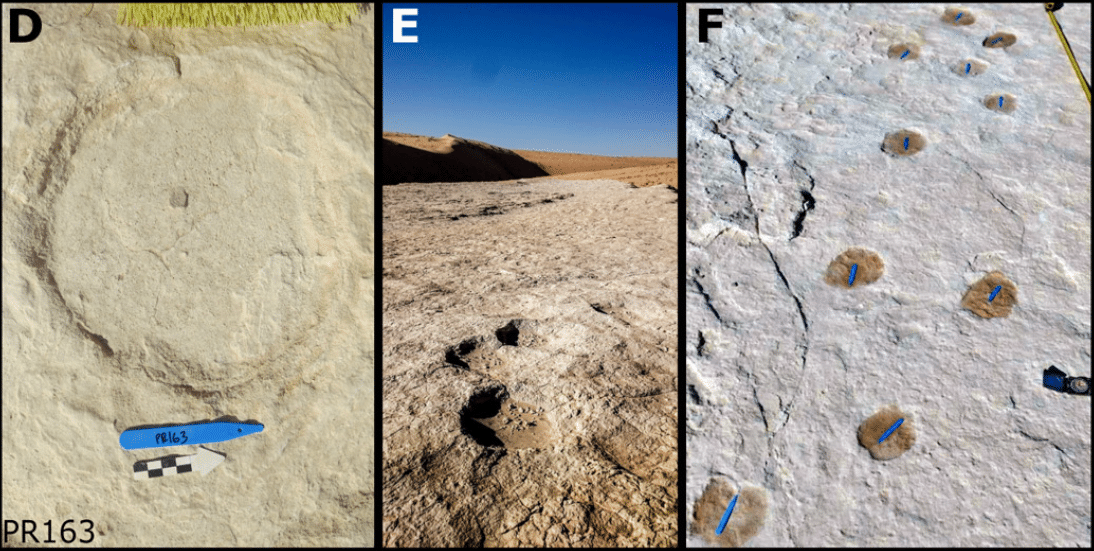
Data from the sediment analysis indicates the lake was a freshwater source surrounded by grasslands. This environment supported large mammals that are now extinct in the region, such as Palaeoloxodon recki, a straight-tusked elephant. The discovery of these fossil footprints provides a snapshot of the faunal diversity that existed in the Nefud Desert during the last interglacial.
The research team noted that the footprints were visible due to the rapid erosion of the overlying lake sediments. Once exposed, these features are susceptible to weathering and require immediate documentation. The team used 3D photogrammetry to create high-resolution digital models of each track before environmental degradation occurred.
A Ghostly Record of Migration
The Alathar tracks provide a precise timestamp for human expansion out of Africa. Before this discovery, the timing of human movement into the Arabian interior was largely based on stone tool sites that are difficult to date accurately. Footprints serve as ghost fossils that record a specific moment in time, often lasting only a few hours or days before burial.
Sediment cores taken from the lakebed reveal that the Alathar basin held water for several centuries before drying out. During this window, the Arabian Peninsula served as a land bridge between Africa and Eurasia. The presence of water buffalo and oryx tracks at the same stratigraphic level confirms the presence of a diverse herbivore population.
The researchers found no evidence of predation or butchery at the site. The tracks show animals and humans moving toward and away from the water edge, but they do not show signs of prolonged interaction. This suggests the lake was a transit point for multiple species rather than a site of conflict or hunting.
Measurement of the elephant tracks showed individuals of varying ages, including juveniles. This indicates that the Arabian corridors were stable enough to support the breeding cycles of megafauna. The human tracks follow the same general orientation as the animal trails, suggesting a shared reliance on the seasonal water source.
First Appeared on
Source link






