


12,000-year-old case of super rare genetic disease confirmed in new study
Researchers identified the earliest case of a genetic disease with the help of DNA: a mother and child buried together in southern Italy 12,000 years ago both exhibited signs of possessing a rare genetic disease, highlighting the deep history of this medical phenomenon throughout human history.
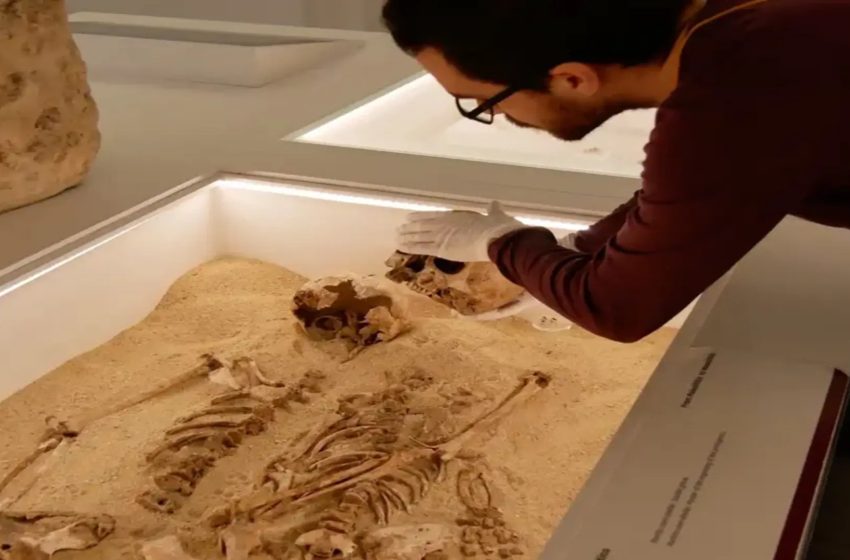
Just published in The New England Journal of Medicine, scientists examined the remains of two Stone Age skeletons discovered in 1963. This Upper Paleolithic burial even became famous, though puzzling to researchers, because the unusual skeletal remains were even disfigured.
An adolescent, Romito 2, was laid to rest in the arms of Romito 1, believed to be an adult female. Their embrace led archaeologists to infer that they were mother and child. The younger, at 3.6 feet, exhibited signs of having acromesomelic dysplasia, a condition marked by severe short stature and pronounced limb shortening. The mother, or Romito 1, showed similarities, though not as pronounced as her younger relative.
Archaeologists couldn’t prove it though. Not until now.
A seriously important moment for rare diseases
According to a press release, a team of researchers from the University of Vienna and collaborators in Italy, Portugal, and Belgium employed an interdisciplinary approach, combining paleogenomics, clinical genetics, and physical anthropology.
They first extracted DNA from the petrous part of the temporal bone of both individuals, a region known for preserving genetic material. These two individuals had a first-degree relationship, they confirmed, so they appeared to have been mother and child.
A real breakthrough for medical science
Then, after screening the genes associated with skeletal growth and comparing the ancient and modern data, researchers diagnosed her with acromesomelic dysplasia. She had a homozyhous variant of the NPR2 gene, essential for bone growth. Her mother, most likely, Romito 1, carried an altered copy of the same gene, which explained her shorter stature, though her daughter appeared to suffer from a more acute case of the condition.
Co-author Adrian Daly told Live Science in an email that “this is the earliest DNA confirmed genetic diagnosis ever made in humans, the earliest diagnosis of a rare disease, and the earliest familial genetic case; it is a real breakthrough for medical science.”
“Identifying with near certainty a single base change in a gene in a person that died between 12,000 and 13,000 years ago is the earliest such diagnosis by about 10 millennia.”
Ron Pinhasi from the University of Vienna spoke further of the significance of the study in a press release as they applied ancient DNA analysis “to specific mutations in prehistoric individuals.” The methodology employed helps to trace just how far back genetic conditions travel through our human history to even glean new insights into unknown variants.
“Rare genetic diseases are not a modern phenomenon but have been present throughout human history. Understanding their history may help in recognising such conditions today.”
“Identifying both individuals as female and closely related turns this burial into a familial genetic case. The older woman’s milder short stature likely reflects a heterozygous mutation, showing how the same gene affected members of a prehistoric family differently.”
In this case, the disorder expressed itself differently in the two bodies, though they shared the same genetic dysfunction. But, a note on the importance of care and compassion, as Romito 2 survived thanks to sustained care within her community.
First Appeared on
Source link






