


2.6-million-year-old Paranthropus jawbone changes human timeline
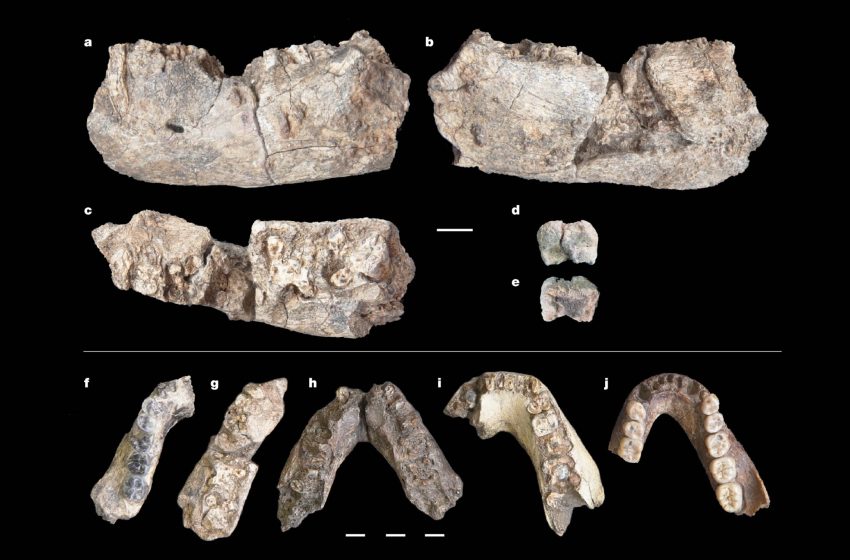
A newly uncovered Paranthropus jawbone fossil is reshaping how scientists map the early human family. Researchers found the partial lower jaw in Ethiopia’s Afar region and dated it to about 2.6 million years ago.
The find pushes the known range of Paranthropus more than 600 miles north, hinting that the genus was far more mobile and adaptable than once believed.
The research, led by Dr. Zeresenay Alemseged of the University of Chicago, shows that Paranthropus was present in Afar during a critical window of early human evolution.
Rather than marking a true boundary, its absence from the region now appears to reflect gaps in the fossil record.
By linking one local discovery to broader environmental and evolutionary patterns, the find challenges long-held ideas about where early human relatives lived – and how they responded to changing landscapes.
Finding the missing cousin
Paranthropus is an extinct branch of the human family marked by unusually large molars and powerful chewing anatomy.
Estimated to be about 2.6 million years old, the fossil extends the species’ known range by roughly 620 miles to the north.
Afar had produced many fossils from other lineages, yet Paranthropus had never shown up there, at least in known collections. That empty spot fueled claims that dietary limits or weak competition kept the genus farther south.
The fragments came from the Mille-Logya research area, where sediments preserve a rare slice of deep time. Field crews found pieces of the lower jaw on January 19, 2019, and then screened the ground to recover more.
Permissions from Ethiopian heritage officials allowed careful transport to Addis Ababa, where museum staff protected the fragile fragments.
Because the basin holds layers spanning several million years, each new bone can anchor a moment that was missing before.
Paranthropus jaw reveals diet
High-resolution X-ray scans let researchers peer inside the fossil, down to the roots that once anchored heavy teeth.
Because dense bone blocks X-rays, those internal shapes allowed software to reconstruct the jaw in detail without damaging the fragile fragments.
Comparisons with other fossils revealed a broad, sturdy jaw body and oversized molar roots – traits linked to strong chewing forces – even though the specimen lacked enough landmarks to confidently assign it to a single species.
Those massive roots signal heavy chewing loads during daily meals, while large muscle attachment areas along the face and jaw would have increased bite force by pulling harder on bone.
However, scratch and pit patterns on Paranthropus teeth show that meals were not always built around hard objects.
Together, the anatomy and wear patterns suggest a powerful but flexible feeding system, preventing the Afar jaw from being cast as evidence of a narrowly specialized eater.
Chemical fingerprints
Chemical traces locked in tooth enamel offered another angle on what Paranthropus ate across different habitats.
Food leaves chemical fingerprints that persist long after death. The researchers examined stable isotopes, subtle differences in carbon atoms.
Carbon analysis of Paranthropus teeth pointed strongly to grass and sedge meals, even though the jaws looked built for hard foods.
That broader diet aligns with the Afar fossil and supports the idea that the genus was not locked to a single food source.
Early humans shared space
Evidence from the site also placed the jaw in a landscape already visited by early Homo, the genus that includes humans.
Overlap matters because shared habitats can spark competition, and local conditions can favor some traits over others.
“If we are to understand our own evolutionary trajectory as a genus and species, we need to understand the environmental, ecological, and competitive factors that shaped our evolution,” said Alemseged.
The new find turns competition from a simple story into a testable question that depends on more fossils.
Gaps in the fossil record
Fossils only appear when bodies are buried, preserved, and then exposed again, so whole regions can look empty.
Erosion, river cuts, and small search areas decide what survives, and they can hide a species for decades.
When a find fills that gap, old explanations can collapse in one season, and new questions take their place. It also means future discoveries could overturn current maps, especially in regions that remain poorly explored.
Paranthropus jaw and human history
The crucial stretch between three and 2.5 million years ago marks the first steps of several human lineages. It unfolded during a period of shifting rainfall and vegetation that reshaped available foods and may have rewarded new bodies and behaviors.
Yet few well-dated fossils come from this window, leaving researchers to piece together family trees from fragments and debate how many relatives shared the landscape.
Against that backdrop, the new jaw, its detailed scans, and earlier dietary evidence point to a tougher, more mobile Paranthropus living alongside early humans.
Together, they reinforce the importance of eastern Africa, where a small number of sites still anchor most stories of human origins.
To move beyond those anchors, researchers now need more fossils from these critical layers to test long-standing ideas and build a broader, more reliable map of early human diversity.
The study is published in the journal Nature.
—–
Like what you read? Subscribe to our newsletter for engaging articles, exclusive content, and the latest updates.
Check us out on EarthSnap, a free app brought to you by Eric Ralls and Earth.com.
—–
First Appeared on
Source link






