


2026 NCAA Tournament First Look : College Hockey News
CHN Staff Report
Our first look at the NCAA Tournament Regionals.
Also check out the schedule, times and TV.
And our 2026 CHN Bracket Contest is ready. Win prizes. Tell your friends.
Albany Regional
Friday, March 27 and Sunday, March 29
1. Michigan (29-7-1) vs. 16. Bentley (23-11-5), 5:30 p.m. ET, ESPN-U
8. Minnesota Duluth (23-14-1) vs. 9. Penn State (21-13-2), 9 p.m. ET ESPN2
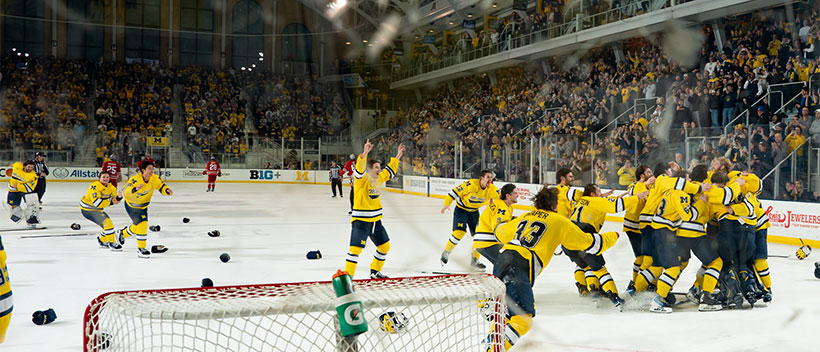
Michigan comes in having rampaged its way through the Big Ten Tournament, outscoring opponents 18-6 in three games. It has the top offense in the country by far, and is playing its best hockey right now. Michigan last won the NCAA Tournament in 1998, despite being close a few times. But the Wolverines are just 1-8 at the Frozen Four since the last championship, and lost in the semis three years in a row recently (2022-24).
This Michigan team looks different, though, on a mission after missing the NCAAs last season.
Bentley comes in having won its second straight Atlantic Hockey Tournament championship. Last season, the Falcons gave Boston College fits in the First Round. This may be a taller task, however.
The programs have met three times, all in Ann Arbor, with Michigan winning all three. The last meeting was in 2012.
Minnesota Duluth is returning to the NCAAs after a three-year absence. Prior to that, UMD made seven in a row, made four Frozen Fours, and won two championships. There’s always a concern the well has run dry after a run like that, and turnover in assistants — not to mention the added challenges of new-money landscape — but UMD coach Scott Sandelin has navigated through all of that to put his team in position for another possible championship.
The Bulldogs are coming off a double overtime loss to Denver in the NCHC title game, but came back from a 3-0 deficit in the process, on the road. Prior to that, UMD won at North Dakota in the NCHC semis.
Penn State made its first-ever Frozen Four appearance last season, and has had another strong year in 2025-26, despite the usual ups and downs of any season. Led by freshman phenom Gavin McKenna and his 51 points, as much as anything, the Nittany Lions have been re-energized by the return of Aiden Fink and Charlie Cerrato from injuries. That helps balance the already formidable offense. The key for Penn State is more defense, and staying disciplined, since it takes the most penalties of any team in the country.
Its special teams have been outstanding though, with a 26.2 percent power play, and 83.6 penalty kill. Thing is, UMD’s has been even better — over 29 percent on the power play and 89 percent PK.
Minnesota Duluth and Penn State will be meeting for the first time ever.
“Obviously, no matter where you play this time of the year, it’s good, so I think our guys will be looking forward to playing Penn State,” UMD coach Scott Sandelin said. “It’s a tough bracket but a good bracket.”
Three of the teams in this field boast a Hobey finalist — Max Plante (UMD), T.J. Hughes (Michigan) and McKenna (Penn State).
Sioux Falls Regional
Thursday, March 26 and Saturday, March 28
2. North Dakota (27-9-1) vs. 15. Merrimack (21-15-2), 8:30 p.m. ET, ESPN2
7. Providence (23-10-2) vs. 10. Quinnipiac (26-9-3), 5 p.m. ET, ESPN+
North Dakota brings a first-year head coach to the Regional, while everyone else is well-grizzled. But Dane Jackson was a long-time assistant, and is the only one of the four who is alum of the team he is coaching.
UND made a splash in the offseason bringing in two of the bigger Major Junior names, in Cole Reschny and Keaton Verhoeff. Those two have been good, but it was another freshman, recruited the old-fashioned way, who has ignited the offense — Will Zellers and his 18 goals. Also, though, it was the players who stuck around for a bunch of years really leading the way — Ben Strinden, Dylan James, Aaron Wiebe and Jake Livanavage. Freshman Jan Spunar has gotten the bulk of the work in net, and has been really good at times, and not great other times.
That’s as opposed to Merrimack goalie Max Lundgren, who just made 49 saves in winning the Hockey East Tournament championship game. He’s played every minute of every game for the Warriors this season, and has a .920 save percentage.
Merrimack lost 5-0 in the NCAAs three years ago, and forward Mark Hillier is the only one left from that team.
“We’re excited,” Merrimack coach Scott Borek said. “We’re playing one of the best teams in the country. We’re playing in their home rink, essentially. You’re guaranteed a great atmosphere. It should be a great experience for our players and our program.”
It’s a rare meeting between the programs. The only previous matchup came in a two-game series in Grand Forks at the start of the 2009 season.
“Our guys understand there are bigger games now in front of us,” Borek said.
A pair of coaches with national championships under their belt will go at it when Providence takes on Quinnipiac.
The Friars, led by Nate Leaman, won the Hockey East regular-season crown outright for the first time this season, but couldn’t get past Merrimack in the league quarterfinals, losing in overtime.
Providence lost its starting goalie, Philip Svedeback, midway through the year. Freshman Jack Parsons, however, stepped in and saved the season. He has a .923 save percentage.
John Mustard leads the team in scoring as a sophomore, and freshman Roger McQueen, a CHL import and first-round pick, is next.
Quinnipiac also lost in its league’s quarterfinals, in a best-of-3 with Clarkson, where it got swept. Quinnipiac just won its sixth straight ECAC regular-season crown, though, and is formidable as always.
“With the travel I think it’s a big plus (to have the extra time off),” Leaman said. “I would’ve hated to play an overtime game last night then figure out the travel.”
The Bobcats are young, though, led in scoring by three freshmen, including Hobey Baker Award finalist Ethan Wyttenbach, who also leads the nation in scoring. Antonin Verreault is well behind Wyttenbach’s scoring pace, but still has 15-23—38, while Markus Vidicek has 20 goals.
Dylan Silverstein got fewer starts this year than Matej Marinov in the Bobcats’ net, but has better numbers and played both quarterfinal games. So it’s anyone’s guess what coach Rand Pecknold will do in the NCAAs.
It’s an unusual bracket, with three Eastern teams playing in South Dakota. It’s happens moreso the other way because there are usually more Western teams in the tournament, and because there are fewer Western arenas. The Committee did have an option, though, of swapping Providence-Quinnipiac to Albany in exchange for UMD-Penn State. But chose not to go that route, or any route that would’ve boosted attendance in some Regionals.
“I think they dropped the ball on that,” Leaman said. “But, hey, it doesn’t matter to us. We’re a better road team. Drop the puck, we’re playing.
“It feels a little bit like youth hockey, two teams go across the country to play each other in the tournament when we could’ve gone an hour and a half.”
Worcester Regional
Thursday, March 26 and Saturday, March 28
3. Michigan State (25-8-2) vs. 14. Connecticut (20-12-5), 1:30 p.m. ET, ESPN2
6. Dartmouth (23-7-4) vs. 12. Wisconsin (21-12-2), 5 p.m. ET, ESPN-U
Michigan State hopes to finally reach a Frozen Four after three stellar seasons in a row. The last two years, the Spartans won the Big Ten Tournament championship but then lost in the Regionals. Maybe this year, without a league postseason championship, things will go the other way.
While other freshmen were getting more ink, for some reason Porter Martone was overlooked. After being selected No. 6 overall in last year’s draft, the Philadelphia Flyers steered him towards Michigan State, where all he’s done is go 24-23—47 with a plus-27. His 76 penalty minutes are also eye-opening. Fellow Major Junior import Cayden Lindstrom, who was the first CHL player to take advantage of the new opening, actually has 90 PIMs, but didn’t have a strong year otherwise at 3-7—10. Two other freshmen, however, did complement Martone — Ryker Lee and Anthony Romani.
And how about Charlie Stramel, who with 19-25—44 and plus-30 was named a Hobey Baker Award finalist. As is junior goalie Trey Augustine, the only goalie in the final 10, and he’s also a finalist for the Mike Richter Award. He put up a .929 save percentage in a more high-flying league.
Connecticut squeaked into the NCAA Tournament for the second straight year, after losing the Hockey East Tournament championship game. It needed there to be no bid-stealer upset teams in the other conference tournaments, and with Ohio State’s loss late Saturday, that officially didn’t happen.
Ryan Tattle, Jake Richard and Joey Muldowney are the keys up front, and all were part of last year’s NCAA team. Tyler Muszelik brings a .929 save percentage as well. UConn has show the ability to defeat anyone all season long.
Dartmouth just won the ECAC Tournament for the first time since the league began in 1962. It also reaches the NCAA Tournament for the first time since 1980.
Dartmouth boasts the nation’s leading scorer in Hayden Stavroff (29), with Hank Cleaves adding 17. The stingy team defense is anchored by goaltender Emmett Croteau (.924), who allowed just one goal in two games at Lake Placid.
Another first: The Big Green will be facing Wisconsin for the first time in program history.
Wisconsin returns after a one-year absence, coming in after an up-and-down season. After a good start, it hit a bad patch in January, then seemingly turned things back around before getting blown out at home by Ohio State in the conference quarterfinals.
The offense has been solid, if not overwhelming, but the penalty kill has been the biggest issue, at just 71.4 percent. Part of that has been the ups and downs of freshman goalie Daniel Hauser (.898).
Wisconsin has lots its last five NCAA Tournament games, dating back to 2010.
Loveland Regional
Friday, March 27 and Sunday, March 29
4. Western Michigan (26-10-1) vs. 13. Minnesota State (22-10-7), 2:30 p.m. ET, ESPN-U
5. Denver (25-11-3) vs. 11. Cornell (22-10-1), 6 p.m. ET, ESPN+
A lot of familiar faces in this Regional.
Denver has made the NCAA Tournament 17 of the last 18 times, missing only the weird COVID year. It won three national championships in that span.
Western Michigan has now made it all five years that Pat Ferschweiler has been head coach, and won the national title last year.
Minnesota State is in its 10th NCAAs in the last 13 seasons, and made a pair of Frozen Fours under Mike Hastings.
Cornell has made it seven of the last eight seasons it has played, missing only 2022, the year it returned from a one-year hiatus due to COVID. Since then, the Big Red are 3-0 in First Round games, and fell one goal short of the Frozen Four each time.
Not only that, but the teams are familiar to each other. Denver and Western Michigan, of course, have had many heated battles as top NCHC teams, including overtime games in last year’s NCHC championship, this year’s NCHC semis, and last year’s Frozen Four.
Cornell and Denver have also played in two of the last three NCAA Tournaments, with Cornell knocking off the then-defending champs in 2023, and Denver exacting revenge with a one-goal win in the 2024 Regional Final, on the way to the national championship.
And Minnesota State took Western Michigan to overtime in the First Round of last year’s NCAA Tournament.
Western Michigan has a number of key players back from last year’s national championship team, and supplemented them with two key transfers — William Whitelaw and Zach Wisdom. The Broncos have had to adjust to some injuries defensively, but Hampton Slukynsky has helped make up for it, playing every minute in net this season.
Tristan Lemyre is Minnesota State’s leading scorer, and has played on each of the last two national championship teams. He and Whitelaw are among 27 players in college hockey this season to be playing for their third team. And in fact, those last two national championship teams are here — Denver and Western Michigan.
Evan Murr has been a force again defensively for the Mavericks, and then of course there’s two-time Richter semifinalist Alex Tracy in net.
Denver is coming on without the explosive offense it’s had in years past, but with the typical stretch-run play where everything comes together in all facets. How much of that is Johnny Hicks’ play in net, and how much of that is how the team coalesced around him, is probably the usual “a bit of both.” But whatever the reason, Denver comes in on a roll, unbeaten since Hicks took the net (12-0-1).
Denver came into the season knowing it would have a turnover in goal, with two freshmen in Hicks and Quentin Miller. Miller assumed the start role and was playing well until an injury forced him out of a game on Jan. 24. Hicks came in, won in relief, and hasn’t lost since, putting up a .958 save percentage.
Defenseman Eric Pohlkamp, a Hobey finalist, leads the team in scoring with 17-20—37 and leads the nation with 173 shots. But lately, it’s been his improved defensive commitment that has seen his numbers go down a bit, but led to Denver’s success. In the NCHC championship game, Pohlkamp seemed to be a bit hobbled still from a shot block he took in the NCHC semi a week earlier, but he wound up with 31 minutes played and seven shots on net, so …
Cornell is in its first year under head coach Casey Jones, but as an alum and assistant coach in there in two different stints, he’s no stranger to the Big Red. Cornell has reached the second round three straight years, and fallen one goal short of the Frozen Four each time, including last year’s OT heartbreaker at the hands of Boston University.
First Appeared on
Source link






