


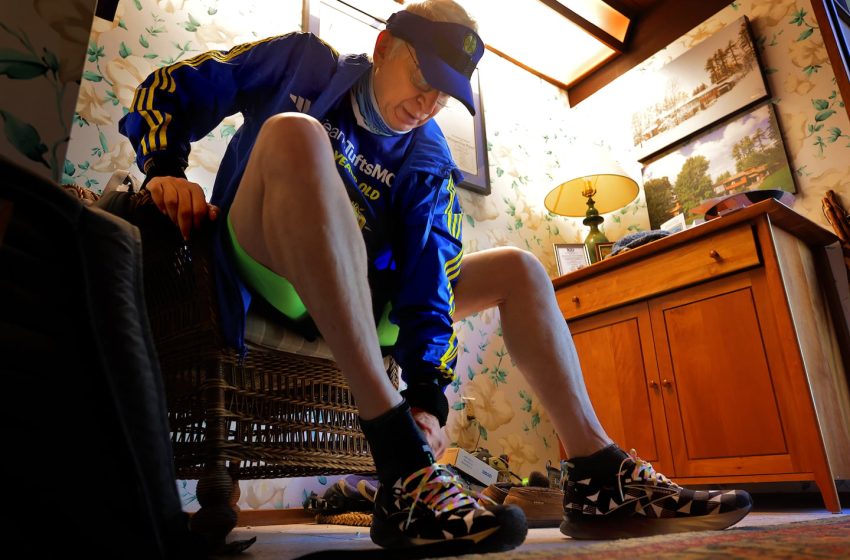
80-year-old Mass. doctor runs Boston Marathon to honor patient
As a practicing endocrinologist who specializes in treating patients with Hypermobile Ehlers-Danlos syndrome, Holick said he’s running in tribute to young people with the rare genetic disease, which wreaks havoc on the body’s connective tissues.
Distance running is also Holick’s strategy for strengthening his own body in hopes of minimizing the side effects of his cancer treatments and ultimately extending his life, he said.
“Having low testosterone and remaining anemic are two significant impediments that slow you down,” said Holick, who lives in Sudbury. “They make you want to stop running, but I refuse to let that happen.”
At 8 a.m. on a recent cold, gusty Saturday, Holick joined dozens of other runners, most in their 20s, in the basement of Boston University’s “Jenga Building” along the Charles River. They stretched and mentally prepared for a 20-mile run from Kenmore Square to Wellesley and back.
The independent race prep group, called The Marathon Coalition, also meets weekly on Zoom to discuss training and offer support and encouragement.
Holick is the most zealous athlete of the bunch when it comes to his training routine, said coach Rick Muhr.
“There is no one close to him in age, but despite his age, I would consider him my most enthusiastic runner,” Muhr said.
Holick said he wants to inspire older adults to exercise more, given its benefits for physical and mental health.
After receiving his cancer diagnosis in December 2021, Holick began weightlifting twice a week and walking between five and eight miles a day to improve his health before undergoing chemoradiation treatment. At the start of treatment, he made a New Year’s resolution to run the Boston Marathon and accomplished his goal in 2024. His time was just over seven hours.
But after two years of hormone deprivation therapy and nearly 30 radiation therapy sessions, Holick has become more susceptible to muscle loss and fatigue.
“Even though it’s only a number, being 80 is certainly a challenge,” said Holick, who is running this year’s Marathon with Team Tufts Medical Center.
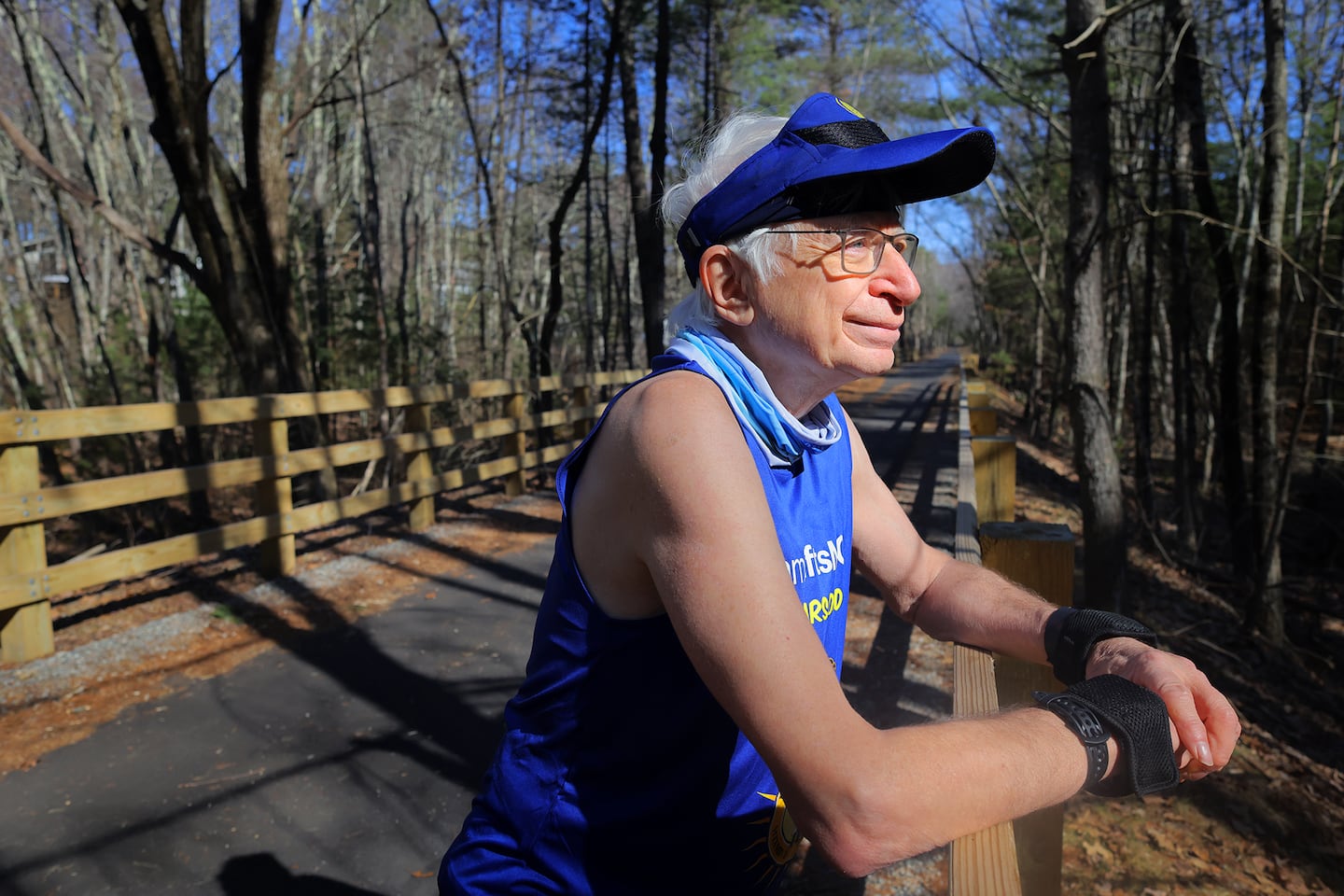
In his Sudbury neighborhood, Holick completes several 6-mile runs each week, going around a circular road multiple times or running along a train track.
His form is strong and he keeps a consistent pace, Muhr, 68, said.
Muhr said Holick has an analytical approach to his training, studying running techniques and asking in-depth questions to understand how the body responds to different workouts.
“He is like a sponge for knowledge,” Muhr said.
Holick’s curiosity about the human body led him to treat patients suffering from hEDS, a commonly misunderstood disease that causes many doctors to give up on patients, said Aurora Stipnieks, whose daughter Karen died from complications of the disease in August 2024. She was 24.
“My daughter would explain it’s like your body is a popsicle stick house you put together with defective Elmer’s glue,” said Stipnieks, 55. “A piece falls in, and then another piece falls in, and then you’re constantly trying to hold this whole structure together.”
The disorder is thought to affect just one out of every 5,000 people, but Holick believes it could be more common. In some cases, parents whose child bruises easily have been accused of abuse, Holick said. But in many instances, a child’s body was actually hyper-sensitive due to hEDS, he said.
While other doctors approached Karen Stipnieks’s disease with skepticism, Holick dedicated himself to finding answers, no matter how complicated the girl’s symptoms became, Aurora Stipnieks said.
“Instead of giving up and saying, ‘There must be something else going on,’ he actually digs and digs and finds intricacies between hormones and vitamin D levels that affects this disease,” said Stipnieks, a veterinarian who lives in Medfield.
Holick said he’s dedicating his marathon to Kira Serisky, who was 17 when she died from hEDS in 2021, and Karen Stipnieks. The disease caused their joints and organ systems to nearly shut down.
Before Karen Stipnieks died, she asked Holick to perform her autopsy to study her genome in the hopes of making scientific discoveries about hEDS. Holick went on to publish a medical research paper on her case.
“Every time I think of Karen, I get emotional; I set up her autopsy, I saw her on a cold slab‚” Holick said. “I’m running because I can’t get that picture out of my head.”
Serisky’s mother, Marge Serisky, said she is looking forward to watching Holick run on April 20. She downloaded the B.A.A. Racing app to track his progress.
“The world needs more Dr. Holicks, doctors who will listen to their patients, who will fight for their patients, who will investigate,” said Serisky, who lives in Shelburne, Vt.
Muhr said he will watch the Marathon from outside the Wellesley Hills Congregational Church near the 15-mile mark, the start of what many runners consider the most challenging part of the race. He hopes to lock eyes with Holick as he passes.
“It’s going to be a very emotional moment for me, because I know how hard he has worked,” Muhr said.
Claire Thornton can be reached at [email protected]. Follow Claire on X @claire_thornto.
First Appeared on
Source link






