


‘This is a special game’: NBA Pioneers Classic gives league’s first Black players their respect
BOSTON – It would gall Chuck Cooper III when he would hear people try to name the first Black players in different sports. They would start with Jackie Robinson integrating Major League Baseball in 1947, and of course Cooper had no problem with them recalling that iconic sports figure.
When the conversation turned to the NBA’s first, the next name Cooper often heard was Bill Russell. That’s when Cooper would become upset.
The Celtics legend had 11 championship rings and the sports world’s respect, but Cooper knew “the first Black NBA player” wasn’t one of the honors Russell had earned. That’s because Cooper knew that at the start of the 1950-51 season, his father, also named Chuck Cooper, along with Earl Lloyd and Nat “Sweetwater” Clifton had integrated the league.
Beginning with Sunday’s first NBA Pioneers Classic game between the Milwaukee Bucks and Boston Celtics, Cooper’s disappointment has been permanently replaced with joy knowing that the league will honor his father’s accomplishments, along with those of Lloyd and Clifton, on Feb. 1 of each year to start Black History Month.
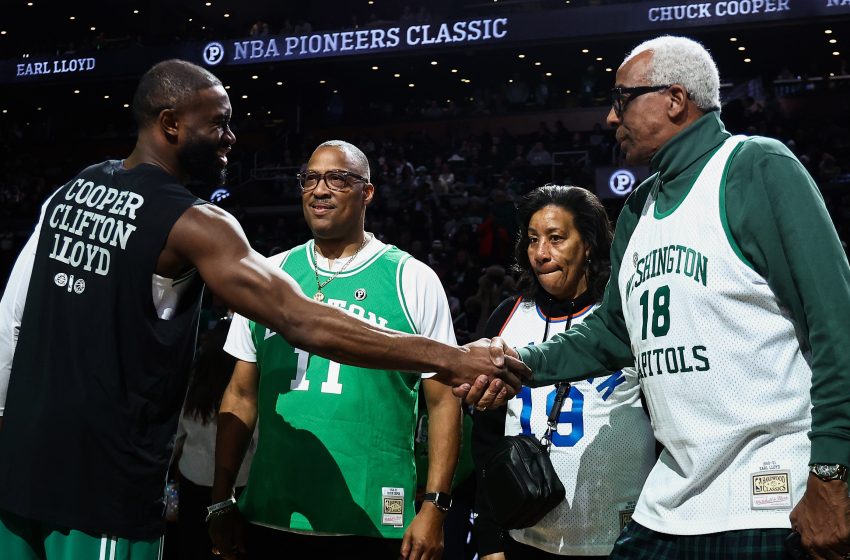
The children of the three players were featured at TD Garden in different ways before, at halftime and after the game. Celtics fans and personnel took photos of them at center court before the game. They were introduced to the crowd at halftime, and journalists photographed and interviewed them throughout the game.
Speaking of his dad Earl Lloyd, who died in 2015, Kevin Lloyd said, “He would definitely be pleased with how the game has evolved from when he played to today. He’s looking down with a smile on his face to know that he’s a part of something. This is a special game and he’s a part of this.”
“I think it’s great,” Clifton’s daughter, Jataun Robinson, said. “I think that honoring them would mean a lot to them if they were living.”
Jesse D. Garrabrant/NBAE via Getty Images
On April 25, 1950, Chuck Cooper from Duquesne University became the first Black player drafted by the NBA when the Celtics chose him in the second round. Lloyd was drafted in the ninth round along with Harold Hunter, who never played in a pro game.
On Oct. 31, 1950, Lloyd became the first Black player in an NBA game when his Washington Capitols opened the season against the Rochester Royals (now the Sacramento Kings.)
Clifton, who had been a star with the Harlem Globetrotters, was the critical factor in opening the door for Black players because the New York Knicks wanted to sign him to play center. During the league’s first four years, from 1946-1950, the owners had secretly banned Black players, but Knicks president Ned Irish pressured other owners into dropping the ban so Clifton could be signed, which occurred on May 3, 1950.
In December 1950, a fourth Black player, Hank DeZonie, also played five NBA games that season with the Tri-Cities Blackhawks before retiring.
Those milestones had been overlooked because, at the time, college basketball was far more popular than pro basketball, and although Cooper, Lloyd and Clifton had solid NBA careers lasting at least six seasons, none of them became a star.
“To me, the evolution has been tremendous,” Cooper said. “To be honest, the education process started with Ron Thomas’ book ‘They Cleared the Lane.’ Through the years, we just kept chipping away. The Cavaliers had an event and brought all three families together. Me, Kevin and Jataun, we locked in together. The communication with the NBA just started to elevate with the storytelling.”
By 2019, all three players had been inducted into the Hall of Fame, then the NBA named three of the division championships after the pioneers, and the momentum toward Sunday’s game kept building.
Cooper believes Boston was the appropriate place to hold the first Pioneers Classic because the Celtics were the first to draft a Black player, the first to have an all-Black starting five, and the first to have a Black coach in Russell.
“When I talk to young people, one thing I tell them is that when you make the right decisions for the right reasons, good things happen,” Cooper said. “In the Celtics’ case, great things happened.” Then he pointed out the Celtics’ 18 championships.
Current Celtics star Jaylen Brown enjoyed the game as much as the Pioneers’ families.
“It was awesome. It was pretty cool to be able to pay homage to people of the past,” Brown said. “I’m a person who likes to pay their respects. You know, to know where you’re going, you have to know where you came from. So, I thought the NBA did a good job honoring some of those guys from the past.”
The Pioneers Classic does more than honor the past; it also helps improve the future for students who attend historically Black colleges and universities (HBCUs). The NBA Foundation and the NBPA (National Basketball Players Association) Foundation each contributed $75,000 in scholarships to West Virginia State University, where Lloyd graduated, and Xavier (La.) University, where Clifton attended. The foundations also have partnered to commit to contributing $750,000 to support HBCUs over the next five years.
Ron Thomas is an Associate Professor in the Morehouse College Journalism in Sports, Culture and Social Justice Department.
First Appeared on
Source link






