


Then and Now, Part 2
Last week, I started telling stories about various Lorwyn Eclipsed cards and the previous designs that inspired them. Today, I’m going to tell some more stories.
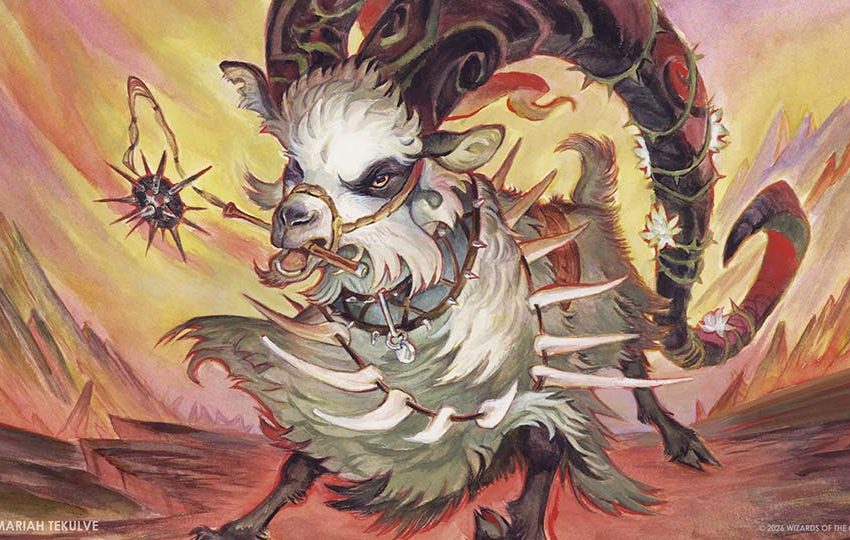
Goatnap and Oft-Nabbed Goat
Here’s an example of two different cards in Lorwyn Eclipsed that reference the same card from the original Lorwyn set. To tell this story, I have to go back to Lorwyn design and talk about the making of
We had chosen to make a typal set built around eight creature types. Because the typal theme was so strong, it drove the mechanical themes of the draft archetypes. So, if you draft a Goblin in your first booster, you were highly incentivized to keep drafting Goblins. The core problem here was that the Goblin player wanted Goblins, but no one else did. That’s a problem for two reasons.
One, gameplay becomes repetitive because the Goblin player keeps drafting and playing the same cards, creating less variance in their games. Generally, variance is key to things being fun, so it would lessen the number of drafts they’d want to do. Drafts get “stale” faster.
Two, it decreases dynamics between drafters. If two players seated next to each other are never interested in the same cards, there’s less interaction between them, which makes for a less-interesting draft. The solution to this problem was to create some kind of typal glue, or something that made players fight over the same cards some of the time. Lorwyn‘s typal glue is the changeling mechanic. Creatures with changeling are all creature types, so every deck playing that color would want them. We put some creatures with changeling in Lorwyn. They played well, so we upped the number of changeling creatures. There ended up being a lot of creatures with changeling in the file.
This brings me to
Since Lorwyn is a typal set, it felt like an opportunity to do something more focused. What creature type should this Goblin steal? That’s when someone came up with the idea of the creature stealing Goats. It was a cutesy way to have it interact with changeling creatures. Everybody on the design team loved the card, and it went into the set.
Then came the big argument. Some of the team felt (myself included) that we should put one Goat in the set so that there was an actual Goat for the
I was able to make two cards in Eventide that create 0/1 white Goat tokens.
We’re always looking to make versions that don’t just use the opposite counter. While some of the -1/-1 counter cards in Lorwyn Eclipsed can mostly be replicated with +1/+1 counters because it’s hard to completely avoid that, we like to find unique design space when we can.
So, we designed this cool card where you steal a creature back and forth. What kind of creature should it be? Well, Modern Horizons was all about mechanical callbacks and Lorwyn did establish the type of creature that gets stolen often: Goats.
Figure of Fable
At MagicCon: Chicago 2025, I did a talk about the top 20 most influential card designs of all time. The third most influential design was this card:
Brian came up with a clever solution. Each activation could add a new creature type to the creature, acting as the gate for the next activation. Besides allowing us to fit all the rules text on the card, the creature types also acted as flavor to help sell the story of the creature’s progression. Because it was in Eventide, Brian used hybrid mana for the mana cost and activated abilities, allowing the card to go in more decks.
It also inspired the Class subtype which first showed up in Dungeons & Dragons: Adventures in the Forgotten Realms, representing classes from Dungeons & Dragons. Classes returned in Bloomburrow, where they represented the talents of the animalfolk.
The new design had to address a few issues. First, it felt appropriate for the new version of the card to be a Kithkin, but the first card had appeared in Eventide. In Lorwyn and Morningtide, the Kithkin are white and green. In Shadowmoor, the Kithkin are white and blue. Because Eventide was an enemy-color hybrid set, it had to be red-white or white-black. White and red felt better to the story Brian wanted to tell with the card (and every other Kithkin in Eventide was mono-white).
Kithkin in Lorwyn Eclipsed are one of the five creature types we focused on, and it matched the original Lorwyn set where the Kithkin were white and green. The card paid homage to the original. It changed in some ways that were cool, so we made the decision to make it a green-white hybrid card.
Next was the evolution of its power and toughness. Figure of Destiny followed this format:
- It starts as a 1/1 for one hybrid mana.
- You could then pay one hybrid mana to make it a 2/2.
- You could then pay three hybrid mana to make it a 4/4.
- You could then pay six hybrid mana to make it an 8/8 with flying and first strike.
Starting with a 1/1 for one hybrid mana felt like it was something we should carry over. Having the creature become a 2/2 for one hybrid mana activation felt a bit weak. Creatures have improved quite a bit since Eventide, and green and white are the most creature-centric colors. We could do better than a 2/2, so we decided to make it a 2/3.
This change introduced a new wrinkle.
The design team wanted to make the activated abilities similar to each other. Each card’s abilities cost one mana, then three mana, then six mana. To follow that format for
Finally, they needed to come up with an ability or abilities for the last activated ability. Green doesn’t tend to get flying or first strike, so repeating the abilities wasn’t an option. Green and white overlap in the following evergreen keywords: defender, flash, indestructible, vigilance, and ward. Defender is a downside. Granting flash wouldn’t do anything. Indestructible was a little stronger than Play Design wanted. We considered vigilance but decided on a mechanic that was at least deciduous for both colors: protection.
The Incarnations
One day, Bill Rose said he had something to tell me and something to ask me. First, he was putting together the design team for Invasion, then codenamed “Beijing,” and he wanted me to be part of the team. It was going to Bill Rose, Mike Elliott, and myself. At the time, we were the three strongest full-time Magic designers in R&D. The Mercadian Masques block was not looking great (and didn’t end up doing that well), and Bill, who had recently become head designer, was eager to make sure that Invasion was a hit, so he got the three best designers in Magic R&D to be the design team. Then came the question: could we use my dad’s house in Tahoe to do the first week of the design?
I believe it was in Tahoe that Bill first pitched the kicker mechanic. We’d had a handful of cards that essentially did what kicker did, but it didn’t have a name, and Bill wanted to formalize it. We spent a lot of that first week exploring kicker’s design space, and it turns out that it was pretty big. One of the things that fascinated me was the idea of creatures that, when kicked, could let you essentially cast a spell.
I’ve always been a fan of utility, so I was intrigued by all the things that we could do with kicker. This brings me to the design of Lorwyn. As a designer, I love to take an existing mechanic and turn it on its head. There were kicker creatures that you could kick for an effect we’d put on a spell. What if I did the opposite and created spells you could kick to cast a creature? You could kick a spell to create a token, but that wasn’t what I was after. Tokens have to be pretty simplistic for memory reasons, and I was interested in more elaborate creature designs.
The earliest version of evoke went on instants and sorceries and turned the spell into a creature when kicked. I thought it was pretty cool. But as often happens, sometimes an idea runs into practicality problems. The game really doesn’t want instants and sorceries (which aren’t permenant types) on the battlefield, so the rules basically don’t allow it. If an instant or sorcery would enter the battlefield, the rules have you put it into your graveyard instead.
The rules text needed to prevent this (essentially having the creature lose its instant or sorcery type and become only a creature) was both lengthy and hard to understand. But the rules manager at the time, Mark Gottlieb, had another idea. What if instead of a spell, it was an enters ability on a creature spell. If you paid the evoke cost, which was usually cheaper, you’d sacrifice the creature when it entered. That was a lot less words. It wasn’t quite as cool, but the audience wouldn’t have interacted with the previous version, and the tweak played just as well. It still let you get a spell for a cheap cost or a creature with a spell-like effect for a higher cost.
Evoke was a pretty big hit, especially
Multicolor sets are pretty popular, so it’s a theme we revisit often. Each time we do, I like to investigate unexplored design space for multicolor spells. What new things can we do with multicolor cards? Ravnica: City of Guilds gave the design team a new problem to chew on. Multicolor cards have the issue that they are very specific in terms of who can play them. If a card is white and blue, only a deck with white and/or blue resources can play it. Are there ways to make cards that are playable in one color but better if you have a second color?
Richard used
We thought about whether there was a way to have off-color abilities on a spell. There was. Invasion had done it with kicker costs, for example.
You could use
The answer was yes. Instead of requiring mana of a certain color as an additional cost, we could just give you a bonus for using the secondary color when casting the spell. We ended up making a 20-card cycle with this ability in the original Ravnica: City of Guilds block. We made 20 because each guild had a spell going in each direction.
This takes us back to the design of Shadowmoor. We were looking for cool things to do with hybrid spells when we remembered this cycle from the Ravnica: City of Guilds block.
The result was a ten-card cycle with cards in Shadowmoor and Eventide. Each of these cards has a hybrid mana cost. You get two different effects depending on which color you use. Like the spells from the Ravnica: City of Guilds block, they were not tied to one of the colors. A green-blue hybrid spell can be played in a mono-green or mono-blue deck but works optimally in a deck with both colors.
This brings me back to Lorwyn Eclipsed. One of the challenges of trying to bring back four sets worth of designs in a single set requires finding opportunities to fit as much as we can while leaving room to explore new things. One of the ways to do this involves combining ideas. This allows us to call back to multiple things at once. It also gets to count as something new as you are combining in such a way to create something that hasn’t existed before. Finally, one of the big innovations of Lorwyn Eclipsed was the commingling of Lorwyn and Shadowmoor, which allowed us to mix mechanics from the two mini-blocks and create more mechanical space.
That’s how the mythic rare cycle of Elemental Incarnations came to be. We wanted to bring back evoke in some way. Evoke requires creatures to have an enters effect (or something similar). What if we mixed evoke from the Lorwyn mini-block with the hybrid spells from the Shadowmoor mini-block? This would now allow for several more outcomes (you could get either or both spell effects, with or without a creature). It would mix Lorwyn and Shadowmoor in a fun way, cross the streams to play up the new creative twist of the setting, create something new, and call back to different things.
The key to designing them involves picking two abilities, one in each color, that were useful independently but synergistic together. For example,
The Callback Is Coming from Inside the House
That’s all the stories I have to tell. I hope you enjoyed this two-part article looking at the history of how some Lorwyn Eclipsed cards came to be. As always, I’m eager for any feedback, be it on this article, any of the cards I talked about, or Lorwyn Eclipsed itself. You can email me or contact me through social media (Bluesky, Tumblr, Instagram, TikTok, and Twitter).
Join me next week for another installment of Making Magic.
Until then, may you create many stories about Lorwyn Eclipsed.
First Appeared on
Source link






