


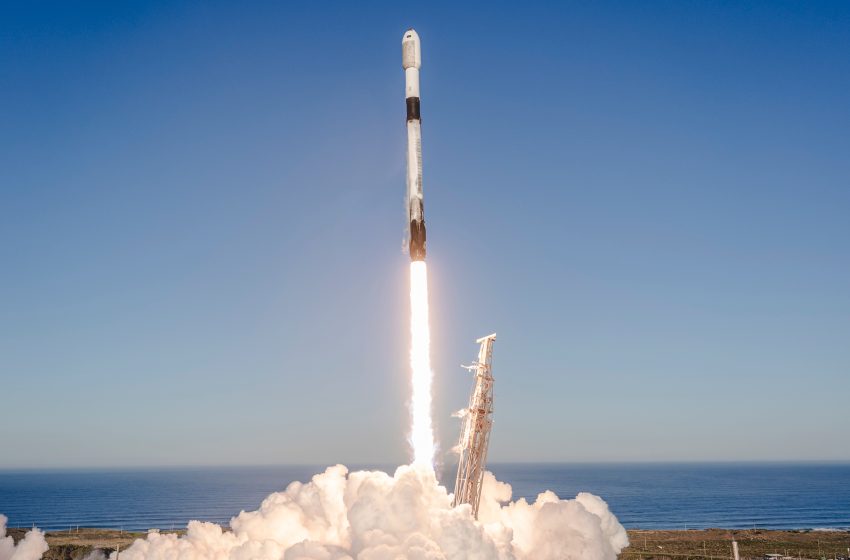
SpaceX pauses Falcon 9 launches after upper stage anomaly
WASHINGTON — SpaceX is pausing Falcon 9 launches after an issue with the rocket’s upper stage encountered at the end of a launch Feb. 2.
A Falcon 9 lifted off from Vandenberg Space Force Base in California at 10:47 a.m. Eastern. The rocket’s upper stage deployed its payload of 25 Starlink satellites into low Earth orbit 62 minutes after liftoff, following two burns of the stage’s single Merlin engine.
In a statement about nine hours after the launch, SpaceX said the upper stage “experienced an off-nominal condition” while preparing for a final engine burn to deorbit the stage. The company did not elaborate on the condition but said the stage performed normally up to that point, including through payload deployment.
“The vehicle then performed as designed to successfully passivate the stage,” the company said. Passivation typically involves venting residual propellants and discharging batteries to remove stored energy that could cause the stage to break up.
“Teams are reviewing data to determine root cause and corrective actions before returning to flight,” the company said.
SpaceX did not say how long that process is expected to take. The launch manifest on the company’s website lists the next Falcon 9 launch for Feb. 5 from Florida, a mission that had previously been scheduled for Feb. 3.
Falcon 9 has experienced several upper-stage issues in recent years. In September 2024, the Crew-9 mission encountered a problem during the upper stage deorbit burn that caused the stage to reenter outside its designated area in the South Pacific. SpaceX paused most Falcon 9 launches for about two weeks until the Federal Aviation Administration accepted the company’s investigation findings.
In February 2025, another Falcon 9 upper stage failed to perform a deorbit burn, which SpaceX attributed to a propellant leak. The stage later made an uncontrolled reentry over Europe, with some debris landing in Poland. That incident did not result in an extended pause in Falcon 9 launches.
In July 2024, a Falcon 9 upper stage suffered a mission-ending failure when its engine failed to restart, leaving the stage and its Starlink payloads in a very low orbit. SpaceX resumed launches 15 days later after an investigation traced the failure to a liquid oxygen leak.
Spaceflight analyst Jonathan McDowell noted late Feb. 2 that the upper stage from the most recent launch was in an orbit of about 110 by 241 kilometers. The low perigee suggests the stage will reenter soon.
Related
First Appeared on
Source link






