



Earth Is Being Covered in a ‘Forever Chemical’ That Won’t Break Down, Scientists Warn
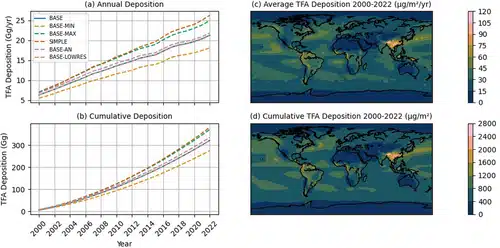
A recent study published in Geophysical Research Letters sheds light on an alarming global environmental issue, how chemicals used to protect the ozone layer are contributing to the spread of a dangerous, persistent “forever chemical.” These chemicals, initially thought to be a safe alternative to ozone-depleting substances like CFCs, are now forming trifluoroacetic acid (TFA), a highly persistent pollutant that accumulates in the environment and poses potential risks to both aquatic life and human health. The research, conducted by a team of scientists led by Lancaster University, highlights the increasing global deposition of TFA, with its sources coming from refrigerants and anesthetics.
The Unintended Consequences of CFC Replacements
The replacement of harmful CFCs, initially introduced to safeguard the ozone layer, is now being linked to the rise of a new environmental pollutant, trifluoroacetic acid (TFA). These replacements, such as hydrochlorofluorocarbons (HCFCs) and hydrofluorocarbons (HFCs), are used in refrigeration and other industrial processes. While these chemicals were intended to prevent further ozone depletion, their breakdown in the atmosphere has led to the creation of TFA, which does not easily degrade. The study conducted by Lancaster University’s atmospheric scientists, led by Dr. Lucy Hart, found that these CFC replacements are likely the dominant source of TFA in the atmosphere. As Dr. Hart noted,
“Our study shows that CFC replacements are likely to be the dominant atmospheric source of TFA. This really highlights the broader risks that need to be considered by regulation when substituting harmful chemicals such as ozone-depleting CFCs.”
The findings, published in Geophysical Research Letters, emphasize the complexity of environmental regulation, suggesting that while some chemicals may solve one issue (like ozone depletion), they may inadvertently contribute to another. This underscores the need for broader and more comprehensive approaches to chemical regulation, accounting for potential long-term consequences that may not be immediately apparent.
TFA’s Global Spread and Persistent Nature
TFA is part of a larger group of chemicals known as per- and polyfluorinated alkyl substances (PFAS), often referred to as “forever chemicals” due to their extremely slow degradation rate in the environment. The study showed that TFA is accumulating across the globe, in places where one might not expect, including remote regions such as the Arctic. These chemicals, despite their localized emission sources, can travel vast distances in the atmosphere. Dr. Hart explained,
“CFC replacements have long lifetimes and are able to be transported in the atmosphere from their point of emission to remote regions such as the Arctic where they can breakdown to form TFA.”
This global movement of pollutants highlights the complexity of environmental challenges in an interconnected world.
The study further confirmed that the Arctic, often considered a pristine region, is now accumulating TFA at increasing levels. Studies have detected rising concentrations of TFA in ice-core samples taken from the Arctic, providing concrete evidence that even the most isolated parts of the Earth are being impacted by human activity. According to Dr. Hart,
“Studies have found increasing TFA levels in remote Arctic ice-cores, and our results provide the first conclusive evidence that virtually all of these deposits can be explained by these gases.”
This phenomenon not only demonstrates how far pollutants can travel but also raises concerns about the irreversible effects they may have on these delicate ecosystems.
The Growing Threat of TFA in Water Bodies
The accumulation of TFA is particularly concerning when it comes to water bodies. As these chemicals deposit from the atmosphere, they often end up in rivers, lakes, and oceans, where they can accumulate over time. The presence of TFA in aquatic environments poses potential risks to marine life, as well as to human populations who rely on water bodies for drinking water and agriculture. The study’s findings indicate that TFA levels are increasing each year, and this trend is unlikely to reverse in the near future.
Professor Ryan Hossaini, co-author of the study, pointed out the significance of this issue, saying,
“The rising levels of TFA from F-gases is striking. Although HFC use is gradually being phased down, this TFA source will remain with us for decades. There’s an urgent need to understand other TFA sources and to assess TFA’s environmental impacts. This requires a concerted international effort, including more extensive TFA monitoring in the UK and elsewhere.”
His statement stresses the importance of global collaboration and increased monitoring to address the ongoing issue.
Calls for Long-Term Monitoring and Global Action
The findings from this study make it clear that TFA pollution is not just an isolated issue; it is a global concern that requires international attention and regulation. The study calls for more rigorous monitoring of TFA levels worldwide, including in regions where pollution is not yet visibly problematic, such as in remote ice cores and deep-water bodies.
“In all regions where TFA measurements are available, a consistent picture of increasing atmospheric concentrations and deposition to Earth’s surface is emerging,” said Dr. Stefan Reimann, one of the study’s co-authors.
The research also points to the growing use of new refrigerants, such as HFOs, which, like their predecessors, also break down into TFA. As HFOs become more widely adopted in industries like automobile air conditioning, the levels of TFA in both the atmosphere and water bodies could continue to rise, creating even more uncertainty about the long-term environmental consequences of these chemicals. Dr. Hossaini noted that “This study is outstanding, as it combines for the first time all the important sources of atmospheric TFA and has a global focus. With increasing use of HFOs, accumulation of TFA in water bodies will potentially grow, and this makes long-term monitoring a necessity.”
First Appeared on
Source link






