Qualcomm Rumored To Address Any Overheating Problems With Its Snapdragon 8 Elite Gen 6 This Year, And It Won’t Be Because Of TSMC’s Advanced 2nm Process
- 0-20%: Unlikely – Lacks credible sources
- 21-40%: Questionable – Some concerns remain
- 41-60%: Plausible – Reasonable evidence
- 61-80%: Probable – Strong evidence
- 81-100%: Highly Likely – Multiple reliable sources
Samsung’s Heat Pass Block (HPB) is currently applied to the Exynos 2600 and is an excellent implementation to help lower temperatures and improve thermal resistance by 16 percent. With reports doing the rounds that other chipset makers will also adopt this technology to their SoCs, the latest rumor now claims that Qualcomm will be implementing it in its Snapdragon 8 Elite Gen 6 Pro and Snapdragon 8 Elite Gen 6 later this year.
Looking at the high clock speeds achieved by the Snapdragon 8 Elite Gen 5, the thermal limitations of passive coolers like vapor chambers are already being reached, requiring more advanced solutions to tame rising temperatures. Sure, TSMC’s 2nm process should help, but the improved lithography can only do so much when companies are targeting aggressive clock speeds to have an advantage over the competition.
Qualcomm was already rumored to be testing its Snapdragon 8 Elite Gen 6 Pro at clock speeds of 5.00GHz, hinting that the HPB could be in the testing phase right now
To bring readers up to speed, an HPB a basically a copper-based heatsink that’s placed directly onto the silicon die, with the DRAM chip placed next to it. On older chipset designs, the DRAM was placed directly on top of the SoC, creating a heat trap and giving the chipset little room for breathing, forcing external vapor chambers and graphite sheets to do the heavy lifting. Since copper is an excellent heat conductor, the chipset’s temperatures will probably be lowered.
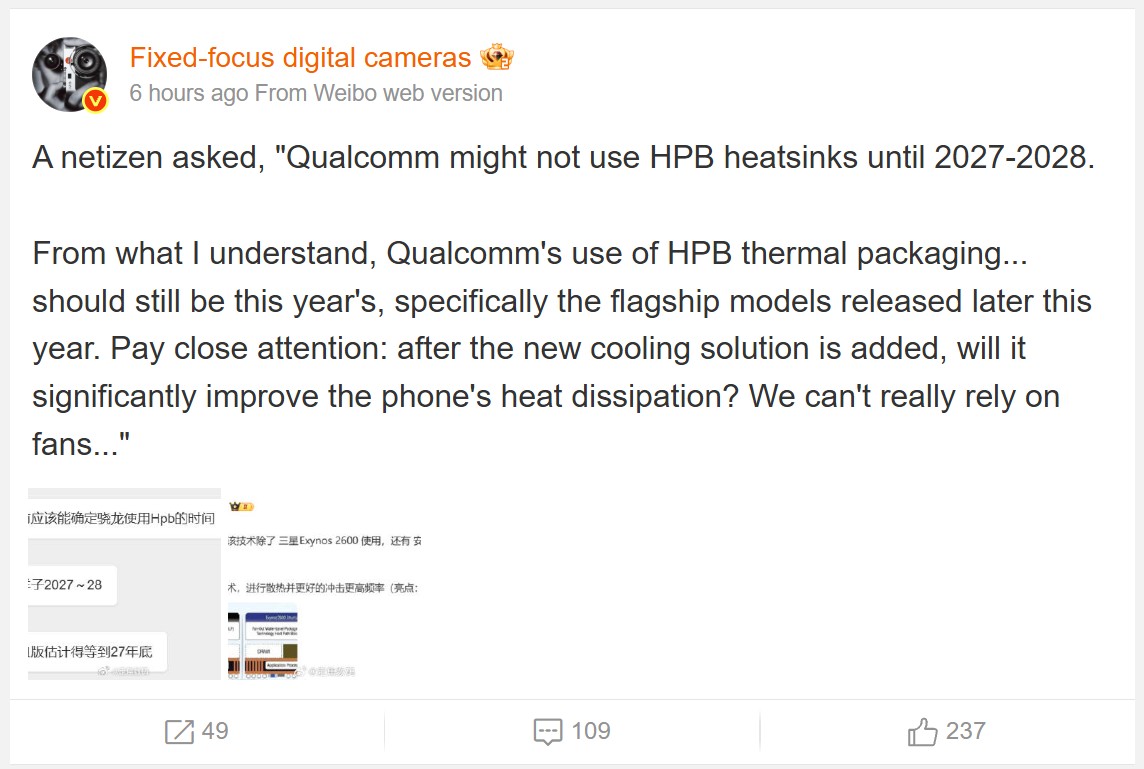
On Weibo, Fixed-focus digital cameras has returned with a post, claiming that the Snapdragon 8 Elite Gen 6 Pro and Snapdragon 8 Elite Gen 6 will feature the HPB. Earlier, the same tipster stated that Qualcomm was testing its higher-end 2nm chipset to achieve a minimum clock speed of 5.00GHz on the performance cores. In a controlled environment, with no power or thermal restraints, the Snapdragon 8 Elite Gen 6 Pro would likely reach those frequencies without a comprehensive cooling solution.
However, transfer this silicon to a compact space like a smartphone’s internals and witness the completely opposite behavior, which is where the Heat Pass Block technology comes into play. At this point, it has become mandatory for Qualcomm to incorporate some form of advanced cooling, and we believe that a similar solution should have been applied to the Snapdragon 8 Elite Gen 5.

After all, the latter manages to beat the A19 Pro, but in Geekbench 6, Qualcomm’s flagship SoC needs to consume 61 percent more power to achieve this feat. We can say with confidence that the San Diego firm will attempt the same aggressive power scaling for the Snapdragon 8 Elite Gen 6 Pro and Snapdragon 8 Elite Gen 6, making the inclusion of the HPB even more necessary.
News Source: Fixed-focus digital cameras
Follow Wccftech on Google to get more of our news coverage in your feeds.
First Appeared on
Source link