


They Drilled Deeper Into Earth’s Crust Than Anyone Before… Then Hit Something Unexpected
In May 2023, a team of researchers aboard the JOIDES Resolution drilled 1,268 meters into the Earth’s crust, reaching mantle-altered rock closer than ever before. Working just south of the Lost City hydrothermal field in the Atlantic Ocean, the scientists extracted a core of abyssal peridotite, marking the deepest successful mantle sampling mission to date.
Though they didn’t cross the boundary that officially separates Earth’s crust from its mantle, the team recovered vital material that could reshape how geologists understand the largest layer of our planet. The mission also raises questions about the future of deep-sea drilling efforts, as funding dries up just when results are accelerating.
Searching for Answers in the Planet’s Deepest Rock Layer
The mantle, making up 70 percent of Earth’s mass and 84 percent of its volume, remains largely a mystery. No mission has yet managed to retrieve pristine mantle rock from below the Mohorovičić discontinuity, the Moho, which is considered the true threshold between crust and mantle. Because the Earth’s crust is typically between 9 and 12 miles thick, directly accessing the mantle has proven nearly impossible.
Some locations, however, offer better chances. At the Mid-Atlantic Ridge, particularly around the Atlantis Massif, the crust is unusually thin, and faulting has cracked the rocky layers open. This makes the region especially promising. Nearby, the Lost City vent field is already famous for its highly alkaline hydrothermal activity and concentration of hydrogen, methane, and carbon compounds. It’s even been considered a plausible environment for the origins of life.
Record-Breaking Drill at the Atlantis Massif
In an expedition funded by the U.S. National Science Foundation, researchers aboard the 470-foot-long JOIDES Resolution exceeded expectations when drilling at a site 800 meters south of the Lost City. According to Popular Mechanics, the team had only planned to drill to 200 meters, the previous depth record in mantle rock, but unexpectedly easy drilling conditions allowed them to go over six times deeper.
“We had only planned to drill for 200 meters, because that was the deepest people had ever managed to drill in mantle rock,” explained Johan Lissenberg, petrologist at Cardiff University, in a statement reported by Nature. “The drilling was so easy that they progressed three times faster than usual.” The drill finally stopped at 1,268 meters, not due to equipment failure or rock hardness, but simply because the mission’s operations window had ended.
New Insights from Serpentinized Mantle Rock
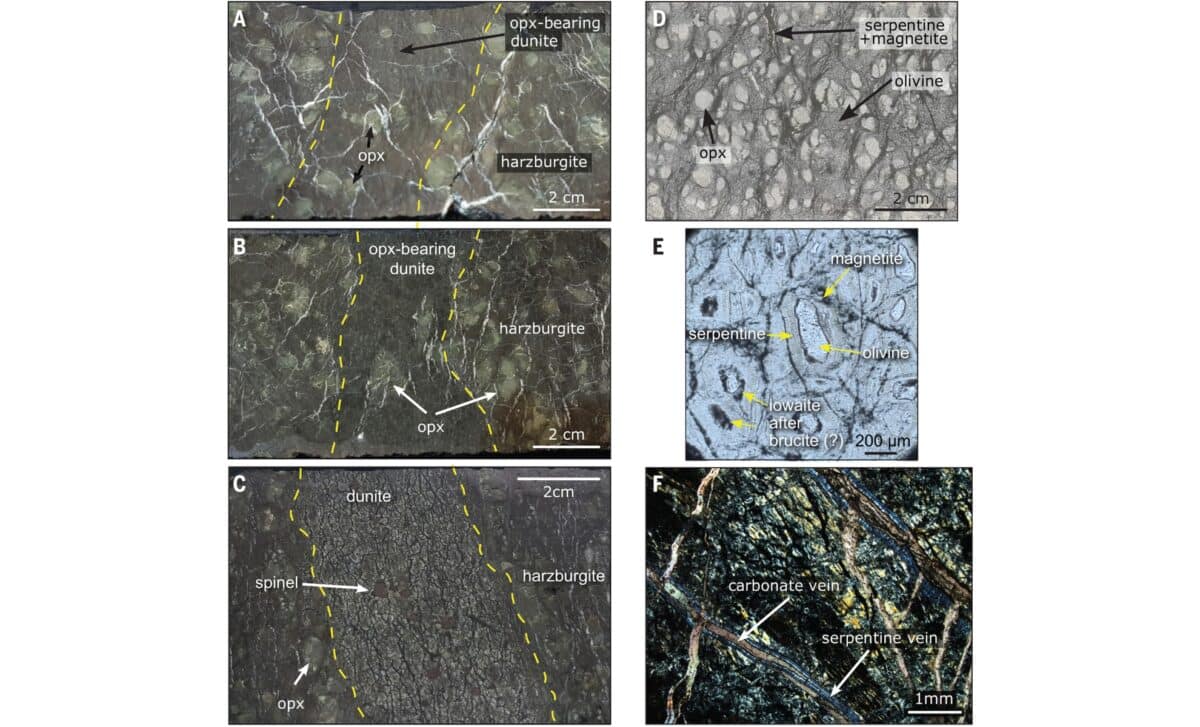
The core recovered during the mission contained abyssal peridotites, the dominant rock in the upper mantle. More specifically, preliminary analysis revealed the presence of harzburgite, a variety of peridotite that forms through partial melting of mantle rock. It also included gabbros, coarse-grained igneous rocks. Both rock types had undergone chemical changes due to prolonged exposure to seawater.
This process, known as serpentinization, alters the structure and composition of the mantle rock, giving it a green, marble-like texture. According to The Conversation, study co-author Andrew McCaig from the University of Leeds emphasized the scientific value of these samples, not only for their geologic content but for their relevance to understanding the Lost City’s geologic foundation.
Momentum Stalled Just as Breakthroughs Emerge
Despite the success of this drill, scientists still fell short of breaking through the Moho, leaving the goal of sampling pristine mantle unmet. Nonetheless, this was the closest any team has ever come. While the mantle’s full secrets remain locked away, the progress made hints at what might be possible with continued exploration.
Yet, as Popular Mechanics reports, the outlook for such efforts is dim. The NSF has declined to fund further core drilling with JOIDES Resolution beyond 2024, putting the future of deep mantle research at risk. Just as researchers are finally within reach of Earth’s most elusive layer, the tools may be taken off the table.
First Appeared on
Source link






