



Scientists Just Found a Fossil at the Bottom of the Ocean. Here’s What It Reveals About Our Ancestors!
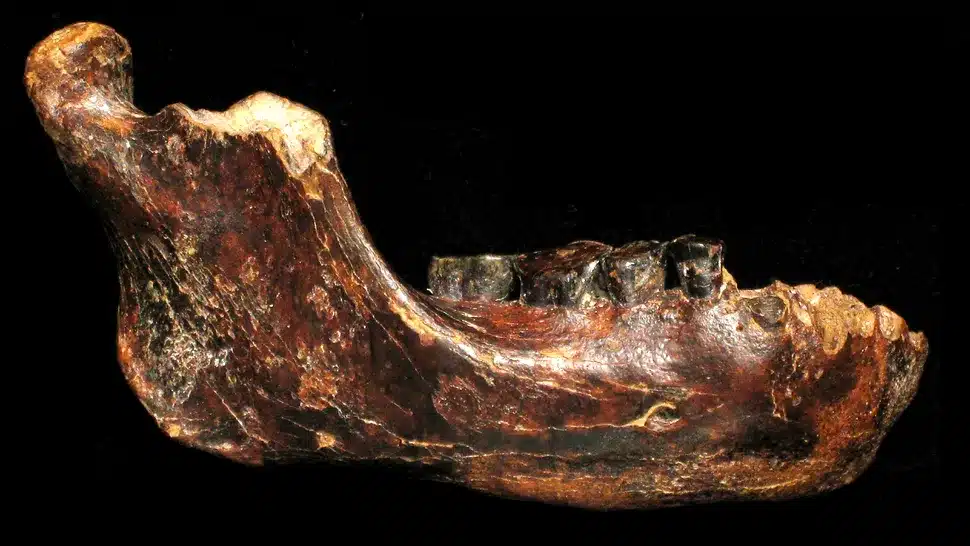
A jawbone retrieved from the bottom of the Taiwan Strait has been confirmed as belonging to a Denisovan, one of humanity’s most mysterious relatives. The fossil, discovered at depths of 60 to 120 meters, is the latest piece of evidence that Denisovans, once thought to inhabit only colder, mountainous regions, also lived in the warmer climates of Asia.
Previously, Denisovans were known to have lived mainly in Siberia’s Denisova Cave and parts of the Tibetan Plateau. But a recent jawbone find off Taiwan suggests that these ancient humans may have roamed a much wider area.
A Surprising Location for an Ancient Human Species
Denisovans have long been associated with cold, high-altitude environments. First identified in 2010, they were believed to have lived in places like Siberia’s Denisova Cave or the Tibetan Plateau, regions far removed from the humid, tropical conditions of the Taiwan Strait. But this new discovery challenges that narrative.
As stated by the researchers, the fossil’s location, 25 kilometers off the coast of Taiwan, was once part of the Asian mainland during the Pleistocene era, before rising sea levels submerged the area. The climate back then was warmer and more humid, far from the cold and dry environments where we’d expect to find Denisovans.
For many years, scientists could only speculate about the range of Denisovans, relying mostly on genetic traces found in modern populations. With this fossil, they now have physical evidence that confirms Denisovans were able to thrive in diverse environments.
New Techniques Illuminate Ancient Fossils
What makes this particular fossil even more significant is the way it was identified. Instead of relying on traditional methods like DNA analysis, which is often difficult to extract from such old specimens, According to a recent study in Science, scientists used paleoproteomics to examine the fossils. This method analyzes proteins found in ancient bones and teeth, providing a new way to confirm the species of a fossil even when DNA is long gone.
In this case, the researchers managed to extract over 4,000 amino acid residues from the fossil’s tooth enamel, and two of those residues were identified as Denisovan-specific. As Dr. Frido Welker, one of the study’s authors, pointed out, this breakthrough allows scientists to say with confidence that the jawbone came from a Denisovan.
“What I think is exciting in this particular study is that we have studied the dental enamel of the teeth as well, and from that, we can deduce that this individual is a male individual.”
Denisovans Were More Adaptable Than We Thought
What this jawbone also shows us is just how adaptable Denisovans were. Their ability to survive in such varied environments suggests they were a highly flexible species, capable of thriving in both cold and warm climates. Dr. Welker said that the regions where Denisovans have been found speak to their ability to adjust to changing conditions.
“When we think about the environments and climates, we have the Altai Mountains, the Tibetan plateau and vastly warmer and more humid environment that was present in the Taiwan Strait, which at the time was mainland East Asia,” he noted. “This signals a huge ability to adapt to very different environmental conditions, and survive in all those places.”
The study has shown that Denisovans had robust mandibles and large teeth, traits likely helping them survive in harsh environments. However, it remains unclear whether these traits were typical of the species or specific to male Denisovans.
“That’s something we’ll need more fossil evidence to confirm,” Dr. Welker said.
Denisovan Research: What to Expect in the Coming Years
Unfortunately, efforts to directly date the fossil through uranium techniques were unsuccessful, meaning we can’t pin down its exact age. However, researchers estimate that it’s likely between 10,000 and 190,000 years old. This uncertainty doesn’t diminish the importance of the find, though. As Dr. Welker explained the combination of paleoproteomics and genetic analysis could eventually help pinpoint when and where Denisovans roamed.
“With paleoproteomics and genetic methods, I hope that in the future we can better pinpoint where and when that happened.”
Looking forward, this discovery could lead to even more revelations about Denisovans, their interactions with Neanderthals and Homo sapiens, and their eventual disappearance.
First Appeared on
Source link






