


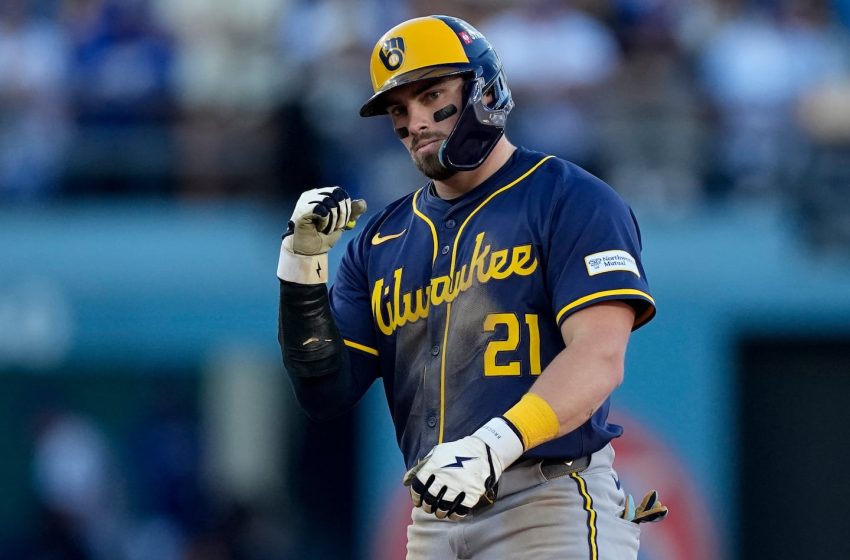
Red Sox trade for Brewers third baseman Caleb Durbin
Headed to Milwaukee in the deal: lefthander Kyle Harrison, infielder David Hamilton, and pitching prospect Shane Drohan.
Although all three players joining the Red Sox have major league experience — and should figure into their 2026 plans — Durbin is the biggest piece, even at a listed 5 feet 7 inches and 183 pounds.
He joins Marcelo Mayer, Romy Gonzalez, and Isiah Kiner-Falefa as options at second and third base.
“It looks like,” Gonzalez said, “we got a sick group.”
Durbin, a righthanded hitter who turns 26 this month, doesn’t hit the ball hard, but he also doesn’t strike out much. The Red Sox were drawn to him in part because his offensive approach is suited to Fenway Park. On average, about one of every five batted balls was pulled in the air, a high rate and a skill that works for hitters targeting the Green Monster.
He finished third in National League Rookie of the Year voting in 2025. He provided about league-average offense, hitting .256 with a .334 OBP and .387 slugging percentage, and rated well defensively at third base (with cameos at second and shortstop). He also stole 18 bases in 24 attempts.
“[The Red Sox] really like a lot of what Caleb brings to the table,” chief baseball officer Craig Breslow said. “He showed last year that he can be a very good everyday player in the big leagues. He does a lot of things really, really well. When you think about some of the deficiencies that our team had last year in terms of putting the ball in play, not expanding the strike zone, catching up to fastballs — those are all things that he excels at. And we think that he’s a really good defender, as well.”
As solid as Durbin was for Milwaukee, wheeling and dealing is the Brewers’ standard operating procedure. They were open to trading Durbin because they believe they have other infield options in the majors, with more on the way imminently, a league source said.
Originally a Braves draft pick in 2021 — out of Division 3 Washington University in St. Louis — Durbin has been traded three times, to the Yankees, Brewers, and now the Red Sox. Last offseason, he was the prize in the deal that sent Devin Williams from the Brewers to the Yankees.
Whether Durbin plays second or third — and which player(s) play the remaining spot — is to be determined. Manager Alex Cora indicated a preference for allowing Durbin, among others, to stick at one position.
“Consistency is very important,” Cora said. “I know the value of being versatile, but having the second baseman and shortstop play as many games as possible together is very important.”
Breslow said of Mayer: “He’ll have an opportunity in front of him to come in and compete for a spot. We’re excited about the potential that he has, and even more excited about the possibility of that manifesting throughout the season.”
Another piece of the evolving infield picture: Monasterio, a 28-year-old righthander hitter. He appears to be a Hamilton-like replacement as a utility infielder who can be sent to the minors. Breslow described him as “an above-average defender at multiple positions” — he has played all four infield spots across parts of three seasons in the majors — and last year saw his offense tick up to a .270 average and .755 OPS, better against lefthanders.
“Giving us another option who can play the infield and be in the lineup against lefthanded pitching is something that is important for us,” Breslow said. “[Monasterio has] kind of served that role very, very well in a couple of seasons with the Brewers.”
Seigler, 26, debuted last year, getting into 34 games. He worked mostly third base but in the minors played extensively at catcher and second. The Yankees selected him in the first round of the 2018 draft.
The Sox’ new draft pick is No. 67 overall, part of what is called competitive balance round B. It in effect replaces their second-round choice, which they lost as a result of signing Ranger Suárez (who had a qualifying offer attached to him).
Among the pieces the Red Sox gave up, Harrison was probably the biggest. Acquired in the Rafael Devers deal last June, Harrison was talked up by team officials as a potential frontline starter. In reality, it was difficult to imagine him getting many starts in what has become a loaded rotation. He became expendable via the Sox’ offseason additions of Suárez, Sonny Gray, and Johan Oviedo, plus the presence of prospects Connelly Early and Payton Tolle.
The Red Sox have re-traded three of four players from the Devers swap. Only Jose Bello, a righthander in the lower minors, remains.
Like Harrison, Hamilton appeared to be getting squeezed out. Drohan, added to the 40-man roster over the offseason, was another depth pitcher without a clear path to significant opportunity.
So the Red Sox did again what they had done at other points in recent months: trade non-critical players, particularly from their pitching depth, to supplement other parts of the roster.
“We were able to trade for guys like Caleb [by] giving up pitching,” Cora said. “You hate to do that, but at the same time, we feel very comfortable with the guys that we have.”
Breslow said: “You can start to see a fairly steady pipeline of pitching talent.”
Tim Healey can be reached at [email protected]. Follow him @timbhealey.
First Appeared on
Source link






