


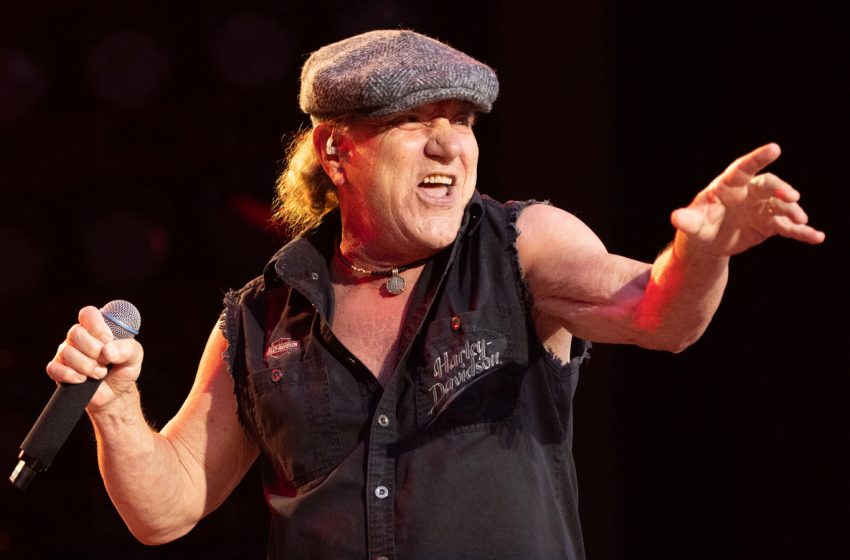
AC/DC Frontman Brian Johnson’s Car Collection Is Exactly As Wild As You’d Expect
Celebrities aren’t new to flashy wheels, but many of them could be accused of treating their cars as little more than a fashion accessory. AC/DC’s Brian Johnson, however, isn’t most celebrities. A legend of rock ‘n’ roll, Brian boasts a voice that’s instantly recognizable, with vocal cords that sound like they were forged in a blast furnace, quenched in whiskey, and tempered in smoke. On the stage, he is a tough act to follow — just watch this iconic two-hour performance at River Plate in 2009 shared by the band on YouTube – and he shows no signs of slowing down, with AC/DC embarking on a seven-month world tour in February 2026.
Besides his life fronting one of the world’s best rock bands, Brian is also known for being a petrolhead of the highest order with a multimillion-dollar car collection. Brian isn’t just any old collector, as his cars don’t sit in a garage beneath white cloth, waiting to be puttered around the neighborhood at 30 mph once every blue moon. Instead, Johnson is famous for driving and even racing many of the cars in his collection. In Florida, Brian can be found running errands in a Rolls-Royce or an almost 100-year-old Bentley. You may even find him participating in races like the Rolex 24, the Silverstone Classic, the Goodwood Festival of Speed, or Sebring historic sportscar racing events.
In fact, Brian is such a petrolhead that his first autobiography wasn’t simply about his time in AC/DC, but was equally focused on his life driving, racing, and loving cars. Strap in –- below we shine a light on some of the standout vehicles from Brian Johnson’s impressive collection.
The crown jewel – 1928 Bentley 4.5-liter Vanden Plas
If there’s one car in this collection that perfectly embodies Brian himself, it’s his loud, unapologetically British Bentley. Affectionately named Thunder Guts, Brian’s 1928 4.5-liter Vanden Plas roars to a start and lives the best life a pre-war Bentley could imagine. Rather than sitting in the shade of a museum and being polished with cotton buds, Thunder Guts still lives a life of active duty and gets driven around Florida (or even to the Daytona Internationl Speedway) three to four times a week.
Debuting in 1927, the 4.5-liter was W.O. Bentley’s answer to the need for speed. It replaced the earlier 3-liter Bentley and was powered by a massive inline-four engine with four valves per cylinder capable of producing 110 horsepower –- a big deal for touring cars of the roaring ’20s! Bentleys similar to the one Brian owns helped cement the legend of the Bentley Boys, who used these cars to secure one of their four consecutive wins at the 24 Hours of Le Mans between 1927 and 1930.
Brian acquired Thunder Guts in 2010 from the late, great Bentley specialist Stanley Mann. Since then, it’s never broken down. “I could be away for three, four months on tour… and you just get in and it’s like starting up an aircraft,” he told Jodie Kidd on Kidd In A Sweet Shop –- which just goes to prove the benefits of an active retirement.
The Widow Maker – 1965 Lola T70 Mk I
If Brian’s Bentley is the charming, aristocratic grandfather of his collection, then his Lola T70 Mk I is the ever-young rockstar –- which might be why Brian loves it so much. Nicknamed Widow Maker because of its extreme handling and speed, Brian’s T70 dates from 1965 and is the last of only 15 ever made by the British manufacturer. Built as a successor to the Mk 6 and designed by Eric Broadley, the T70 Mk I was one of the most successful racing supercars of its era. It features an aluminum monocoque chassis, a fiberglass body, and gas tanks located on either side of the cockpit.
Powered by a mid-engine Ford V8, Brian’s Lola boasts 640 hp and, according to the man himself, “makes a sound like a song.” Besides its impressive specs, Brian’s T70 packs plenty of racing history. It first hit the track in 1965 at the Stardust Grand Prix, piloted by Ronnie Bucknum. In 1968, it served as the camera car for the film “Winning” -– it even still has the camera mounts on the chassis — and might just be the most futuristic-looking car ever in the history of cinema.
Much like its owner, Brian’s T70 keeps making history. In 2011, it made its vintage track debut at the 2011 Speedfest held on Road Atlanta with Johnson behind the wheel –- which came off the dashboard mid-race at almost 150 mph! Luckily, Brian was able to bring the Widow Maker to a safe stop on the green.
The classy daily driver – 2007 Rolls-Royce Phantom
After wrestling the Lola, even a seasoned rock god needs a bit of decompression. Enter the enormous 2007 Rolls-Royce Phantom –- Brian’s daily driver, which he cruises around Florida, Sydney, or anywhere else when he needs to travel in luxury. For a man born into a working-class family in England to a coal miner and immigrant mother, driving a Rolls is somewhat of a childhood dream. “Since I was a kid, there was something magical about Rolls-Royce. It was unattainable, you couldn’t get one,” Brian said on his show “Cars That Rock With Brian Johnson.”
Besides the statement it makes, Brian’s Phantom packs more than enough punch. Under its massive bonnet lies a 6.75-liter V12 engine that pushes out around 450 hp –- enough grunt to propel this leviathan from zero to 60 in under six seconds. Inside the cabin, the Phantom features a hand-stitched leather interior, book-matched wood veneers, double-glazed windows, and soundproofing for a smooth, quiet ride.
Brian acquired his Rolls-Royce in 2008 and he couldn’t be happier -– “It’s the best car I’ve ever had! It’s just 12-cylinders of pure joy. It’s great, it’s comfy and you always have a smile on your face when driving,” he told the Fuelling Around podcast.
The one that got away – 1948 Triumph 2000 Roadster
Brian’s garage might be stacked with permanent residents, but like any true petrolhead, he has a story about the one that got away. For Johnson, that heartbreak came in the form of a stunning Triumph 2000 Roadster from 1948.
The Roadster was Triumph’s first post-war car, which was developed during the Standard Motor Company takeover and made to compete with Jaguar’s sports cars of the time. They were also one of the last cars to feature a “dickie” or rumble seat that could fit two extra passengers. The 2000 Roadster featured a 2-liter engine (a step up from the 1.8-liter 1800), and Brian’s model dates from September 1948 – when the vehicles got a serious upgrade and were fitted with 127 ci (2088 cc) 4-cylinder Vanguard engines and transmissions.
Brian didn’t hide his love for his Roadster, as he regularly reminisces about it in interviews. However, like any true romantic, he couldn’t say no when the offer to sell it came from his close friend, the artist William Kelly. Kelly had asked to borrow the car to take his dying mother on one last ride around her hometown. “She just sat with this big straw hat on, remembering when she was young. And he just came to us after and said, ‘you have to sell me that car, Brian.’ He’s still got it,” Brian recalled on Kidd In A Sweet Shop.
The Italian stallion – Ferrari 458 Italia
In a collection dominated by British classics, Brian’s Ferrari 458 Italia stands out like a bright red sore thumb. But don’t be fooled into thinking that this is some lame attempt to uphold poseur rockstar tradition -– Brian loves his Prancing Horse for very profound reasons.
First and foremost, the 458 Italia is a modern masterpiece that’s won over 30 international awards for its performance and engineering — in fact, you can watch us prove it with a test drive. At its heart lies what might be one of the last great naturally aspirated mid-engine, a 4.5L V8 that can comfortably scream its way to a spine-tingling 9,000 RPM. With 562 hp and nearly 400 lb-ft of torque, the 458 Italia uses F1-derived technology like GDI and split injection to maximize both performance and fuel economy. As if that weren’t enough, the car’s racing exhaust is like music to any petrolhead’s ears.
Still, Brian’s bond to his Ferrari isn’t all about specs. Born to an Italian mother who helped British pilots escape from Italy in World War II, Brian’s passion for Italian cars began early — as a boy growing up in Northern England, he remembers receiving Italian magazines from his overseas relatives and marveling at the pictures in them, especially one that featured Tazio Nuvolari holding a cup and a cigarette. Brian’s love for his 458 is so strong that during one episode of Cars That Rock he shipped the car from Florida to Newcastle in 2016 for the purpose of visiting his brother and taking a thunderous victory lap of the town he grew up in.
The king of the track – 1970 Royale RP-4
Brian seems to have a tool for every job. There’s the Rolls-Royce for running errands in luxury and style, a Ferrari for screaming down the highway, and there’s a 1970 Royale RP4 built exclusively for the serious business of tallying up track wins.
Along with his Lola T70, this piece of racing history proves that Brian isn’t just a collector with great taste -– he’s a bona fide, apex-clipping speed demon. The brainchild of Bob Marston, the RP4 was the successor of the RP2 and famously dominated the Formula F100 championships of 1970 and 1971 at the hands of Ray Allen, who won 12 of the 13 races he ran using this exact car.
A rare beast, Brian’s RP4 is chassis #4 of only 11 models ever made and features a 1.6-liter Ford inline-4 mid-engine capable of producing 150 to 160 hp. Like his Lola T70, Brian’s RP4 doesn’t gather dust in his garage. In fact, he has used it extensively and exclusively on the track, particularly to compete at Historic Sportscar Racing events. Maintained by Heritage Motorsports in Florida, Johnson’s RP4 has always been kept in tip-top shape and, accordingly, garnered plenty of wins. In 2016, Brian famously took home the checkered flag at the Savannah Speed Classic’s Historic Sportscar Racing event.
The gateway drug – 1964 Lotus Cortina Mk 1
Collections all start somewhere, and for Brian Johnson, the vintage virus didn’t take hold with his Bentley Blower, but an iconic British saloon on steroids — the 1964 Lotus Cortina Mk 1.
Though not his first car, the Lotus Cortina was Brian’s first vintage racer and it remains an absolute marvel of English machinery. To the uneducated eye, a Lotus Cortina looks like something a geography teacher would drive to a garden center, but those olive-green stripes along its sides are a warning sign — these cars were engineered to fly. The recipe behind this car’s speed was simple: take the lightweight shell of the two-door Ford Cortina and stuff it with a 1.6-liter twin-cam inline-four engine from the Lotus Elan.
Armed with a four-speed transmission, a light monocoque shell, and MacPherson front suspension, this Frankenstein was an instant success and dominated competition events. Jim Clark famously won the British Saloon Car Championship in 1964 in a new Cortina, and Brian made sure to keep up with tradition, racing his Mk 1 extensively at Historic Sportscar Racing events. His Lotus also features an upgraded 1.8-liter engine, as well as the nicks and dents you’d expect from a car that continues living life on the track.
The first slice of new – Circa 1980 Chevrolet Blazer
Some musicians spend their entire lives battling it out on the sidelines. But for a select few, the struggle eventually rolls to a stop, and the bank balance starts to acquire a lot of commas. For Brian, that happened in 1980, when he was hand-picked to ditch his local Newcastle band Geordie and front AC/DC. After receiving his first major royalty check, he decided to celebrate the only way a petrolhead knows how -– by buying his first-ever brand-new car.
Of course, Brian didn’t cut corners. He went and bought a tank in the form of a Chevrolet Blazer, a nameplate that’s made multiple comebacks. To understand how ridiculous that is, we have to remember that in the 1980s, England’s streets were dominated by cars more miserable than the local weather: Vauxhall Cavaliers, Ford Fiestas, and the depressing Austin Metro. The Blazer, meanwhile, was the complete opposite –- big, loud, and with a thirst like a sailor on shore leave.
In other words, the perfect car for the new frontman of the loudest band on Earth. Brian still remembers driving home his Blazer, “It was big, and it was just brutal, it was American, and I just loved it!” he told Courtney Hansen on Autoweek. “I got it back to Newcastle and the people were just scratching their heads going what the hell is that big bloody thing? They’d never seen anything like it.”
The one that rolled – Austin A35
In 2017, Brian Johnson taught the racing world a very valuable lesson. Physics will eventually catch up with all of us — even if you’re the frontman of a world-famous rock band. The classroom was the Silverstone Classic in the U.K., and the vehicle wasn’t Brian’s terrifying Lola T70 or RP4. Instead, it was a humble Austin A35, a car that looks more like an inverted bathtub than a track weapon. During the qualifying race for the Celebrity Challenge Trophy, Brian pushed the little saloon a little too hard into a corner, flipping it. While the Austin suffered, the man inside walked away unscathed.
Introduced in September 1956, the Austin A35 replaced the A30, offering a big upgrade: a 58 ci (948 cc) inline-four motor that could handle high octane fuel. This meant the cars now crept rather than crawled, reaching max speeds of 70 mph and conquering zero to 60 mph in a leisurely 30 seconds. While it might seem laughable today, that kind of power was more than enough for the British families of the 1950s. Technically, the A35 was impressive for its time, which was why it was so successful. It featured a chassis-less construction, a remote gearbox with better spacing than the A30, a larger rear window that improved visibility, and just enough luxury, thanks to its carpeted interior.
Of course, the A35 Brian was racing was far from stock –- it was a spec racer stripped of weight, caged, and tuned to maximize that A-series engine. Yet, as Brian demonstrated, you cannot tune out bad aerodynamics. The A35 possesses the handling of a garden shed, and is best left to putter around the cold, wet streets of the country that birthed it, not fly around a track.
The unexpected – 1957 Vespa 400
Closing out Brian’s collection, which features thundering V8s and iconic racers, we have — a kitchen appliance. The 1957 Vespa 400 is so small that, parked behind Brian’s Chevy Blazer, it would disappear from the face of the earth.
Essentially a scooter that’s been scared into growing a roof and four wheels, the Vespa 400 was built by Piaggio in France for just four years (thank god) and designed to compete with the Fiat 500 -– a monster truck in comparison. It features a 24 ci (393 cc) two-stroke, rear-mounted engine that produces -– drum roll please -– 14 brake horsepower. Weighing just 770 lbs, its max speed was around 50 mph.
Aptly named Half Pint, Brian acknowledges that the Vespa is far from reliable, but just so much fun. He uses it as a pit vehicle and, in doing so, proves that speed isn’t the only ingredient necessary for an awesome car collection.
First Appeared on
Source link






