


NASA revises plans for future Artemis missions, cancels upgrades to SLS
Updated 12 p.m. Eastern with additional details and comments.
WASHINGTON — NASA announced major changes to its Artemis lunar architecture, adding a test flight of lunar landers in low Earth orbit while canceling planned upgrades to the Space Launch System.
At a Feb. 27 briefing, NASA said it would change the schedule of upcoming Artemis missions to add a flight in 2027 where Orion will rendezvous and dock with lunar landers from Blue Origin and/or SpaceX while in low Earth orbit. The mission would also test a new spacesuit being developed by Axiom Space.
That new mission will be named Artemis 3, which had been reserved for the first crewed lunar landing attempt. Under the new plan, the first lunar landing would be attempted on Artemis 4 in 2028, with the possibility of an Artemis 5 in late 2028.
The new Artemis 3 would be analogous to Apollo 9, a mission in early 1969 that was the first test of the Lunar Module in space, including docking tests in low Earth orbit.
NASA Administrator Jared Isaacman said the new mission would allow NASA to move at a faster rate as it faces competition from China, which is planning its first crewed lunar lander for around 2030.
“NASA must standardize its approach, increase flight rate safely and execute on the President’s national space policy,” he said in a statement. “With credible competition from our greatest geopolitical adversary increasing by the day, we need to move faster, eliminate delays and achieve our objectives.”
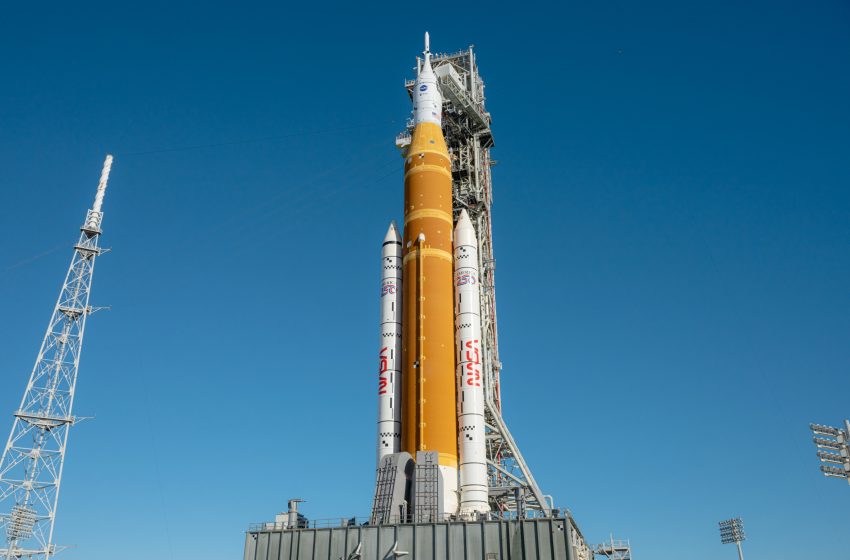
As part of those changes to increase flight rate, NASA said it was abandoning plans to upgrade the SLS after Artemis 3. The first three SLS launches use the Block 1 configuration, with the Interim Cryogenic Propulsion Stage (ICPS) as the upper stage. Future SLS launches were to use the Block 1B version, with the larger Exploration Upper Stage.
Instead, NASA said it will no longer develop the Block 1B, using instead a “near Block 1” configuration. The agency did not disclose details on the specific upper stage it will use; the ICPS is based on the upper stage for the Delta 4, which is no longer in production.
Maintaining the Block 1 configuration is intended to allow for a faster flight rate. Isaacman has publicly expressed frustration with the low flight rate of SLS — Artemis 2, the second SLS launch, will take place more than three years after Artemis 1 — that he believes may explain the issues such as hydrogen leaks seen during preparations for Artemis 2.
“Launching a rocket as important and as complex as SLS every three years is not a path to success,” Isaacman said at the briefing after comparing the technical issues seen during both Artemis 1 and 2. “When you’re launching every three years, your skills atrophy.”
Being able to launch more frequently, he noted, would also allow NASA to make smaller technical steps between missions, rather than going directly to a lunar landing on Artemis 3 as previously planned. The Aerospace Safety Advisory Panel (ASAP) had previously warned of the high risk to Artemis 3 given the large number of first-time activities on that mission.
“A wide objective gap between missions is also not a pathway to success,” he said. “We didn’t go right to Apollo 11.”
Details and reaction
The announcement provided few technical details about the revised plan for Artemis 3 and future missions or changes to the SLS.
Isaacman, for example, declined to identify who would manufacture the upper stage for the “near Block 1” version of SLS after Artemis 3, or how that would be contracted. “We’ve been discussing with industry this strategy for several weeks,” he said. “We obviously have confidence in our ability to source and integrate a more standardized second stage.”
“We’re going to work with our partners and make sure we handle that in the right way,” NASA Associate Administrator Amit Kshatriya said at the briefing when asked about the effective cancellation of the Exploration Upper Stage, but did not elaborate.
The move to speed up SLS launches comes as both Blue Origin and SpaceX are working on plans to accelerate work on their Human Landing System landers for Artemis. Neither company, though, has released details about those revised development efforts, nor has NASA.
Accelerating Artemis missions while not upgrading SLS will have some “puts and takes” on the overall cost of Artemis, Isaacman said, with standardizing vehicles saving money but an increased cadence, including hiring more people, to cost money.
“There are areas where we expect savings as a result of this approach. There are areas where we expect to spend more,” he said, without estimating if there would be a net cost increase or reduction. “We do believe we have the resources to achieve this.”
The changes have been briefed with key members of Congress, Isaacman said, part of what he called a “no surprises” policy of working with Capitol Hill. “They all understand that this is the path forward,” he said. “I don’t think I heard a single objection on these subjects.”
He said that while the new plan addresses some of the objections raised by ASAP about the original plan for Artemis 3, it was not as a result of collaborating with that independent panel. “ASAP was right to call out some of our shortcomings and we should be addressing them. It just happens to be in parallel.”
The changes were coordinated with industry as well. “We didn’t just decide to do this today without making sure we assessed the inventory of hardware that we have available,” Kshatriya said, citing progress on development of future SLS and Orion vehicles as well as SpaceX’s Starship.
The revised plan has the support of Boeing, the prime contractor for the SLS and who had been working on the Exploration Upper Stage.
“As NASA lays out an accelerated launch schedule, our workforce and supply chain are prepared to meet the increased production needs,” Steve Parker, head of Boeing’s Defense, Space and Security business unit, said in a statement.
Lockheed Martin, the Orion prime contractor, also endorsed the new architecture. “We’re excited about Administrator Isaacman’s bold decision to increase the Artemis launch cadence,” Robert Lightfoot, president of Lockheed Martin Space, said in a statement. “Flight-proven systems like Orion will be essential to the future of Artemis, and we are fully committed to meeting the delivery timelines for these historic missions.”
Related
First Appeared on
Source link






