


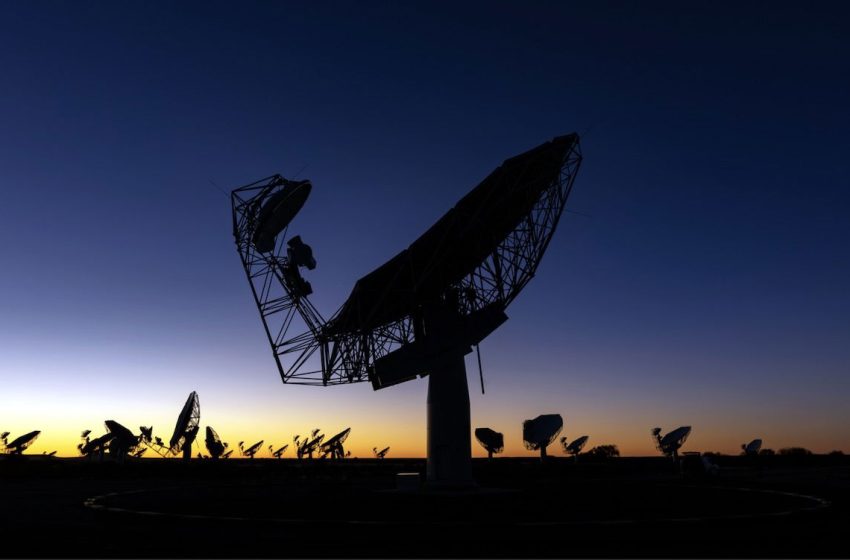
MeerKat Telescope Spots Mega-Powered “Space Laser” Beaming Across the Cosmos, Revealing Most Distant Luminous Object Known
In a discovery that astronomers are calling a “truly extraordinary” find, a powerful “space laser” mega-beam has been detected from across the cosmos.
The remarkable discovery was made by astronomers using the MeerKAT radio telescope in South Africa, by a team led by researchers from the University of Pretoria.
The team says it has detected a distant hydroxyl megamaser with the aid of MeerKAT’s powerful capabilities, along with powerful gravitational lensing, within a merging galaxy located an astounding 8 billion light-years from Earth. The discovery, the team says, marks astronomers’ entry into a new and exciting frontier in radio astronomy.
“This system is truly extraordinary,” said Dr. Thato Manamela, a postdoctoral researcher with the University of Pretoria and first author of a recent study detailing the findings.
A Hydroxyl “Space Laser” is Spotted
These novel “space lasers” are actually a very bright variety of radio emissions that are generated when hydroxyl molecules present in gassy merging galaxies collide. The resulting hydroxyl megamasers produced by these powerful events stimulate hydroxyl molecules, which
Significantly boosts the radio emissions these cosmic regions produce.
Astronomers liken them to “space lasers” because the conditions that give rise to such phenomena are very similar to how scientists produce lasers on Earth, although carried across much greater light wavelengths—clocking in at around 18 centimeters—than those detectable by the human eye.
The resulting light is extremely bright, giving rise to what astronomers call a megamaser, which is visible across extremely great astronomical distances.
HATLAS Shrugged
The recent detections focused on a new system astronomers have designated HATLAS J142935.3–002836. Located more than 8 billion light-years away, this system is so far away that the emissions observed during the recent MeerKAT detections originally occurred when the Universe was less than half its present age.
Presently, HATLAS J142935.3–002836 is recognized as not only the most distant luminous object ever observed by astronomers, but also one so awesomely powerful that an entirely new classification of object, which astronomers now call a gigamaser, has been proposed for it.
One of the most remarkable aspects of the discovery is the surprising strength of HATLAS J142935.3–002836’s signal, despite its incredible distance from Earth. Still, astronomers would not have succeeded in detecting it had it not been for the combination of MeerKAT’s sensitive capabilities and the astrophysical phenomenon of gravitational lensing.
First theorized by Einstein, gravitational lensing occurs when concentrations of matter across the universe bend light between its origin point and Earth, which grants astronomers an unprecedented ability to detect objects from across the cosmos.
An “Extraordinary” Discovery
Dr. Manamela said that he and his team were very surprised to spot such a luminous object beaming toward Earth from so far away.
“We are seeing the radio equivalent of a laser halfway across the universe,” Manamela said in a statement. “Not only that, during its journey to Earth, the radio waves are further amplified by a perfectly aligned, yet unrelated foreground galaxy.”
“This galaxy acts as a lens, the way a water droplet on a window pane would, because its mass curves the local space-time,” Manamela added. “So we have a radio laser passing through a cosmic telescope before being detected by the powerful MeerKAT radio telescope—altogether enabling a wonderfully serendipitous discovery.”
While MeerKAT is specially designed to make such detections, researchers still have to carefully process vast amounts of information it gathers, which also must be properly calibrated before collection. State-of-the-art algorithms and other advanced computational processing methods enable the kinds of discoveries Manamela’s team has made.
The result of this elaborate process is “a powerful demonstration of what MeerKAT can do when paired with advanced computational infrastructure, fit-for-purpose data processing pipelines, and highly-trained software support personnel,” according to Professor Roger Deane, Director of the Inter-University Institute for Data Intensive Astronomy (IDIA) and a Professor at the Universities of Cape Town and Pretoria.
Manamela says that what he and his team are now doing only marks the beginning of the discoveries they hope to unravel in the years ahead.
Fundamentally, what the team has accomplished—in addition to highlighting South Africa’s role in radio astronomy and the partnerships between IDIA and SARAO that are propelling MeerKAT’s discoveries—is a new means of studying the universe by enhancing our ability to detect some of the rarest phenomena in the cosmos.
“This synergistic combination empowers young South African scientists, like Dr. Manamela, to lead cutting-edge science and compete with the best in the world,” Deane said, who was also a co-author on the recent study.
“We don’t want to find just one system—we want to find hundreds to thousands,” Manamela added.
The team’s recent study, “MeerKAT discovery of a high-redshift strongly-lensed hydroxyl gigamaser,” appeared at the preprint server arXiv.org and has been accepted for publication in Monthly Notices of the Royal Astronomical Society Letters.
Micah Hanks is the Editor-in-Chief and Co-Founder of The Debrief. A longtime reporter on science, defense, and technology with a focus on space and astronomy, he can be reached at [email protected]. Follow him on X @MicahHanks, and at micahhanks.com.
First Appeared on
Source link






