


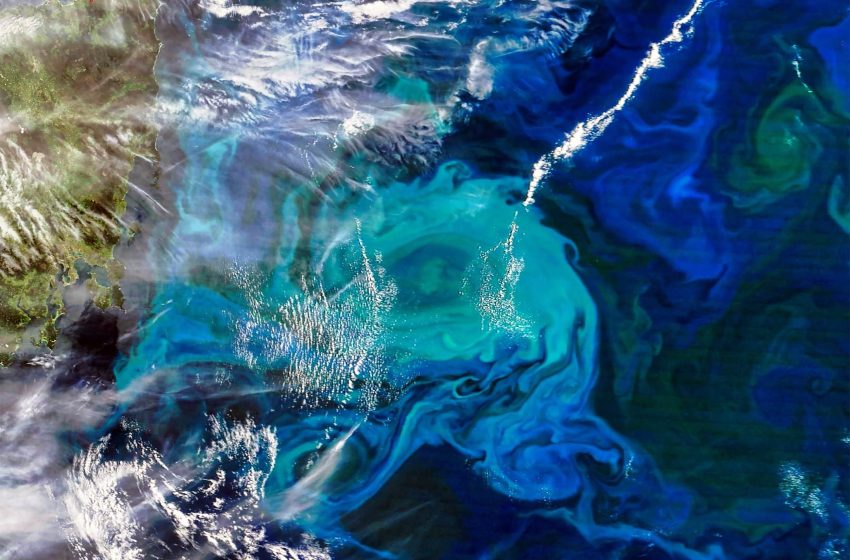
Underwater Antarctic earthquakes fuel explosions of surface life
Deep beneath the waves, the ocean floor is anything but quiet. Plates grind, rocks crack, and heat escapes.
For decades, scientists thought those deep movements stayed deep, locked far below the surface where sunlight never reaches. That assumption is starting to fall apart.
New research shows that underwater earthquakes can set off a chain reaction that ends with giant blooms of life at the ocean’s surface. Tiny organisms respond. The food web shifts.
Even the planet’s carbon balance may feel the effect. It’s a reminder that Earth’s systems interact in ways we’re only beginning to understand.
Microscopic drivers of oceans
Phytoplankton sit at the center of this story. These microscopic, plant-like organisms float in the upper layers of the ocean.
They feed nearly everything else, from small crustaceans to whales. Phytoplankton also pull carbon dioxide out of the air and release oxygen back into it. Without them, ocean life as we know it would collapse.
Scientists have long known that phytoplankton growth depends on nutrients. Light and temperature matter. But in much of the Southern Ocean, iron is the key ingredient, and it’s in short supply. Where iron appears, phytoplankton follow.
A bloom scientists couldn’t explain
Years ago, researchers noticed a massive phytoplankton bloom that returns every year to the same stretch of the Southern Ocean near Antarctica.
Some years, it spreads wide and thick. Other years, it barely shows up. Satellite images showed swings so large they couldn’t be ignored.
“When looking back over satellite observations of this bloom, we’ve seen it swell to the size of the state of California or down to the size of Delaware,” said study lead author Casey Schine, a postdoctoral research associate at Middlebury College.
“Our study ultimately showed that the main factor controlling the size of this annual phytoplankton bloom was the amount of seismic activity in the preceding few months.”
The bloom sits above a jagged underwater mountain chain called the Australian Antarctic Ridge. This ridge is part of a global network of mid-ocean ridges, places where Earth’s crust pulls apart, and magma rises. These areas host hydrothermal vents, underwater hot springs that release heated, mineral-rich fluids into the ocean.
In 2019, earlier research showed that iron from these vents can fuel phytoplankton blooms. But that finding didn’t explain why the same bloom could vary so wildly from one year to the next.
Earthquakes unlock ocean nutrients
Earthquakes offered a clue. When the ground shakes, it can change how hydrothermal vents behave. Cracks open. Blockages clear. Hot fluids rush out faster and carry more dissolved metals, including iron.
“When we ruled out more obvious drivers of this variation, we started thinking about the iron nutrient sources themselves – the hydrothermal vents,” said Schine. The idea was not an easy sell.
“Casey had an idea that maybe the number of earthquakes near the hydrothermal vent was controlling the release of trace metals into surface waters that could stimulate phytoplankton growth,” said the study’s senior author, Kevin Arrigo of the Stanford Doerr School of Sustainability.
“I figured that it was a long shot but told her to go for it. And it turns out that she was right!”
When earthquakes feed phytoplankton
To test the theory, the research team matched decades of satellite data with earthquake records from seismic monitoring stations. They focused on earthquakes with a magnitude of 5 or higher.
The pattern stood out. When more earthquakes struck the region in the months leading up to the Southern Hemisphere summer, the phytoplankton bloom that followed was denser and more productive.
“This is the first ever study to document a direct relationship between earthquake activity at the bottom of the ocean and phytoplankton growth at the surface,” said Arrigo.
A faster path to the surface
One of the most surprising findings involved speed. Iron released from vents nearly 6,000 feet below the surface appeared to reach phytoplankton in weeks to a few months. That runs against long-standing assumptions.
For years, many scientists believed hydrothermal iron took decades to rise and drift thousands of miles before becoming biologically useful. This study suggests something much faster is happening, though the exact process is still under investigation.
A research expedition in December 2024 returned to the Australian Antarctic Ridge to collect more data. Those samples may help explain how deep-sea fluids move upward so quickly and stay concentrated enough to matter.
Ripple effects through the food web
Changes in phytoplankton productivity don’t stay small. These blooms feed krill and other tiny animals. Krill feed fish, penguins, seals, and whales. A stronger bloom can mean a stronger food supply.
“We already know that marginal phytoplankton blooms beyond the sea ice around the Antarctic continent are an important feeding ground for whale,” Schine said. “So, there’s potentially more to the story now that we suspect seismic activity plays a role in bloom productivity.”
Phytoplankton also play a quiet role in climate. By pulling carbon dioxide from the atmosphere, they help regulate how much heat the planet traps.
Better understanding what controls their growth could improve models that predict future carbon uptake by the oceans.
A worldwide ocean puzzle
The Southern Ocean may not be unique. Hydrothermal vents exist across the globe, many in earthquake-prone regions. Whether similar processes drive blooms elsewhere remains an open question.
“There are many other places across the world where hydrothermal vents spew trace metals into the ocean that could support enhanced phytoplankton growth and carbon uptake,” said Arrigo.
“Unfortunately, these locations are difficult to sample and little is known about their global significance.”
What’s clear is that life at the surface may depend more on deep Earth forces than anyone once thought. The planet doesn’t keep its secrets neatly separated. Sometimes, a tremor miles below the seafloor can help life flourish far above it.
The full study was published in the journal Nature Geoscience.
—–
Like what you read? Subscribe to our newsletter for engaging articles, exclusive content, and the latest updates.
Check us out on EarthSnap, a free app brought to you by Eric Ralls and Earth.com.
—–
First Appeared on
Source link






