


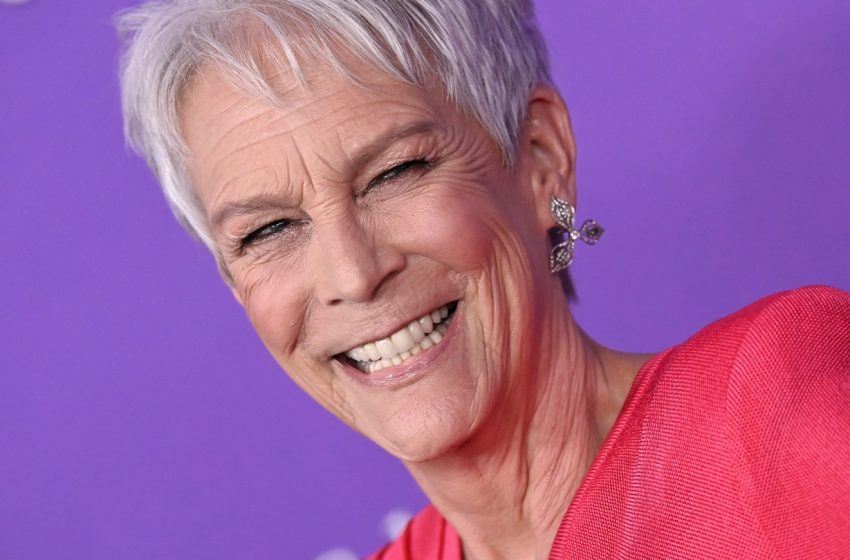
Jamie Lee Curtis Has Some Ideas on How to Protect the Film Industry
Just as the original Halloween did nearly 50 years ago, David Gordon Green’s revival of the iconic horror franchise in 2018 changed the course of Jamie Lee Curtis’s career in a few important ways. The first was that, because the star wasn’t fully up to speed on the filmmakers’ plan to make another trilogy out of it, she approached producer Jason Blum to launch a production deal together. “I’m sure he gave it to me because he needed me to do two more Halloween movies,” she cracks.
The second had to do with the actual creative experience of making that movie. “It was fast and fun and collaborative and nobody took money and it was all made for nothing — and I came back really turned on,” she says. Specifically, Curtis told her husband, the filmmaker Christopher Guest, that she would write and direct the movie she’d been wanting to make since she was 19 years old, called Mother Nature. Through a Zoom box, she shows me her voice-memo recording of the 40-page outline she dictated on March 1, 2018, two weeks after filming on Halloween concluded.
Mother Nature has still not seen the light of day — though Curtis did make a graphic novel out of it; more on that later — but Curtis has made good on that creative reawakening. The 67-year-old’s acting career has exploded, taking home her first Oscar (Everything Everywhere All at Once) and Emmy (The Bear) in the last few years. She’s produced everything from the newly premiered Nicole Kidman TV vehicle Scarpetta to last year’s Freakier Friday sequel to the currently Oscar-nominated The Lost Bus.
Her most intriguing behind-the-scenes endeavor, however, may be a premiere at SXSW on Saturday: the paranoid thriller Sender, helmed by first-time feature director Russell Goldman and starring Emmy winner Britt Lower (Curtis also plays a supporting role).
The film is weird, singular and smartly acted — the culmination of a partnership between Curtis and Goldman that began eight years ago, with the latter fresh out of Wesleyan. “I was an out-of-work writer there to help her figure out Final Draft,” Goldman says, referring to Curtis’s attempts to get that Mother Nature script off the ground. “I had no assumption it would be a creative job, but I didn’t know Jamie yet. Because Jamie oozes creativity.” Goldman now works in development for Curtis’s Comet Pictures, but as she clarifies for me: “He’s a fucking filmmaker. He’s not a development executive.” He is now, technically, both.
Curtis’s fast rise as a power producer has given her a front-row seat to the anxieties and struggles of the industry she grew up in. “I see the lists of actors who are available for work, and when you start going down these lists, these are people who have starred in movies, had their own TV series — and they’re willing to go on tape for a small part in either your movie or your TV show,” she says. “It is a desperate time. There is very little work available.” She worries about “consolidation” — referring, no doubt, to Paramount’s impending acquisition of Warner Bros. — and recently reposted a criticism of Timothée Chalamet’s viral comments about preferring to work in movies versus ballet and opera, art forms that he said are fueled by strained efforts to “keep this thing alive.”
“My daughter has been a dancer her whole life — my daughter teaches dance and has a dance academy — so his comments are silly, and I’m sorry that they’re going to be a bit of his legacy now,” Curtis says of Chalamet. “I’m sure he regrets the comment because you can’t throw those art forms under a bus. You can’t do it. They’re too important. Does that mean that there’s not a reduction in audiences for those art forms? I’m sure there is. Does that mean it’s going to be the destruction of those art forms? No.” She adds, “People still shoot on film, by the way.”
Jamie Lee Curtis in Sender
Which gets at Curtis’s larger philosophy as a film producer. She’s seen what the medium is still capable of, with the success of wild gambles like Everything Everywhere. “I believe that the industry will survive — I think we’re in more of a transition phase,” she says. “I hope heads of companies will take $50 million of their annual budgets and say, ‘Let’s give $5 million to 10 filmmakers who want to make a $5 million movie and see what comes out of that investment,’ as well as these giant investments on these tentpole movies where you’re paying leads in the $20 million range. Let’s do both. I hope that all those big companies recognize that importance.”
“Nobody knows shit about what makes anything successful,” Curtis adds. “You just have to trust the art form.”
**
Curtis has been trying to produce almost as long as she’s been a working actress. Her struggles at finding her foothold behind the scenes led to her decades of work on best-selling children’s books — while film and TV ideas “died on the vine — and they were good ideas.” She’s been working toward this moment, in other words. “I’ve been doing this for a long time, and I’ve been hungry for this level of creativity and partnership and matching artists with work for a long time,” she says.
She spent 12 years committed to telling the fascinating and complex story of Glenn Burke, the first out gay professional baseball player who is also credited with inventing the high-five. Three different film scripts were written. Eventually, eight episodic scripts for a limited series written by the playwright Robert O’Hara with Ryan Murphy on board — reports surfaced that Netflix was backing the project — before it faded away. “It was beautifully written, it was adventurous, it was very sexual, and it just was too much, I think, to imagine,” Curtis says. “It just became impossible to tell that story truthfully without really blowing up all sorts of things. But boy did I try.”
Then there’s Mother Nature, which got pretty far into development, with a screenplay that Goldman helped rework — “He took out all the men and he said, ‘Jamie, the name of your movie is Mother Nature’” — before they moved onto other endeavors as the cost of the project, particularly, proved prohibitive. Together they put out a graphic novel instead and Curtis still sees a path for making a film out of it, with Goldman directing. “Now all of a sudden, Russell Goldman is my partner — he’s not my 5 percent, he’s 50 percent if not more,” she says. Goldman adds, “She embraces risk and meets new, weird ideas with curiosity.”
A few years ago, Goldman had started making short films on the side. All the while, an idea sparked Curtis when a pair of walking sticks was sent to her sister’s home on her birthday — and they realized it was a scam. “I called Russell and I said, ‘This really creepy thing happened…and I think we should make a movie called Return to Sender, about a woman trapped in her apartment or house going crazy because she gets shit sent to her of increasingly violent natures.’” Goldman made that short, starring Allison Tolman. Then unbeknownst to Curtis, he brought in another producer, Molly Hallam, to help turn it into a feature. A delicate but workable financing structure came together, and Curtis got in deep to then get it over the finish line.

Britt Lower in Sender
As indies tend to go these days, it almost fell apart. “All of these fucking actresses that he wanted to go to were all ‘offer only’ now — these are women I’ve never heard of, and I have my finger on the pulse of show business. I was shocked that ‘Betty Smith,’ who Russell was going to talk to about playing the lead in Sender, was ‘offer-only.’ That happened four or five times,” Curtis says. “We couldn’t greenlight the movie until we had an actress. He almost had to let his crew go because he wasn’t able to pull the trigger.” They lost some financing. Finally, Lower came up and met with Russell. She was quickly cast, which immediately led to the ensemble being filled out by the likes of Rhea Seehorn and David Dastmalchian.
“[Curtis] built the infrastructure for me and Britt and the whole Sender team to find what moved us,” Goldman says. “She would be candid about how it landed with her, pushing for better.”
Curtis will go down any number of roads in discussing what’s sparking her — her love of Sinners (“It is spectacular”) and of Ryan Coogler going back to Fruitvale Station, working Amy Madigan and Roger Corman on 1983’s Love Letters (“Roger Corman wouldn’t let you have a generator because a generator means you can light longer, and that means more time”) — but it’s clear she’s only just ramping up as a producer.
She smiles as she reveals the next movie she’s working on with Goldman. “It’s called Closed Set about an intimacy coordinator who goes rogue, and it becomes like Fatal Attraction,” she says. Based on Sender, you can trust it’ll be a true original — and that Curtis wouldn’t have it any other way.
First Appeared on
Source link






