


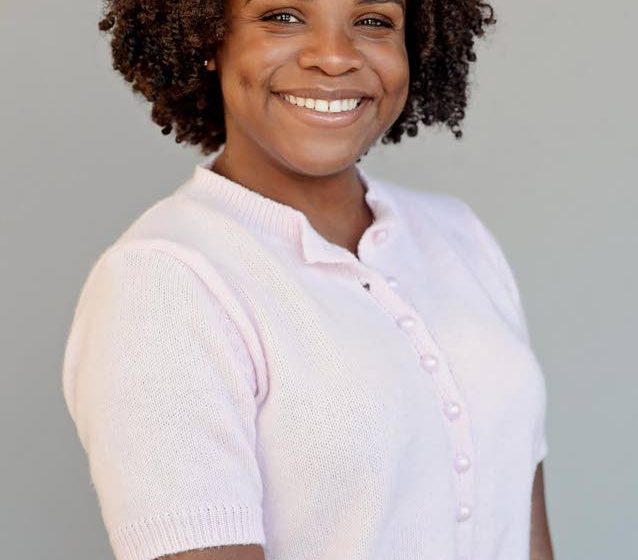
Inspired by family, fuelled by science
WEBSTER… it’s my big dream to find a cure and get a Nobel Prize
JHODI Webster remembers watching as her stepfather slowly lost his memory after being diagnosed with Alzheimer’s disease. The painful experience sparked a deep curiosity that would shape her life’s purpose.
Now a post-doctoral research fellow at Mayo Clinic, Arizona, in the United States — the largest integrated, not-for-profit medical group practice in the world — the 28-year-old Jamaican is conducting research on the disease that once touched her family, forging connections with others facing similar struggles, and working tirelessly to unlock new treatments and possibly a cure.
A former student of St Andrew High School for Girls, Webster shared that her passion for science took root in grade nine when she first set her sights on becoming a medical doctor. However, her stepfather’s diagnosis ultimately redirected her path toward medical research.
After completing high school she migrated to the United States in 2016 on a scholarship to pursue a Bachelor of Science in Neuroscience at Agnes Scott College, where she became a research assistant.
“My stepfather was actually diagnosed a bit early in his life. There is a group of people who have early onset dementia, early onset Alzheimer’s, but that was just my first experience with anything like that — seeing somebody that I know just not be themselves. Coming here [the United States], I started to learn more about Alzheimer’s and Parkinson’s disease,” said Webster.
“I just got really interested in figuring it out. There are so many people who know somebody who has Alzheimer’s or Parkinson’s disease, but there’s no cure. There’s really a lot of medications [but they] just kind of put a bandaid on the symptoms and what’s happening with the patient, so I kind of wanted to figure out. I’m not saying I’m going to find a cure or anything but I was just really interested in why there was no cure,” she told the Jamaica Observer.
Alzheimer’s and Parkinson’s are both progressive disorders that affect the brain but they impact people in different ways. Alzheimer’s disease primarily affects memory and thinking, leading to symptoms such as confusion, difficulty recognising loved ones, and challenges with everyday tasks as brain cells gradually deteriorate. Parkinson’s disease, on the other hand, is mainly known for its effects on movement, causing tremors, stiffness, slowed movement, and balance problems, though it can also lead to cognitive decline in later stages.
After completing her bachelor’s degree in 2020, Webster said she enrolled in a master’s and PhD programme in neuroscience at the University of Alabama at Birmingham, graduating with a doctorate in neuroscience in 2026.
Webster shared that her research project examined the overlap between Parkinson’s and Alzheimer’s neurodegenerative diseases which, despite having different symptoms, both involve cognitive decline and dementia. She said that due to the lack of suitable animal models, the research focused on developing one that incorporates the toxic proteins found in affected patients’ brains. The model allowed for the study and classification of the neuroinflammatory response associated with these conditions.
“We’re able to show that in Parkinson’s and Alzheimer’s disease brains, when you have this overlap of protein pathology you also get a very distinct immune response that is not seen in the brains of patients with just pure protein pathology. The goal of that was to inform some new therapeutic options for these patients — not just targeting the toxic proteins that are in the brain, that build up in the brains of these patients, but also targeting the inflammatory response in the brain,” she explained.
Webster said she presented her findings at scientific conferences both in the United States and internationally, in one instance travelling to Portugal for conferences.
“I’ve won a lot of prizes for my presentations and my poster presentations. I was also able to get a few scholarships from local organisations here like the Parkinson’s Association of Alabama, as well as the Caribbean Association in Alabama that gave me two scholarships during my time in graduate school. I feel like I was able to accomplish so much because I was just trying to be more connected with the community and because I just wanted to prioritise also getting my research out there,” she told the Sunday Observer.
Webster shared that it was through the Parkinson’s Association of Alabama that she connected with loved ones and caregivers of individuals living with Parkinson’s disease, many of whom had experiences similar to her own family’s. She described the encounters as both illuminating and deeply emotional, further strengthening her drive to pursue research in the field.
“Seeing somebody that you’ve known for years basically not know you, not know themselves, and just being a complete shell of themselves, it’s hard. I feel like that personal aspect of it made doing the research for Alzheimer’s a bit more meaningful for me. It wasn’t just about finding a cure, or wasn’t just about figuring out what’s happening in the brain, but it was more about also connecting with the people that are actually going through this — the patients, the caregivers — and also informing them on the research that we’re doing,” she shared.
“We’d often get people asking, ‘Can you find a cure?’ Everybody wants that, right? But I feel like there’s… obviously, we want a cure but there’s so much more that comes before that. I think making sure that I was connected with the community, being able to share my research with the community and have them share their experience with me just made the experience a bit more meaningful,” she told the Sunday Observer.
As she seeks to continue her research at Mayo Clinic, Webster shared that she hopes to understand a bit more about how neuroinflammation contributes to Parkinson’s and Alzheimer’s diseases, as well as other diseases such as amyotrophic lateral sclerosis (ALS) — a progressive, neurodegenerative, fatal condition that destroys nerve cells in the brain and spinal cord, causing loss of voluntary muscle control — to hopefully come up with some immunotherapies that can be disease-modifying.
“I think it would be awesome to find a cure; that’s like my big dream. It may be unrealistic but it’s my big dream to find a cure and get a Nobel Prize. That’s what’s on my vision board every year but I think that, being more realistic, patients with those diseases are suffering every day, and they almost don’t have a lot of time,” said Webster.
“They can live 10 to 20 years with these diseases but it’s 10 to 20 years of a low quality of life and I would really love to advocate for a lot of immunotherapies for these neurodegenerative diseases and that’s exactly what I’ll be working on at Mayo Clinic — trying to develop some more targeted therapies to these over-active immune cells that are in the brain, to prevent the neurones from dying and hopefully even prevent the cognitive decline that we see in these diseases,” she explained.
Reflecting on her journey from humble beginnings, Webster joked that she has been a student her entire life, rarely pausing to consider how far she has come as she remains focused on the mission ahead. However, in taking a moment to reflect, Webster said she is immensely proud of what she has accomplished and deeply grateful to those who supported her along the way.
“It was academically hard, yes, but it was also emotionally hard as well. I feel like I almost just went through the motions and was trying to do what I needed to do, and did not acknowledge where and how far I came, until this very moment. Now, I’m feeling very proud of myself and I’m also just feeling very grateful. I’m feeling grateful for every single teacher, person, mentor that was with me along the way because I feel like I just had the best people in my corner and I really owe a lot of it to them,” she said.
Jhodi Webster busy in the lab as she continues work on elucidating mechanisms of neuroinflammation in neurodegenerative disease.
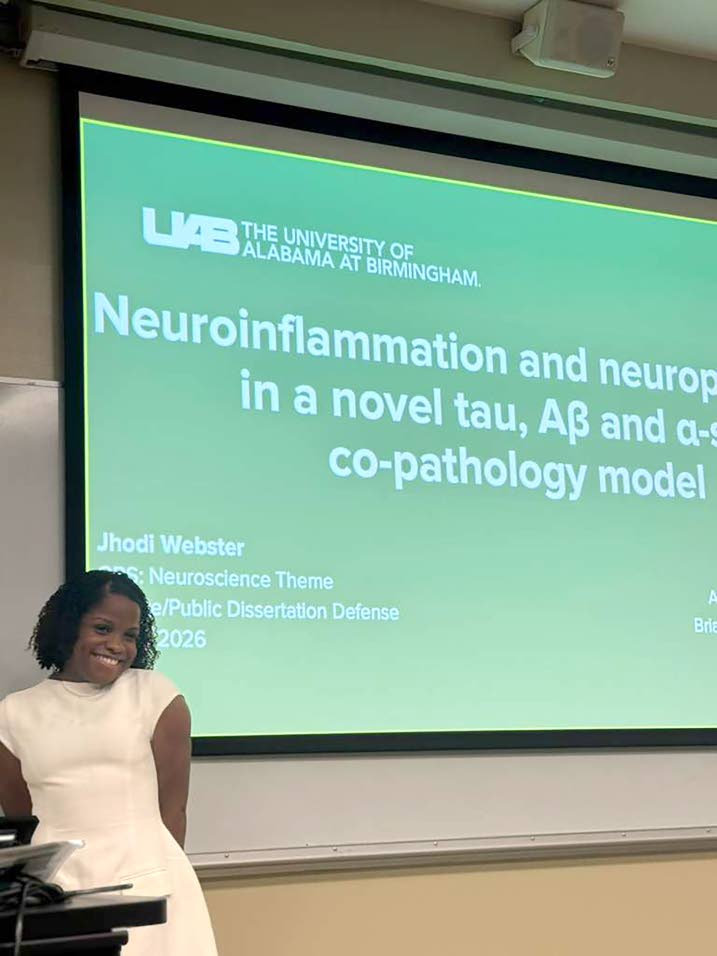
Jhodi Webster during her public dissertation defence presentation at the University of Alabama at Birmingham.
First Appeared on
Source link






