


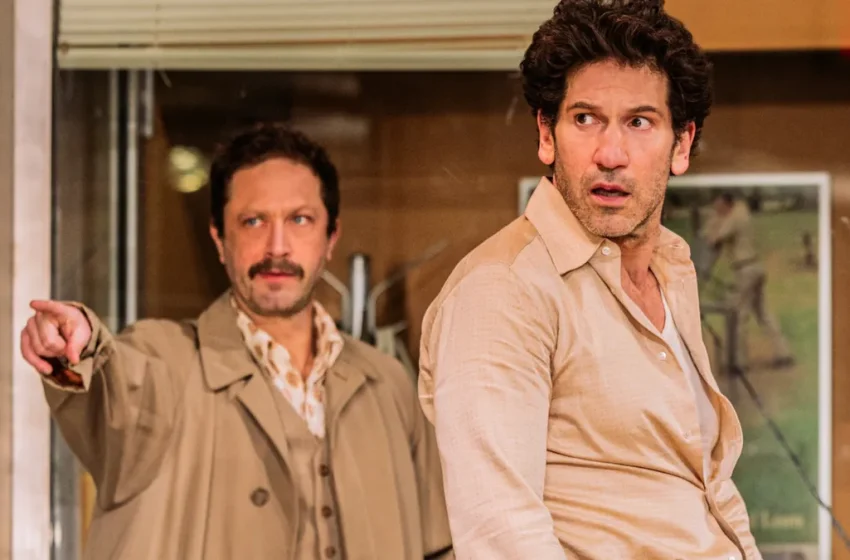
‘Dog Day Afternoon’ aims for laughs in bad Broadway outing – Review
Jon Bernthal and Ebon Moss-Bachrach star in the confounding and offensive “Dog Day Afternoon,” a misguided adaptation of Sidney Lumet’s 1975 movie.
NEW YORK — What if “Dog Day Afternoon” was actually a poor man’s attempt at “The Carol Burnett Show”?
That seems to be the tonally incoherent concept behind Rupert Goold’s new screen-to-stage production, an appalling near-disaster that opened at the August Wilson Theatre March 30.
It’s an unenviable task adapting Sidney Lumet’s 1975 masterpiece “Dog Day Afternoon,” a gritty, nerve-shredding thriller about a real-life Brooklyn bank heist gone horribly wrong.
But Pulitzer Prize-winning playwright Stephen Adly Guirgis (“Between Riverside and Crazy”) seems to fundamentally misunderstand everything that makes the film so unnervingly devastating, robbing the story of all suspense in favor of broad slapstick and borderline homophobic disdain for its main characters.
“The Bear” stars Jon Bernthal and Ebon Moss-Bachrach step into the roles made famous by Al Pacino and John Cazale, playing amateur crooks Sonny and Sal as they haplessly hold up a bank that is coincidentally short on cash. Police surround the building and the men take hostages, as Sonny makes increasingly ludicrous demands in an ill-advised effort to fund gender-affirming surgery for his wife, Leon (Esteban Andres Cruz).
The movie has some situational humor, for sure, whether the pacifist Sonny is negotiating bathroom breaks with his captives or letting them handle his rifle. But Lumet and screenwriter Frank Pierson ease up on the laughs as Sonny’s predicament grows more helpless, allowing the audience to feel his desperation as the drama barrels toward a tragic finale.
Guirgis and Goold, on the other hand, make this “Dog Day” a farcical comedy of errors from start to finish, undercutting every potentially poignant or frightening moment with a punchline. The bank’s staff are reduced to archetypes ‒ the prudish housewife (Wilemenia Olivia-Garcia), the hippie stoner (Paola Lázaro), the office flirt (Andrea Syglowski) ‒ and they’re never afforded any meaningful character development beyond fussing over who they’re sleeping with or how they look on TV.
As the women prattle idly with their captors, a debilitated security guard (Danny Johnson) briefly comes to so he can settle a debate over the neighborhood’s best doughnuts. Later, hennish boss Colleen (Jessica Hecht) can’t console a crying Sonny for more than a few seconds without shrieking for him to “buck up and get a grip.” Like Colleen, Guirgis’ adaptation is allergic to the faintest traces of sincerity or urgency.
Most offensive is the play’s mishandling of its queer storylines. Midway through Lumet’s film, a TV news broadcast proclaims that the bank is being held up by “two homosexuals” ‒ a description that Cazale’s doleful Sal challenges with pained stoicism, leaving viewers to draw their own conclusions about the complexities of his life outside the bank vault.
But on stage, the entire exchange is played for yuks with blustering machismo, with a police detective (John Ortiz) rattling off tired clichés about dog-walking, soufflé-making “nancy-boys,” and Colleen gleefully insisting, “I knew it from the moment he walked in!”
Most disappointingly, Leon has been stripped of any nuance. In the movie, which was progressive for its time, the trans character attempts suicide after being subjected to emotional and physical abuse by the manipulative Sonny, who tries to make amends by going rogue and stealing money for their surgery. But here, Leon’s dire circumstance has been flattened to just another zinger: “I’m a whore! I’m like a McDonald’s ‒ over a million served!” Leon bemoans, earning hearty laughter from the indifferent crowd.
It’s hard to blame Cruz, or frankly any of the cast, who have very little room to find genuine human beings in this sitcom-y three-ring circus, which for what it’s worth, is handsomely realized by scenic designer David Korins.
Bernthal, who is so exceptional in films such as “Sharp Stick” and “King Richard,” certainly has a forceful presence, even if he lacks Pacino’s feral, live-wire energy. And although Moss-Bachrach doesn’t convey Cazale’s inherent sadness, you can feel the air shift in the room whenever Sal snaps into a more menacing register.
It may seem unfair to judge “Dog Day” so closely to its venerated source material, and Guirgis and Goold admirably don’t settle for a carbon copy of the film. But what is ultimately to be gained by making this a hammy, Neil Simon-esque romp? When you deprive the audience of any real tension or emotional stakes, what is there left to grasp?
The dissonance of this production is never more apparent than in its limp retread of the movie’s iconic “Attica!” scene, in which Sonny fancifully imagines himself to be a sort of Robin Hood figure railing against police and the establishment. Flashing lights and costumed officers flood the theater, as Bernthal and Hecht awkwardly try to get the audience to chant along.
It’s a hollow attempt to reverse-engineer an electrifying moment, cheaply playing on theatergoers’ nostalgia and hoping they don’t realize there’s not much else going on beneath the hood. Most condemning of all, it illustrates how this “Dog Day Afternoon” is all bark and no bite.
“Dog Day Afternoon” is now playing at the August Wilson Theatre (245 W. 52nd Street) through June 28.
First Appeared on
Source link






