NVIDIA Shows Neural Texture Compression Cutting VRAM by 85% or Boosting Quality for the Same Budget
During a GTC 2026 session titled “Introduction to Neural Rendering,” NVIDIA showcased its Neural Texture Compression (NTC) technique once again.
Neural Texture Compression was showcased for the first time nearly three years ago and has been available via an SDK since early 2026, but so far, no game developers have used it. Perhaps that is why NVIDIA has once again taken the chance to explain its potential benefits.
Senior DevTech Engineer Alexey Bekin described Neural Texture Compression as a machine learning approach for storing textures more efficiently. Instead of storing every texel directly, NTC compresses the texture into compact learned latent features that capture its essential visual information. At runtime, a small neural network running on the GPU reconstructs texel values from these features, computing them on demand instead of loading large textures from memory. Critically, NTC is not generative; it’s deterministic. That means it reconstructs the same texture each and every time.
The system has two components. The latent texture is a dramatically smaller representation of the original asset, where each texel stores a feature vector describing material properties rather than a final color. To ensure fine detail is recoverable, positional encoding is applied to the UV coordinates before they reach the decoder, thus injecting high-frequency spatial information that helps the network accurately reconstruct sharp details and repeating patterns that would otherwise be lost in a compressed representation.
Training works as a standard neural optimization loop: the network takes positionally encoded UV coordinates plus a latent code, produces a reconstruction, compares it against the original texture as ground truth, computes a reconstruction loss, and iteratively updates both the MLP weights and the latent code until the output converges to an accurate reproduction of the source material.
NVIDIA’s Neural Texture Compression offers three structural advantages over traditional formats like the widely used BCN:
- Higher compression ratios: significantly more texture data fits in the same amount of video memory
- High channel count support: complex assets with many packed material channels (normals, roughness, albedo, AO, and more in a single material set) compress cleanly without requiring the data to be split or simplified.
- Practical storage and bandwidth savings: smaller on-disk footprints mean smaller game installs, smaller patches, and faster downloads.
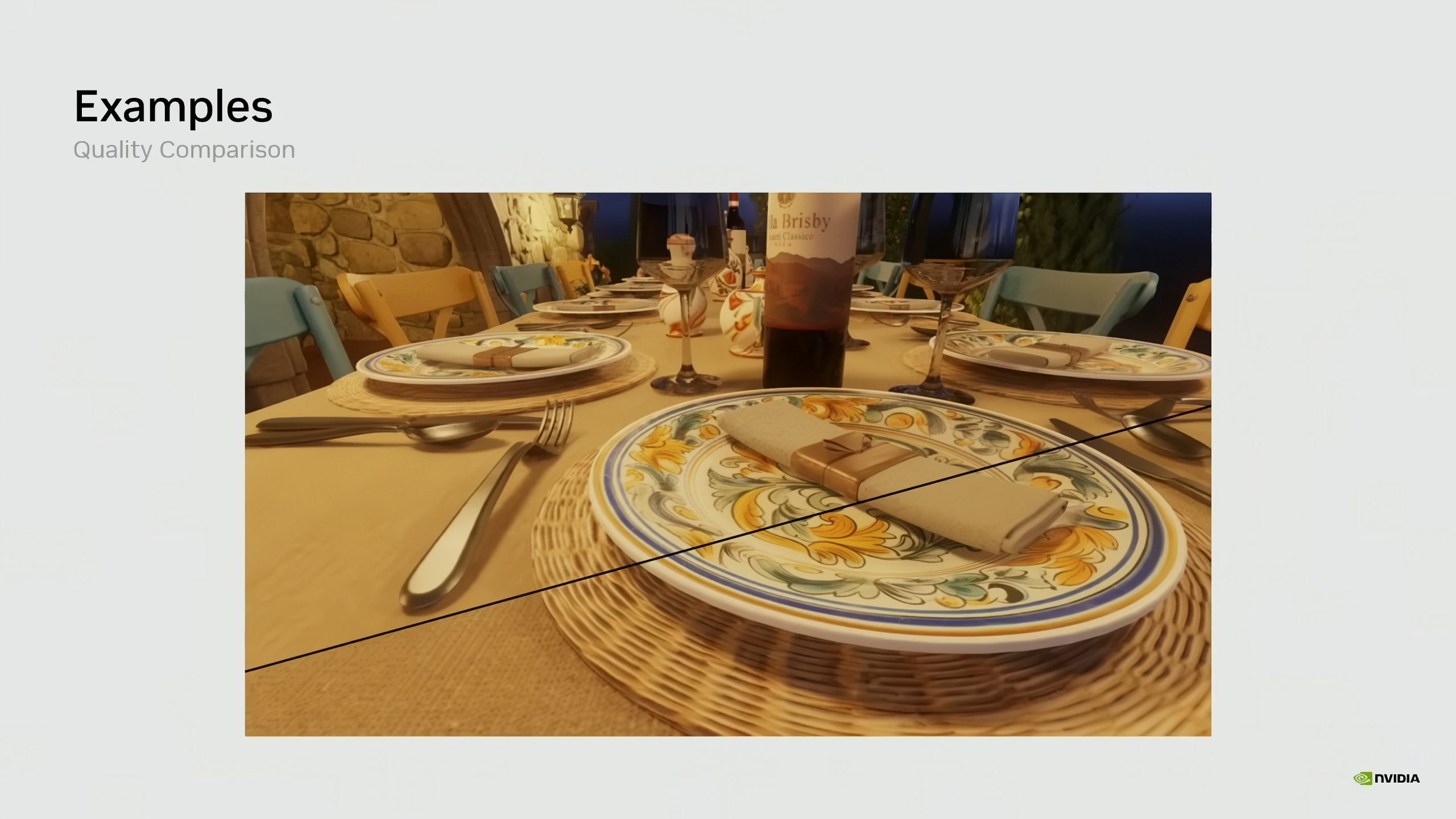
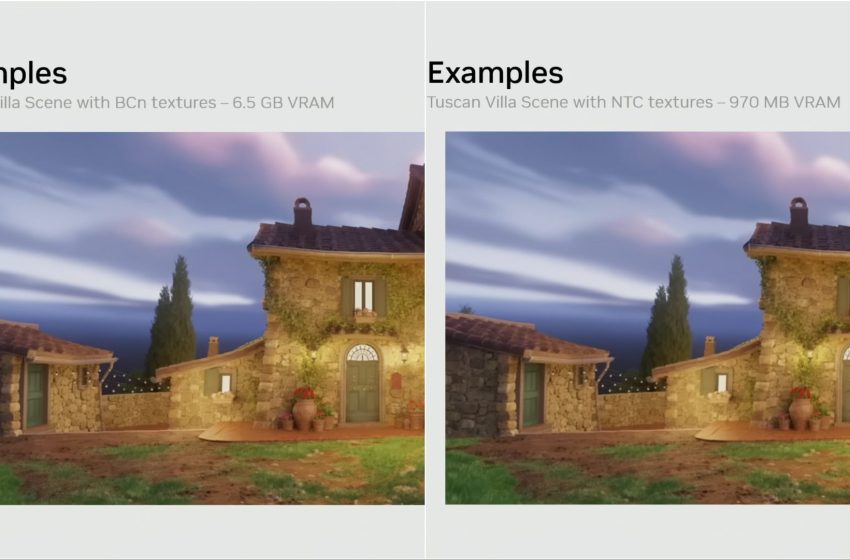
Bekin showed a Tuscan Villa demo scene where NTC enabled an 85% reduction in VRAM usage (970MB) over the textures compressed with regular BCN (which consumed 6.5GB VRAM). That’s going to be very useful for games with scenes that are heavy on VRAM usage, but Neural Texture Compression can also be used to increase texture quality while maintaining the same VRAM budget, avoiding the typical compression artifacts caused by BCN.
According to leaker Kepler_L2, Sony might use Neural Texture Compression (which, despite being engineered by NVIDIA, is also supported on AMD and Intel hardware) to reduce PlayStation 6 game install sizes while keeping costs down with a 1TB SSD.
The NTC SDK, currently in beta, can be accessed on this GitHub page.

About the author: With over two decades of experience in gaming journalism, Alessio Palumbo has led the gaming vertical at Wccftech since August 2015. He started working at a young age for Italian websites like Everyeye.it, Gamestar.it, Nextgame.it, and Multiplayer.it before kickstarting the indie English-language publication Worlds Factory as its founder and Editor in Chief.
In the last decade, he has coordinated the overall output of Wccftech’s gaming section, managed PR relations, assigned reviews, produced daily news coverage, edited gaming content as needed, and delivered game reviews.
Arguably, his trademark content is the long series of exclusive developer interviews that have been cited by Wikipedia and by the biggest news media and gaming publications.
His passion for technology also makes him knowledgeable when it comes to gaming hardware and tech. His favorite genres include RPGs, MMORPGs, and action/adventure games.
Follow Wccftech on Google to get more of our news coverage in your feeds.
First Appeared on
Source link