



A 190-Million-Year-Old Dinosaur Fossil Was Found Under Antarctic Ice, And It’s Absolutely Massive
Roughly 190 million years ago, long before ice sheets blanketed the southernmost continent, a massive plant-eating dinosaur lumbered through what is now Antarctica. Its fossilized remains, buried deep in frozen rock for eons, have finally been studied and officially identified as a new species: Glacialisaurus hammeri.
The discovery itself isn’t exactly recent. A field team led by paleontologist William Hammer first unearthed the bones in the early 1990s while working high up on Mount Kirkpatrick, not far from the Beardmore Glacier. But the extreme Antarctic environment meant the fossils had to be chiseled and sawed out over multiple seasons—an exhausting and dangerous process. For years, the bones sat unclassified, waiting for closer inspection. Now, thanks to researchers Nathan Smith and Diego Pol, they’ve been given a name and a place on the dinosaur family tree.
Fossils Under Fire And Frost
The bones of Glacialisaurus weren’t simply lying around in the snow. They had to be pried out of dense rock at over 13,000 feet in elevation, hardly an easy stroll. The excavation involved jackhammers, rock saws, and plain grit.
“The fossils were painstakingly removed from the ice and rock,” explained Nathan Smith, a Postdoctoral Research Scientist at the Field Museum of Natural History, describing the tough work across two separate field seasons.
What the team pulled out was far from a complete skeleton: mostly parts of a leg, foot, and ankle. But even these fragments carried enough unique features to set this dinosaur apart. In an issue of Acta Palaeontologica Polonica, the experts officially described the remains as a new genus and species. For William Hammer, the scientist who led the original dig, it must have been a long but rewarding wait.
Who Was Glacialisaurus?
So, what kind of dinosaur fossil are we talking about? Glacialisaurus hammeri was a sauropodomorph, a member of the same broad group that would later produce giants like Apatosaurus and Diplodocus. It’s estimated to have measured about 20 to 25 feet long and weighed between 4 and 6 tons. Not quite the size of its later relatives.
“Throughout the evolution of sauropodomorphs, there appears to be a general trend of increasing body size, and Glacialisaurus would likely fit somewhere in the middle of this evolutionary trend,” explained Smith.
The sauropodomorphs are an interesting group because they sit somewhere between early two-legged plant-eaters and the enormous quadrupeds that came later. According to Nathan Smith and Diego Pol’s analysis, Glacialisaurus lived at a time when these early dinosaurs were still evolving rapidly and spreading widely.
Its tail—while not fully preserved—may have served defensive purposes. Some of its relatives are believed to have cracked their tails like whips, potentially generating loud, even supersonic booms. That detail hasn’t been confirmed for Glacialisaurus, but it gives you an idea of the kind of creature it might have been.
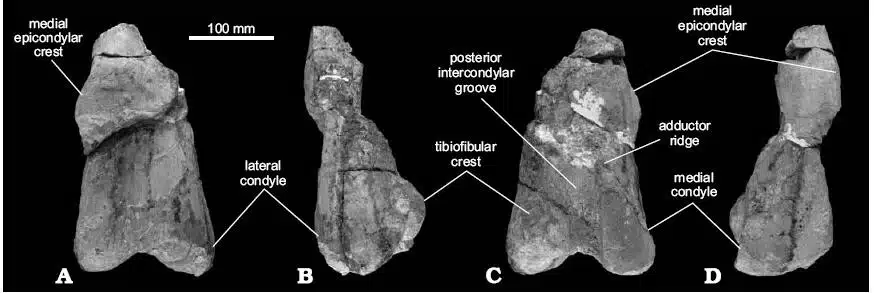
A Bigger Picture Under The Ice
The site where Glacialisaurus was found wasn’t a one-dinosaur discovery. Nearby, researchers also uncovered the remains of a theropod called Cryolophosaurus ellioti, along with bones from a possible sauropod, a pterosaur wing bone, and even a tooth from a tritylodont, one of those strange, extinct mammal-like reptiles that defy easy classification.
All this suggests that Jurassic Antarctica wasn’t some barren wasteland, but a fairly lively ecosystem—maybe cold, maybe seasonal, but clearly able to support a range of species. As stated by a report from Live Science, the presence of both primitive and more advanced dinosaurs in the same area hints that evolutionary stages overlapped more than we thought. Smith remarked that:
“Either these groups were directly competing with each other for resources, or they somehow occupied slightly different niches within the environment.”
Glacialisaurus and its relatives help show how widely these early dinosaurs were spread, even in places few would expect.
First Appeared on
Source link






