


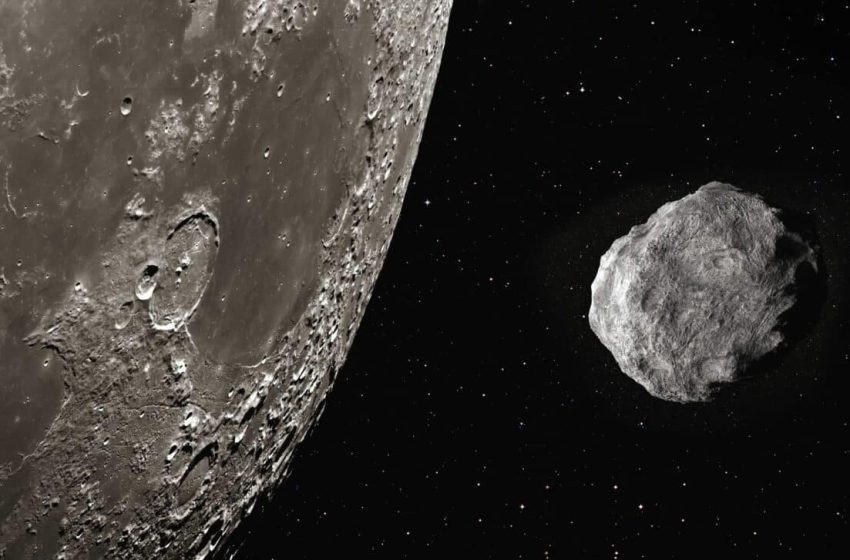
A 60-Meter Asteroid Is Headed for the Moon, What Will Happen to Earth?
A 60-meter-wide asteroid, 2024 YR4, could collide with the Moon in December 2032, offering scientists an unprecedented chance to observe a powerful lunar impact. Though the likelihood of the event is only 4.3%, this potential collision has ignited excitement among planetary scientists, who view it as a rare opportunity to study the Moon’s geological history and its response to such a powerful impact. While there is no risk to Earth, the aftermath of the collision could pose threats to satellites in orbit.
A Unique Opportunity to Study the Moon
Asteroids striking the Moon is not unusual, but a collision of this scale has never been observed with modern instruments. The asteroid 2024 YR4, traveling at speeds of up to 14 kilometers per second, could release energy equivalent to 6.5 million tons of TNT. If it strikes, it would create a crater approximately one kilometer wide and hundreds of meters deep.
Impacts from asteroids shape the Moon and other planetary bodies, but such events are rarely observed in real time. Most impacts on the Moon are too small to notice, and those that are visible are often much less dramatic. According to NASA’s Center for Near-Earth Object Studies, the expected impact from 2024 YR4 would be far more significant, producing a visible flash followed by a glow visible to Earth’s telescopes.
This event provides an incredible opportunity for scientists to test existing theories on how craters form and how impacts influence a planetary body’s geology. As explained in a study published on arXiv, led by Yifan He from Tsinghua University, who is leading research on the potential impact, the event would allow scientists to study the heat released by the impact, how lunar material absorbs and emits that heat, and gain valuable data about the Moon’s composition beneath its surface.
A Moonquake Like Never Before
The impact from 2024 YR4 could also trigger seismic waves strong enough to be recorded as a “moonquake.” Scientists predict that the impact could generate seismic waves with an intensity equivalent to magnitude 5 on Earth, far stronger than anything detected by the Apollo mission’s seismometers.
The ability to study seismic waves from such an event would be invaluable to planetary scientists. As calculations suggest, this “moonquake” could provide unprecedented data on the Moon’s subsurface, helping to refine models of the Moon’s internal structure.
Is Lunar Debris the Next Satellite Danger?
The debris created by the impact could reach Earth’s orbit, potentially posing a threat to satellites and spacecraft. Paul Wiegert, an astronomer at the University of Western Ontario, explained that:
“The impact would excavate a crater about 0.62 miles (1 kilometer across),” he said. “Most of this material would fall back to the moon, but a small fraction, around 0.02% to 0.2%, could be ejected at high enough speeds to escape the moon.”
Fragments of lunar debris could hit satellites moving at speeds of around 10 kilometers per second, fast enough to damage or destroy these valuable spacecraft.
“The debris would be travelling a bit slower than typical meteors, at around 22,400 miles per hour (10 km/s) rather than 44,700 to 67,100 mph (20 to 30 km/s), but this is still faster than most bullets.”
The potential for cascading collisions, known as Kessler Syndrome, is also a concern. This phenomenon could disrupt satellite networks and cause widespread communication and navigation failures.
Should We Intervene or Let It Happen?
As the asteroid’s trajectory is monitored and refined, the question arises: should we attempt to deflect it, or should we let the event occur naturally? The U.S Space Agency has demonstrated the ability to alter an asteroid’s path with its DART mission, which successfully redirected an asteroid in 2022.
“This result is one important step toward understanding the full effect of DART’s impact with its target asteroid” remarked Lori Glaze, the head of NASA’s Planetary Science Division at NASA Headquarters in Washington. “As new data come in each day, astronomers will be able to better assess whether, and how, a mission like DART could be used in the future to help protect Earth from a collision with an asteroid if we ever discover one headed our way.”
A similar mission could be considered to prevent the impact, though that would also mean missing out on a rare scientific opportunity to observe the event.
First Appeared on
Source link






