


A Dormant Giant Volcano That Has Never Erupted Before Is Showing Signs of Life, Could It Be Waking Up Soon?
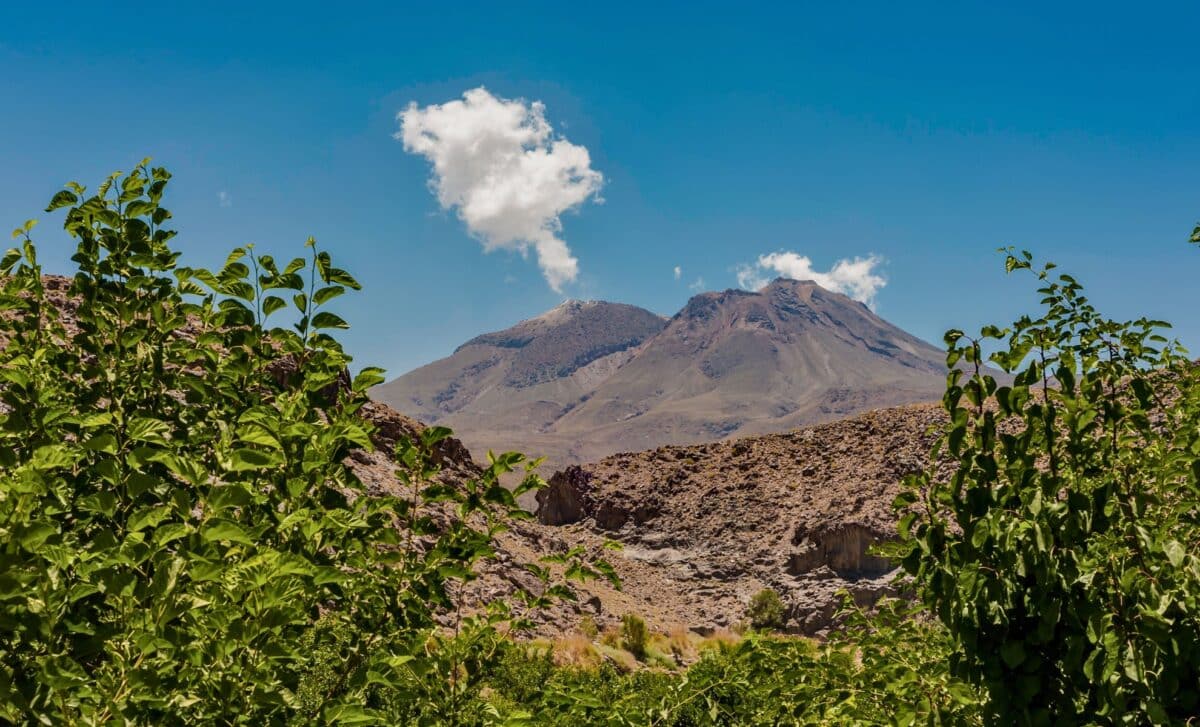
For centuries, Mount Taftan has been considered dormant volcano, a quiet sentinel in the Makran region of southeastern Iran. But recent satellite data shows subtle signs of swelling at its summit, prompting scientists to worry about the volcano’s sudden return to activity. This change is raising alarms in a region that has long been oblivious to the potential dangers of this ancient giant.
Located at the border of Iran and Pakistan, this volcano is part of the continental volcanic arc formed by the subduction of the Arabian plate beneath the Eurasian plate, standing as a towering presence at 12,930 feet (3,940 meters).
Though it has shown minimal signs of life, such as smoke emissions in 1902 and an unconfirmed lava flow in 1993, its last major eruption occurred roughly 700,000 years ago, long before the rise of modern civilization. However, recent findings have scientists revisiting the volcano’s behavior, as new data suggests it may not be as dormant as once believed.
Mount Taftan: A Volcanic Giant in a Remote Region
Mount Taftan is the only active volcano in the Makran region, a relatively isolated and sparsely populated area. Despite its location in an often-overlooked part of the world, the volcano has always posed a potential threat to the region, which includes parts of Iran and Pakistan. Historically, scientists have had few opportunities to study the volcano’s internal dynamics due to its remote location, making the recent discovery all the more significant.
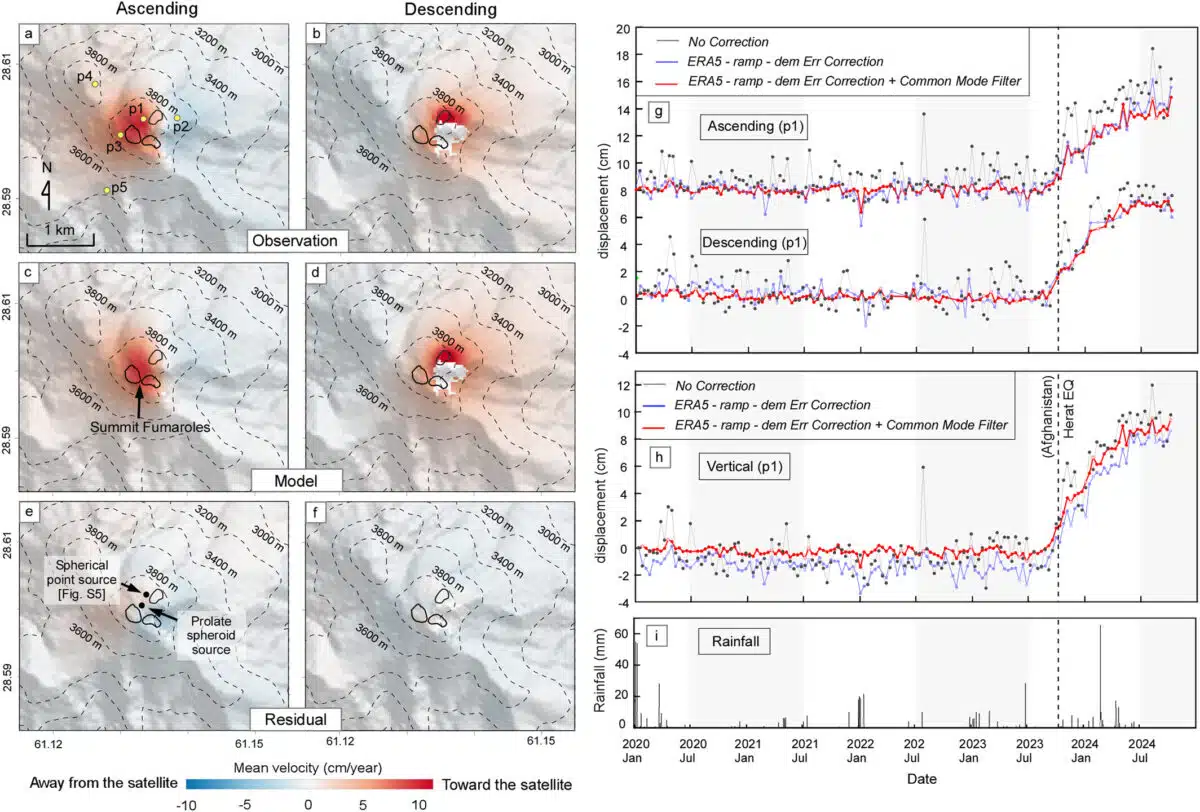
According to a scientific study published in Geophysical Research Letters, between July 2023 and May 2024, satellites detected a slight but concerning inflation of the summit, approximately 3.5 inches (9 centimeters). This subtle swelling is indicative of a possible buildup of magma and gas beneath the surface, a precursor to potential volcanic activity. The lack of clear seismic events or unusual weather patterns before the swelling has left experts scratching their heads about the underlying cause.
A Subtle Shift in Activity
What makes the recent changes at Mount Taftan particularly alarming is the absence of preceding signs such as earthquakes or weather disturbances. The swelling at the summit seems to be a result of magma slowly moving upwards, pushed by a pocket of superheated water and steam trapped hundreds of meters below the surface. Researchers believe this buildup could be linked to a change in the volcano’s gas permeability or deep magmatic movements that current instruments are not sensitive enough to detect.
This shift in behavior contradicts previous assessments of the volcano as a “peaceful” giant. Scientists have long viewed Taftan as one of the less active volcanoes in the region. Yet, the current observations suggest that even ancient volcanoes, once thought to be dormant, can experience unexpected changes, underscoring the need for continuous monitoring in volcanically active areas.
Why We Can’t Ignore Mount Taftan
In a region already prone to natural hazards, an eruption could have devastating effects on local communities. The area is home to remote villages and critical infrastructure, and a volcanic eruption could disrupt daily life and cause significant damage. The authors of the study are caution about predicting an imminent eruption, “Taftan is more active than we once thought.”
The recent findings have also led scientists to call for enhanced monitoring of the region. Experts recommend strengthening local monitoring networks, updating geological risk maps, and reassessing the potential hazards posed by Mount Taftan and other nearby volcanic structures.
First Appeared on
Source link






