


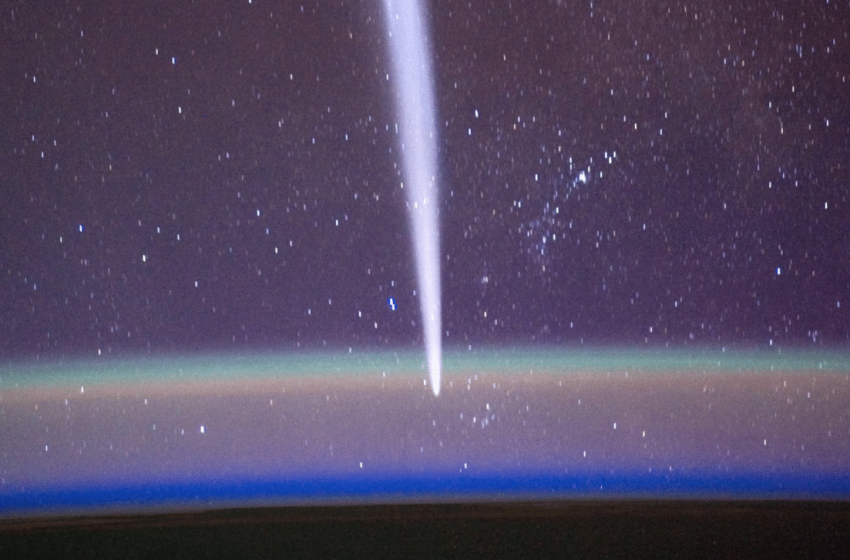
A Massive Comet Could Light Up the Sky This April If It Survives the Sun’s Fiery Embrace
A cosmic drama is unfolding above us as Comet C/2026 A1 (MAPS) prepares to make its perilous closest approach to the Sun on April 4, 2026. This event could either result in a stunning visual spectacle or the sudden disintegration of the comet, and skywatchers are holding their breath. Discovered only three months ago by a team of amateur astronomers, Comet MAPS is already in the spotlight, attracting global attention for its proximity to the Sun and the potential for an unforgettable celestial display. But will it survive the Sun’s extreme heat, or will it break apart under the pressure? The outcome could significantly alter our understanding of these fascinating cosmic travelers.
The Discovery of Comet MAPS
In January 2026, four amateur astronomers, Alain Maury, Georges Attard, Daniel Parrott, and Florian Signoret, made an extraordinary discovery using an 11-inch telescope at the AMACS1 observatory in Chile’s Atacama Desert. Their find, a comet now officially named C/2026 A1 (MAPS), quickly garnered excitement within the scientific community. The significance of this discovery lies in the comet’s classification as a Kreutz sungrazer, a group of comets known for their dramatic dives close to the Sun. The last notable sungrazer to capture attention was Comet ISON in 2013, which sadly broke apart before it could become the dazzling spectacle observers had hoped for.
Unlike typical comets, sungrazers like MAPS are known for their intense interaction with the Sun, and this particular comet is no exception. As it heads toward its perihelion, the point of closest approach to the Sun, Comet MAPS will pass just 101,100 miles above the Sun’s surface, an astronomically small distance. This close encounter will subject the comet to immense gravitational and thermal forces, determining whether it will emerge intact or disintegrate completely. The world is now eagerly watching, hoping for a cosmic show unlike any other.
What Happens When Comets Meet the Sun?
Comets like MAPS are often described as “dirty snowballs,” composed of ice, dust, and gases. As they venture closer to the Sun, the heat causes them to vaporize, creating the characteristic bright coma and long tail. However, the extreme conditions near the Sun can also spell disaster for a comet. The Sun’s intense radiation, combined with gravitational forces, can cause a comet to break apart or evaporate entirely, leaving little to no trace.
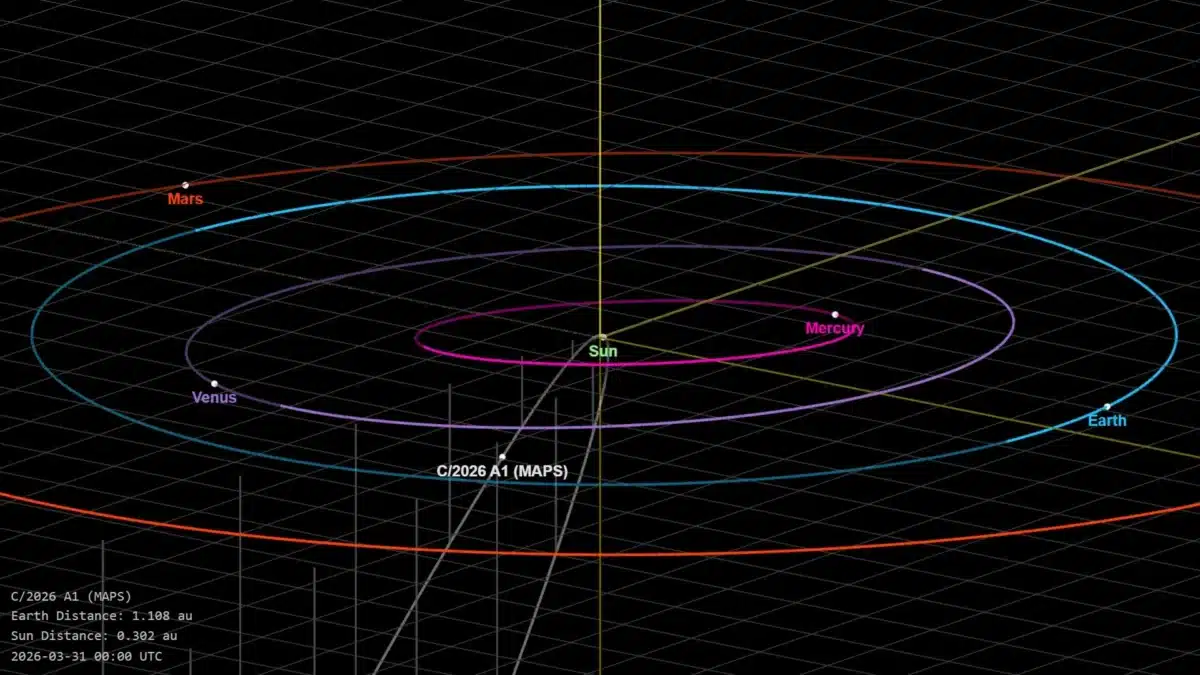
Comet MAPS faces an even greater challenge due to its relatively small nucleus, estimated at only 0.2 miles (0.4 km) across. In comparison, other famous sungrazers like Comet Ikeya-Seki had much larger nuclei, making them more resilient to the Sun’s forces. According to a recent study published by the American Astronomical Society, this small size raises significant concerns for the survival of MAPS. The study suggests that the comet could disintegrate before, during, or shortly after its perihelion, especially given its already vulnerable state as it approaches the Sun.
The Possible Outcomes for Comet MAPS
As Comet MAPS approaches its critical encounter with the Sun, there are three potential outcomes that astronomers are closely monitoring. The most likely scenario, according to Space.com, is that the comet will disintegrate before it reaches perihelion, much like Comet ISON in 2013, which was expected to shine brightly but instead broke apart as it neared the Sun. If MAPS follows this path, there will be no visible remnants, and the hopes for a dramatic display will be dashed.
Another possibility is that the comet could survive its closest approach to the Sun but break apart afterward. This scenario happened with the Great Southern Comet of 1887, which survived its close pass but disintegrated shortly after, leaving only a faint tail without its visible coma or head.
The least likely, but still possible, outcome is that MAPS survives its solar close pass and emerges intact. If this occurs, the comet could put on a stunning show, potentially visible to the naked eye in the western evening sky during the second week of April. If it survives, it would become one of the brightest comets in recent history, comparable to the Great Comet of 1965.
Tracking the Comet’s Journey
For those eager to observe Comet MAPS, it’s important to remember that direct observation near the Sun is dangerous. The intense infrared rays of the Sun can cause permanent eye damage, even through sunglasses or telescopes. Instead, scientists and amateur astronomers alike will rely on SOHO’s LASCO C3 coronagraph, which captures images of the Sun and its surroundings without the risk of eye damage. The comet will pass within range of this device from April 2 to April 6, providing crucial data for astronomers and skywatchers alike.
If you want to safely follow the comet’s progress, SOHO’s live feed will offer near-real-time images of MAPS as it approaches the Sun and possibly survives, or disintegrates, in this critical moment.
First Appeared on
Source link






